| ☒ | Preliminary Proxy Statement |
| ☐ | Confidential, for use of the Commission only (as permitted by Rule 14a-6(e)(2)) |
| ☐ | Definitive Proxy Statement |
| ☐ | Definitive Additional Materials |
| ☐ | Soliciting Material under § 240.14a-12 |
| ☒ | No fee required. |
| ☐ | Fee paid previously with preliminary materials. |
| ☐ | Fee computed on table in the exhibit required by Item 25 (b) per Exchange Act Rules 14a-6(i)(1) and 0-11. |
PRELIMINARY PROXY STATEMENT
SUBJECT TO COMPLETION DATED JANUARY 2, 2026
| 2026
NOTICE
OF
ANNUAL
MEETING
AND
PROXY
STATEMENT |
[●], 2026
Dear Fellow Shareholders,
On behalf of the Board of Directors (the “Board”) of Matthews International Corporation (“Matthews,” the “Company,” “we,” “us,” or “our”), I want to thank you for your investment and support of the Company and invite you to attend our 2026 Annual Meeting of Shareholders.
In my letter to you that accompanied the proxy statement for our 2025 Annual Meeting of Shareholders, I indicated that these past 12 months would likely prove to be even more consequential for the future of the Company than the preceding 12 months, and I believe that to be borne out in our accomplishments. As you know, in November 2024 and as part of the work that Matthews’ management team, under the leadership of Chief Executive Officer Joseph C. Bartolacci, has been pursuing for some time, we announced that the Board had engaged J.P. Morgan to assist the Company with a review of strategic alternatives. In the year since, the Board and management team have continued to rigorously evaluate Matthews’ portfolio of businesses, thoughtfully considered shareholder feedback about the Company, and decisively acted to enhance shareholder value. The ongoing strategic review has already simplified the Company’s business mix and strengthened our balance sheet through the following transactions:
| • | Sale of SGK Brand Solutions to the Propelis Joint Venture: In January 2025, Matthews announced the sale of the SGK Brand Solutions business to Propelis. Upon closing of the sale in May, the Company realized $350 million of total upfront consideration and received a 40% stake in the common stock of Propelis, allowing Matthews’ shareholders to benefit from cost synergies and continued business growth. Since the closing in May, we believe that Propelis is on track to perform at an annual rate well above the $100 million adjusted EBITDA of the combined entities as of their closing date. |
| • | Sale of the Warehouse Automation Business: In December 2025, the Company closed the sale of the Warehouse Automations business to Duravant for total consideration of $230 million, representing cash consideration of $223.3 million plus the assumption of certain liabilities of the business. We believe the total purchase price represents a compelling valuation multiple that is significantly accretive to the Company’s current trading range. |
| • | Execution of Other Opportunistic Transactions: Matthews has completed other transactions as part of its strategic review and regular review of its business portfolio, including the acquisition of The Dodge Company and the pending sales of the European packaging and tooling businesses. |
Collectively, these transactions are expected to generate significant cash proceeds that will be used to reduce our debt toward the Company’s long-term net leverage ratio goal of 2.5x. These divestitures also represent a commitment by the Board and management team to sustain Matthews’ momentum in its Memorialization businesses and capitalize on the opportunity in the high-growth energy storage solutions market in which Matthews vigorously competes and has significant competitive technologies, as well as in the Product Identification business in which the Company has unique competitive advantages in its new Axian product.
Deleveraging remains Matthews’ top priority, having decreased total debt by $65.6 million during fiscal 2025. In addition, the Company returned meaningful capital to shareholders through more than $12 million in share repurchases and approximately $32 million in dividends during fiscal 2025. Additionally, on November 19, 2025, the Board declared an increase in the quarterly dividend to $0.255 per share, which represents Matthews’ thirty-second consecutive annual dividend increase since becoming a publicly traded company.
Last year, I also underscored how serious our Board has taken its commitment to protect our shareholders’ investment and to unlock the valuable assets within Matthews as you reflected on how to vote your shares at the 2025 Annual Meeting. In particular, I highlighted our effort to introduce diverse perspectives and enhance shareholder value; the Company had prioritized Board refreshment by appointing three new directors since October 2020 and nominating one new candidate for election to the Board at the 2025 Annual Meeting. Since last year’s report to you, with the appointment to Thomas Gebhardt in February 2025, we have increased the number
of directors appointed to the Board since October 2020 to four new directors and J. Michael Nauman was elected at the 2025 Annual Meeting, bringing the total new directors to five since October 2020.
Prior to the 2025 Annual Meeting, I also announced that I would retire from the Board upon the certification of the vote at the 2026 Annual Meeting. As I close out this chapter of my tenure with Matthews, I want to relay that it has been a distinct honor to serve as Chairperson and as a member of the Board of the Company and a privilege to work and serve alongside my fellow directors, Mr. Bartolacci, the entire management team and our over 5,000 employees in representing your interests and driving value for our shareholders. At Matthews, as we celebrate our 175 years as a company, we are very proud of our legacy and culture—but are always looking forward to using our strong history and culture to propel us to additional innovations across the Company, strengthen performance and grow our profitability. Given the opportunities that lay ahead and our strong foundation, I am also pleased that J. Michael Nauman will lead the Board of Directors through the next phase of Matthews’ enduring story as its Chairperson and, I am sure, to continued and greater success for the Company and our shareholders.
As you consider how to vote your shares at the 2026 Annual Meeting, I again encourage you to reflect on how serious this Board has taken its commitment to you and considering your best interests, rather than the interests of a select few. Please join me in voting your shares “FOR” the election of our four nominees: Thomas A. Gebhardt, Aleta W. Richards, David A. Schawk, and Francis S. Wlodarczyk using the WHITE proxy card.
Your Vote is Important
The accompanying Notice of Annual Meeting of Shareholders and Proxy Statement describe the business to be conducted at the Annual Meeting. You will also find a WHITE proxy card and postage-paid return envelope. WHITE proxy cards are being solicited on behalf of the Board of Directors of Matthews. This year, your WHITE proxy card looks different than the proxy card we send to our shareholders most years as proxy rules require that we list the nominees of Barington (as defined below) in addition to the Board’s nominees.
Your vote is important, and we ask that you please vote “FOR” the election of our four nominees: Thomas A. Gebhardt, Aleta W. Richards, David A. Schawk, and Francis S. Wlodarczyk using the WHITE proxy card.
You may receive solicitation materials from Barington, including proxy statements, mailings and proxy cards, asking for your support in favor of their three nominees, including two nominees who were previously defeated by our shareholders at last year’s annual meeting. The Board of Directors urges you to disregard any such materials and does not endorse any of Barington’s nominees.
If you have any questions or require any assistance with voting your shares, please call the Company’s proxy solicitor, Georgeson LLC, at:

51 West 52nd Street, 6th Floor
New York, NY 10019
Shareholders, Banks and Brokers
Toll Free: (888) 755-7097
MATWinfo@Georgeson.com
We appreciate your ongoing support and investment in Matthews International.
Thank you,
Alvaro Garcia-Tunon
Chairperson of the Board

Notice of the
ANNUAL MEETING OF THE SHAREHOLDERS
To be held on [●], 2026
To Our Shareholders:
The 2026 annual meeting of the shareholders of Matthews International Corporation (“Matthews,” the “Company,” “we,” “us,” or “our”) will be held virtually at 9:00 AM (EST) on [●] (together with any adjournments or postponements thereof, the “Annual Meeting”). You can attend the Annual Meeting online, vote your shares electronically and submit your questions during the Annual Meeting at www.cesonlineservices.com/matw26_vm. To participate in the Annual Meeting, you must pre-register at www.cesonlineservices.com/matw26_vm by 11:59 PM (EST) on [●], 2026. For more information on how to virtually attend the Annual Meeting, see the following “Questions and Answers About Our Annual Meeting” section of the accompanying Proxy Statement.
The purpose of the Annual Meeting is to consider and act upon the following:
| 1. | To elect four (4) directors of the Company to serve until the 2027 Annual Meeting of Shareholders and until their successors are elected and qualified if Proposal 6 is approved or until the 2029 Annual Meeting of Shareholders and until their successors are elected and qualified if Proposal 6 is not approved;* |
| 2. | To approve the adoption of the Second Amended and Restated 2019 Director Fee Plan; |
| 3. | To ratify the appointment of Ernst & Young LLP as the independent registered public accounting firm to audit the records of the Company for the fiscal year ending September 30, 2026; |
| 4. | To provide an advisory (non-binding) vote on the executive compensation of the Company’s named executive officers; |
| 5. | To approve the adoption of the Amended and Restated Articles of Incorporation, a copy of which is attached as Appendix D-1 to the accompanying Proxy Statement (the “Amended and Restated Articles”); |
| 6. | To approve the amendment of the Company’s current Restated Articles of Incorporation (as amended to date, the “Articles of Incorporation”) to declassify the Board of Directors; |
| 7. | To approve the amendment of the Articles of Incorporation to adopt a majority of votes cast standard in uncontested elections of directors; |
| 8. | To approve the amendment of the Articles of Incorporation to eliminate certain supermajority voting requirements; and |
| 9. | To transact such other business as may properly come before the meeting. |
| * | See “Proposal 1 – Election of Directors” in the accompanying Proxy Statement for a description of a potential re-classification of directors in connection with Mr. Garcia-Tunon’s planned retirement from the Board. |
Shareholders of record as of the close of business on [●] will be entitled to submit questions and vote at the Annual Meeting. A list of these shareholders of record will be available electronically during the Annual Meeting at www.cesonlineservices.com/matw26_vm.
An activist shareholder, Barington Companies Equity Partners, L.P. (collectively with its affiliates and related parties, “Barington”), has nominated three (3) director candidates in opposition to the Board’s nominees: James A. Mitarotonda, Chan W. Galbato, and Sheila Hooda (the “Barington Nominees”). This is the second consecutive annual meeting of shareholders at which Barington has nominated candidates, including two of the same candidates (James A. Mitarotonda and Chan W. Galbato) who were rejected by shareholders at the Company’s 2025 Annual Meeting of Shareholders. The Barington Nominees are included on the Company’s “universal” WHITE proxy card due to rules of the U.S. Securities and Exchange Commission. The Board of Directors does not endorse the Barington Nominees and recommends that you use the WHITE proxy card to vote “FOR” only the four director nominees proposed by the Board of Directors (Thomas A. Gebhardt, Aleta W. Richards, David A. Schawk, and Francis S. Wlodarczyk), “WITHHOLD” on each of the Barington Nominees, and vote “FOR” each of the other proposals.
You may receive solicitation materials from Barington, including proxy statements and proxy cards. The Company is not responsible for the accuracy or completeness of any information provided by, or relating to, Barington or the Barington Nominees contained in solicitation materials filed or disseminated by, or on behalf of, Barington or any other statements Barington may make. The Board of Directors strongly urges you to discard and NOT to vote using any proxy card sent to you by Barington. If you have already submitted a proxy card, you can revoke such proxy and vote for the Board of Directors’ nominees and on the other matters to be voted on at the Annual Meeting by marking, signing and dating the enclosed WHITE proxy card and returning it in the enclosed postage-paid envelope or by voting via telephone or Internet by following the instructions on your WHITE proxy card, WHITE voting instruction form or notice. Only your latest validly executed proxy will count and any proxy may be revoked at any time prior to its exercise at the Annual Meeting as described in the accompanying Proxy Statement.
We hope you can participate in this important meeting.
| Sincerely, |
| /s/ Brian D. Walters |
| Brian D. Walters |
| Executive Vice President, General Counsel & Corporate Secretary |
[●], 2026
Your vote is important-especially this year. Regardless of whether you plan to attend the virtual-only Annual Meeting, please exercise your right to vote as soon as possible by completing, signing, dating, and returning your enclosed WHITE proxy card by mail in the postage-paid envelope provided, by using Internet voting as described in your enclosed WHITE proxy card, or by following the other instructions for voting on your enclosed WHITE proxy card. If you have any questions or require any assistance with voting your shares, please call the Company’s proxy solicitor, Georgeson LLC:
51 West 52nd Street, 6th Floor
New York, NY 10019
Shareholders, Banks and Brokers
Toll Free: (888) 755-7097
MATWinfo@Georgeson.com
Matthews International Corporation
Proxy Statement
Table of Contents
Matthews International Corporation
Two NorthShore Center
Pittsburgh, Pennsylvania 15212 - 5851
1-412-442-8200
Important Notice Regarding the Availability of Proxy Materials for the
Annual Meeting of Shareholders to Be Held on February 19, 2026
The Company’s 2026 Proxy Statement and the Annual Report to Shareholders for the fiscal year ended September 30, 2025 are available free of charge on the Company’s website at http://www.matw.com/investors/sec-filings. You may also obtain copies of the Company’s 2026 Proxy Statement and Annual Report for Fiscal Year 2025, free of charge, by contacting the Company’s Investor Relations Department at Matthews International Corporation, Two NorthShore Center, Pittsburgh, Pennsylvania 15212-5851, Attention: Investor Relations, telephone (412) 442-8200.
Important Notice Regarding Forward-Looking Information Contained in this Proxy Statement
Any forward-looking statements contained in this Proxy Statement are included pursuant to the “safe harbor” provisions of the Private Securities Litigation Reform Act of 1995. These forward-looking statements include, but are not limited to, statements regarding the expectations, hopes, beliefs, intentions or strategies of the Company regarding the future, and may be identified by the use of words such as “expects,” “believes,” “intends,” “projects,” “anticipates,” “estimates,” “plans,” “seeks,” “forecasts,” “predicts,” “objective,” “targets,” “potential,” “outlook,” “may,” “will,” “could” or the negative of these terms, other comparable terminology and variations thereof. Such forward-looking statements involve known and unknown risks and uncertainties that may cause the Company’s actual results in future periods to be materially different from management’s expectations, and no assurance can be given that such expectations will prove correct. Factors that could cause the Company’s results to differ materially from the results discussed in such forward-looking statements principally include uncertainties regarding future actions that may be taken by Barington in furtherance of its intention to nominate director candidates for election at the Company’s 2026 Annual Meeting, potential operational disruption caused by Barington’s actions that may make it more difficult to maintain relationships with customers, employees or partners, risks to our ability to achieve the anticipated benefits of the joint venture transaction with Propelis that closed in fiscal year 2025, changes in domestic or international economic conditions, changes in foreign currency exchange rates, changes in interest rates, changes in the cost of materials used in the manufacture of the Company’s products, including changes in costs due to adjustments to tariffs, any impairment of goodwill or intangible assets, environmental liability and limitations on the Company’s operations due to environmental laws and regulations, disruptions to certain services, such as telecommunications, network server maintenance, cloud computing or transaction processing services, provided to the Company by third-parties, changes in mortality and cremation rates, changes in product demand or pricing as a result of consolidation in the industries in which the Company operates, or other factors such as supply chain disruptions, labor shortages or labor cost increases, changes in product demand or pricing as a result of domestic or international competitive pressures, ability to achieve cost-reduction objectives, unknown risks in connection with the Company’s acquisitions, divestitures, and business combinations, cybersecurity concerns and costs
1
arising with management of cybersecurity threats, effectiveness of the Company’s internal controls, compliance with domestic and foreign laws and regulations, technological factors beyond the Company’s control, impact of pandemics or similar outbreaks, or other disruptions to our industries, customers, or supply chains, the impact of global conflicts, such as the current war between Russia and Ukraine, the Company’s plans and expectations with respect to its exploration, and contemplated execution, of various strategies with respect to its portfolio of businesses, the Company’s plans and expectations with respect to its Board, and other factors described in the Company’s Annual Report on Form 10-K and other periodic filings with the U.S. Securities and Exchange Commission (the “SEC”). In addition, although the Company does not currently have any customers that would be considered individually significant to consolidated sales, changes in the distribution of the Company’s products or the potential loss of one or more of the Company’s larger customers are also considered risk factors. Matthews cautions that the foregoing list of important factors is not all inclusive. Readers are also cautioned not to place undue reliance on any forward looking statements, which reflect management’s analysis only as of the date of this Proxy Statement, even if subsequently made available by Matthews on its website or otherwise. Matthews does not undertake to update any forward looking statement, whether written or oral, that may be made from time to time by or on behalf of Matthews to reflect events or circumstances occurring after the date of this Proxy Statement unless required by law.
Information referenced in this Proxy Statement
The content of the websites referred to in this Proxy Statement are not incorporated by reference into this Proxy Statement.
2
PROXY STATEMENT SUMMARY
This summary highlights information contained elsewhere in this Proxy Statement. You should read this entire Proxy Statement carefully before voting. This Proxy Statement and the accompanying WHITE proxy card were first mailed to shareholders on or about [●].
2026 Annual Meeting of Shareholders
| Time and Date: | 9:00 AM (EST) on [●], 2026 | |
| Location: | Virtually via Webcast. You can attend the Annual Meeting online, vote your shares electronically and submit your questions during the Annual Meeting by visiting www.cesonlineservices.com/matw26_vm. To participate in the Annual Meeting, you must pre-register at www.cesonlineservices.com/matw26_vm by 11:59 PM EST on [●], 2026. | |
| Record Date: | [●] | |
| Voting: | Only shareholders as of the Record Date are entitled to vote. As of the Record Date, there were [●] shares of the Company’s Class A Common Stock (“Common Stock”) outstanding and expected to be entitled to vote at the Annual Meeting. There are no other securities of the Company outstanding and entitled to vote at the Annual Meeting. | |
| Proxy Voting Methods: | If you were a shareholder of record at the close of business on the Record Date, you may vote your shares (i) in advance of the Annual Meeting, over the Internet, by telephone or by mail or (ii) at the Annual Meeting, by ballot over the Internet. You may also revoke your proxies at the times and in the manners described in the “Questions and Answers About Our Annual Meeting” section of this Proxy Statement. For shares held through a broker, bank, or other nominee, you may submit voting instructions to your broker, bank, or other nominee. Please refer to information from your broker, bank, or other nominee on how to submit voting instructions.
To vote by proxy if you are a shareholder of record:
• By Internet: You may submit your proxy online via the Internet by accessing the website on your enclosed WHITE proxy card. Then, follow the instructions provided on the voting site. You will be required to provide the unique control number found on the enclosed WHITE proxy card.
• By Telephone: You may submit your proxy by calling toll-free in the U.S. or Canada the number specified on your enclosed WHITE proxy card.
• By Mail: If you do not have access to a touch-tone telephone or to the Internet, please sign, date, and return the enclosed WHITE proxy card in the postage-paid envelope provided. | |
| Attending the Annual Meeting: |
You are cordially invited to attend the Annual Meeting. Attendance at the Annual Meeting will be limited to shareholders of the Company as of the close of business on the Record Date and guests of the Company. You will not be able to attend the virtual Annual Meeting in person at a physical location. In order to attend the virtual meeting, you will need to pre-register at www.cesonlineservices.com/matw26_vm by 11:59 PM (EST) on [●], 2026. Please see “When and where will the Annual Meeting be held? How can I attend the virtual Annual Meeting?” in this Proxy Statement for instructions about how to pre-register. Once pre-registered, shareholders as of the Record Date will be able to attend the virtual Annual Meeting by visiting the link noted above, where you will be able to listen to the meeting live, submit questions, and vote. |
| If you are a shareholder of record, you may vote either “in person” (electronically) at the virtual Annual Meeting or by proxy. Whether or not you plan to attend the |
3
| Annual Meeting, we urge you to complete and return the enclosed WHITE proxy card or submit your proxy through the Internet or telephone by following the instructions provided in the WHITE proxy card to ensure your vote is counted. If you are a beneficial owner of shares held in “street name” and these proxy materials are forwarded to you by the brokerage firm, bank, dealer or similar organization at which you have an account, you are also invited to attend the Annual Meeting. However, because you are not the shareholder of record, you may not vote your shares “in person” at the virtual Annual Meeting unless you request and obtain a valid legal proxy issued in your name from your broker, bank or other agent considered the shareholder of record of the shares. |
Regardless of whether you are a record holder or a beneficial holder, simply attending the Annual Meeting will not, by itself, revoke any proxy that you have previously submitted.
Meeting Agenda and Board Recommendations on Voting Matters
The purpose of the Annual Meeting is to act on the matters set forth in the Notice of the Annual Meeting accompanying this Proxy Statement, which are also listed below. The Board of Directors unanimously recommends that you vote your shares in the manner set forth across from the corresponding proposal below. These proposals and the reasons for the Board’s recommendations are described in more detail in this Proxy Statement Summary and on the page of the Proxy Statement set forth in the table below.
| Proposals | Page |
Recommendation of the Board of Directors | ||||
| 1 | Election of four (4) directors of the Company to serve until the 2027 Annual Meeting of Shareholders and until their successors are elected and qualified if Proposal 6 is approved or until the 2029 Annual Meeting of Shareholders and until their successors are elected and qualified if Proposal 6 is not approved* | 42 |
☑ FOR only the Board’s nominees (Thomas A. Gebhardt, Aleta W. Richards, David A. Schawk and Francis S. Wlodarczyk)
WITHHOLD | |||
| 2 | Approval of the adoption of the Second Amended and Restated 2019 Director Fee Plan | 53 | ☑ FOR | |||
| 3 | Ratification of the appointment of Ernst & Young LLP as the independent registered public accounting firm to audit the records of the Company for the fiscal year ending September 30, 2026 | 64 | ☑ FOR | |||
| 4 | Advisory (non-binding) vote to approve the executive compensation of the Company’s named executive officers | 65 | ☑ FOR | |||
| 5 | Approval of the adoption of the Amended and Restated Articles | 66 | ☑ FOR | |||
| 6 | Approval of the amendment of the Articles of Incorporation to declassify the Board of Directors | 67 | ☑ FOR | |||
| 7 | Approval of the amendment of the Articles of Incorporation to adopt a majority of votes cast standard in uncontested elections of directors | 69 | ☑ FOR | |||
| 8
|
Approval of the amendment of the Articles of Incorporation to eliminate certain supermajority voting requirements
|
71 | ☑ FOR | |||
| 9
|
Transact such other business as may properly come before the meeting
|
|||||
| * | See “Proposal 1 – Election of Directors” in this Proxy Statement for a description of a potential re-classification of directors in connection with Mr. Garcia-Tunon’s planned retirement from the Board. |
4
Proposal 1 – Election of Directors (Page 42)
You are being asked to vote on the election of four (4) directors. The Board has nominated four (4) highly qualified incumbent directors who have critical skills and experience that relevant to the Company’s businesses:
| Nominees of the Board |
Age | Director Since |
Occupation | Experience/ Qualification |
Independent (Yes/No) |
Committee Assignments/ Chair Positions | ||||||
| Thomas A. Gebhardt | 65 | 2025 | Former Interim Chief Executive Officer and Director of Imprint Energy Inc.; Operating Partner, Automotive and Chief Executive Officer, Filtran LLC of Madison Industries; and Chairman and Chief Executive Officer, North America of Panasonic Corporation | Experience and knowledge in diverse high-tech and industrial businesses | Yes | Audit, Governance and Sustainability | ||||||
| Aleta W. Richards | 60 | 2023 | President of Crane Currency | Strong background and expertise in international business, marketing, sales, strategy as well as human resources and people management | Yes | Audit, Governance and Sustainability | ||||||
| David A. Schawk | 69 | 2014 | Former Group President, SGK Brand Solutions and Former Chief Executive Officer and President of Schawk Inc. | Experience as a chief executive officer and director of a multinational brand development and brand management company | Yes | Finance, M&A Review | ||||||
| Francis S. Wlodarczyk | 60 | 2024 | Former Senior Vice President, Intelligent Devices, Rockwell Automation | Experience and knowledge in many global manufacturing industries, and in particular, automation | Yes | Audit, Compensation (Chair), Executive | ||||||
Additional information about the background and experience of these nominees can be found in the section of this Proxy Statement captioned “Proposal 1 – Election of Directors.”
Barington has submitted notice of its intent to nominate three (3) candidates for election to the Board at the Annual Meeting in opposition to the Board’s nominees. Two of Barington’s nominees (James A. Mitarotonda
5
and Chan W. Galbato) are affiliated with Barington and were previously nominated by Barington at the Company’s 2025 Annual Meeting of Shareholders, where they were rejected by the shareholders. The Board has considered the candidacy of these directors and, in light of their skills and experience, unanimously determined that the Board’s nominees are more suitable for the Board and Company’s needs.
Alvaro Garcia-Tunon, whose term expires at the 2028 Annual Meeting of Shareholders, will retire upon the certification of the vote at the Annual Meeting, which will cause the Board’s director classes to be imbalanced. In the event that Proposal 6 to declassify the Board is not approved at the Annual Meeting, the Board intends to effect a rebalancing of the classes to ensure that the classes are as nearly equal as possible, as required by Pennsylvania law. To effect this rebalancing, each of the Board’s nominees (Thomas A. Gebhardt, Aleta W. Richards, David A. Schawk and Francis S. Wlodarczyk) has submitted a conditional resignation letter to the Board that requires whichever of them is re-elected to the Board and receives the fewest votes at the Annual Meeting to resign immediately following the Annual Meeting, and the Board has unanimously voted to re-appoint such person to fill the vacancy created by Mr. Garcia-Tunon’s retirement. As a result, such person will serve through the 2028 Annual Meeting of Shareholders, and not the 2029 Annual Meeting of Shareholders in the event Proposal 6 is not approved. Such re-classification will not occur in the event that Proposal 6 is approved.
On this Proposal 1, the Board unanimously recommends voting “FOR” the election of only the Board’s four nominees (Thomas A. Gebhardt, Aleta W. Richards, David A. Schawk, and Francis S. Wlodarczyk) and marking “WITHHOLD” with respect to Barington’s nominees. The Board urges you NOT to sign, return or vote any proxy card sent to you by Barington, as it will revoke any previously submitted WHITE proxy card that you have submitted.
6
Corporate Governance Highlights (Page 30)
We are committed to good corporate governance, which we believe is important to the success of our business and in advancing shareholder interests. Our corporate governance practices are described in greater detail in the “General Information Regarding Corporate Governance” section. Highlights include:
Board Skills and Experience
The Governance and Sustainability Committee and the Board have worked with management to develop the following matrix for use in evaluating potential director candidates and assist in board succession planning. Such matrix includes a number of factors that the Governance and Sustainability Committee and the Board consider important for assessing the qualifications of potential nominees and current directors.
| Current Directors and the Board of Directors’ Nominees |
|
|
|
|
|
|
|
|
|
|
|
|
| |||||||||||||
| J.C. Bartolacci |
✓ | ✓ | ✓ | ✓ | ✓ | ✓ | ✓ | ✓ | ✓ | ✓ | ||||||||||||||||
| K.E. Dietze |
✓ | ✓ | ✓ | ✓ | ✓ | |||||||||||||||||||||
| T.L. Dunlap |
✓ | ✓ | ✓ | ✓ | ✓ | ✓ | ✓ | ✓ | ✓ | ✓ | ✓ | |||||||||||||||
| L.D. Etzkorn |
✓ | ✓ | ✓ | ✓ | ✓ | ✓ | ✓ | ✓ | ||||||||||||||||||
| A. Garcia-Tunon |
✓ | ✓ | ✓ | ✓ | ✓ | ✓ | ✓ | ✓ | ✓ | ✓ | ||||||||||||||||
| T.A. Gebhardt |
✓ | ✓ | ✓ | ✓ | ✓ | ✓ | ✓ | ✓ | ✓ | ✓ | ✓ | |||||||||||||||
| J.M. Nauman |
✓ | ✓ | ✓ | ✓ | ✓ | ✓ | ✓ | ✓ | ✓ | ✓ | ✓ | |||||||||||||||
| M.K. O’Brien |
✓ | ✓ | ✓ | ✓ | ✓ | ✓ | ✓ | ✓ | ||||||||||||||||||
| A.W. Richards |
✓ | ✓ | ✓ | ✓ | ✓ | ✓ | ✓ | |||||||||||||||||||
| D.A. Schawk |
✓ | ✓ | ✓ | ✓ | ✓ | |||||||||||||||||||||
| F.S. Wlodarczyk
|
✓ | ✓ | ✓ | ✓ | ✓ | ✓ | ✓ | |||||||||||||||||||
Board and Board Leadership Refreshment
Since October 2020, the Governance and Sustainability Committee and the Board have worked to refresh the Board of Directors and has from time to time retained one or more third-party national search firms to advise the Governance and Sustainability Committee with identifying and retaining director candidates utilizing a broad range of criteria, including, but not limited to, background, relevant industry expertise, tenure on the Board, diversity (including knowledge, experience, expertise, gender, race, ethnicity, sexual orientation, culture, thought and geography) and business acumen and experience. As a result of this refreshment initiative, five new directors have joined the Board since 2020: Lillian D. Etzkorn (October 2020), Aleta W. Richards (February 2023), Francis S. Wlodarczyk (April 2024), J. Michael Nauman (February 2025) and Thomas A. Gebhardt (February 2025).
As previously announced on February 14, 2025, Mr. Garcia-Tunon will retire from the Board at the Annual Meeting. The Board of Directors and management of the Company express their sincerest gratitude to Mr. Garcia-Tunon for his service on the Board of Directors and as Chairperson of the Board. Mr. Garcia-Tunon’s expertise and leadership have been invaluable to the Company during his tenure as a director and Chairperson of the Board. The Board intends to effect an orderly transition of the role of Chairperson of the Board and has unanimously appointed Mr. Nauman to serve as Chairperson of the Board immediately following Mr. Garcia-Tunon’s retirement from the Board.


7
Board Attributes and Practices
| • | Non-executive chair (Chairperson role will transition to J. Michael Nauman immediately following the certification of the vote at the Annual Meeting) |
| • | Board will be fully declassified beginning with the 2028 Annual Meeting of Shareholders if Proposal 6 is adopted |
| • | 10 out of 11 directors are independent |
| • | Four of the non-employee directors are female or diverse |
| • | Five new directors appointed or elected over the past six years |
| • | Fully independent standing Board committees |
| • | Annual Board and committee self-evaluations |
| • | Structured process for Board risk oversight |
| • | Related party transaction approval by the Audit Committee of the Board and potential conflicts of interest reviewed by the Governance and Sustainability Committee |
| • | Periodic review of key governance documents |
| • | Regular executive sessions |
| • | Policy against overboarding |
| • | Directors receive a majority of their compensation in restricted stock units (other than the non-executive chair retainer) |
| • | Annual review of the Company’s full year strategic plan |
| • | Approve annual budget of the Company |
| • | Approve material financial appropriations |
Other Governance Best Practices
| • | Robust share ownership guidelines for officers and directors |
| • | Executive compensation clawback policy |
| • | Director resignation policy for directors who receive fewer votes in favor of their election than cast against (to be replaced by a majority of votes cast standard if Proposal 7 is adopted) |
| • | Maximum age of 75 for director nominees |
| • | Board and committee oversight of environmental, social and governance matters |
| • | Annual “Say-on-Pay” advisory vote |
Proposal 2 – Approval of the adoption of the Second Amended and Restated 2019 Director Fee Plan (Page 53)
We are requesting that the shareholders approve the adoption of the Second Amended and Restated 2019 Director Fee Plan. Such approval is requested to increase the number of shares available for grant under the plan in order to continue to provide to non-employee directors of the Company the appropriate annual retainer fee and meeting fee, increase identification of interests between non-employee directors and shareholders, and allow for the payment in fees in shares of Common Stock and defer receipt of certain payments to a future date.
Additional information about the Second Amended and Restated Director Fee Plan can be found in the section of this Proxy Statement captioned “Proposal 2 – Approval of the Adoption of the Second Amended and Restated 2019 Director Fee Plan” below.
8
Proposal 3 – Ratification of the Selection of our Independent Registered Public Accounting Firm for Fiscal Year 2026 (Page 64)
We are requesting that shareholders ratify the appointment of Ernst & Young LLP as the Company’s independent registered public accounting firm for the fiscal year ending September 30, 2026. The table below shows the fees paid by the Corporation to Ernst & Young LLP, the independent public accounting firm for the fiscal years ended September 30, 2025 and 2024.
| 2025 | 2024 | |||||||
| Audit fees (includes audits and reviews of the Company’s fiscal 2025 and 2024 financial statements and divestiture transaction costs) |
$ | 2,050,000 | $ | 2,031,950 | ||||
| Audit-related fees (primarily regulatory compliance work and financial diligence services) |
1,102,000 | 160,000 | ||||||
| Tax fees (primarily tax compliance and advisory work) |
197,000 | 258,119 | ||||||
| All other fees |
— | — | ||||||
Additional information about our relationship with our independent registered public accounting firm can be found under the heading “Relationship with Independent Registered Public Accounting Firm” starting on page 107 of this Proxy Statement.
Proposal 4 – Approval of an Advisory (Non-binding) Vote on the Executive Compensation of the Company’s Named Executive Officers (Page 65)
We are requesting that the shareholders approve an advisory (non-binding) vote on the Executive Compensation of the Company’s named executive officers in accordance with Section 14A of the Securities Exchange Act of 1934, as amended (the “Exchange Act”). The Company is presenting this proposal to give shareholders the opportunity to endorse or not endorse our pay program for named executive officers by voting for or against the resolution provided in Proposal 4. The Board and the Compensation Committee will review the voting results and take into account the outcome when considering future executive compensation arrangements. The Board and management are committed to our shareholders and understand that it is useful and appropriate to obtain the views of our shareholders when considering the design and implementation of executive compensation programs.
Proposal 5 – Approval of the Adoption of the Amended and Restated Articles (Page 66)
We are requesting that shareholders approve the adoption of the Amended and Restated Articles. On January 2, 2026, the Board unanimously voted to approve, and to recommend to shareholders that they approve, the amendment and restatement of the Articles of Incorporation in the form of the Amended and Restated Articles attached as Appendix D-1 to this Proxy Statement. The Amended and Restated Articles will include, among other things, the features described in Proposals 6 through 8 below. The Amended and Restated Articles included as Appendix D-1 to this Proxy Statement also reflect certain immaterial changes to modernize, streamline and align the provisions therein in light of the proposed amendments. Please refer to Appendix D-2 for a marked copy of the Amended and Restated Articles reflecting each of the proposed changes proposed in this Proxy Statement. The approval of this proposal is required to approve the adoption of the Amended and Restated Articles. The approval of each of Proposals 6, 7 and 8 are not dependent on one another. Accordingly, if Proposal 5 is approved and any of Proposal 6, 7 and 8 are not approved, the corresponding amendments marked in each of Sections 6.1.B(1), 6.1.B(2) and 10.3, respectively, will not be included in the Amended and Restated Articles when filed with the Pennsylvania Department of State.
We encourage you to read the full description of the proposal to adopt the Amended and Restated Articles. Additional information about Proposal 5 can be found beginning on page 66.
9
Proposal 6 – Approval of the Amendment of the Articles of Incorporation to Declassify the Board of Directors (Page 67)
We are requesting that shareholders approve an amendment to the Company’s current Articles of Incorporation to declassify the Board over a three-year period (the “Declassification Amendment”). The Articles of Incorporation currently divide the Board into three classes, with the terms of office of the three classes of directors ending in successive years. As set forth in Section 1724(b)(1) of the Pennsylvania Business Corporation Law of 1988, as amended (the “PBCL”), such classes are as nearly equal in number as possible. If the Declassification Amendment is approved by the Company’s shareholders at the Annual Meeting, subject to the approval of Proposal 5 and the filing of the Amended and Restated Articles, the directors with terms expiring at this Annual Meeting will be elected to a one-year term, and each class elected at annual meetings of shareholders after this Annual Meeting will also be elected to a one-year term. As a result, if the Declassification Amendment is approved by the shareholders, the Board will no longer be divided into classes beginning at the 2028 Annual Meeting of Shareholders.
As announced on February 14, 2025, the Board determined to submit the Declassification Amendment for shareholder approval as part of the Board’s continuing review of the Company’s corporate governance practices in light of best practices and shareholder feedback. The Board believes that annual director elections will allow for increased shareholder engagement on Board composition and director performance, while the phased declassification provides for a smooth transition through the declassification process.
We encourage you to read the full description of the amendment, including its background and governance considerations. Additional information about Proposal 6 can be found beginning on page 67.
Proposal 7 – Approval of the Amendment of the Articles of Incorporation to Adopt a Majority of Votes Cast Standard in Uncontested Elections of Directors (Page 69)
We are requesting that shareholders approve an amendment to the Company’s current Articles of Incorporation to adopt a majority of votes cast standard in uncontested elections of directors (the “Majority Voting Standard Amendment”). Currently, all director elections are subject to a plurality of votes cast standard. The Board had previously adopted a director resignation policy (described below under the section of this Proxy Statement captioned “General Information Regarding Corporate Governance – Board Composition and Corporate Governance”), pursuant to which directors who do not receive at least a majority of votes cast in an uncontested director election must tender his or her resignation, subject to review by the Board of Directors. The Majority Voting Standard Amendment would provide that at an uncontested election of directors, a nominee for director will be elected to the Board if the votes cast for such nominee’s election exceed the votes cast against such nominee’s election, and that directors who are not re-elected pursuant to such standard would be required to resign subject to the Board’s review under the Company’s director resignation policy.
As announced on February 14, 2025, the Board determined to submit the Majority Voting Standard Amendment for shareholder approval as part of the Board’s continuing review of the Company’s corporate governance practices in light of best practices and shareholder feedback. While the Majority Voting Standard Amendment will be substantially similar to the effect of the Company’s existing director resignation policy, the Board believes that adopting a majority voting standard is responsive to shareholder feedback and market best practices.
We encourage you to read the full description of the amendment, including its background and governance considerations. Additional information about Proposal 7 can be found beginning on page 69.
10
Proposal 8 – Approval of the Amendment of the Articles of Incorporation to Eliminate Certain Supermajority Voting Requirements (Page 71)
We are requesting that shareholders approve an amendment to the Company’s current Articles of Incorporation to eliminate supermajority voting requirements that are currently required for certain amendments to the Company’s Articles of Incorporation (the “Supermajority Voting Amendment”). Amendments to the Articles of Incorporation currently require the affirmative votes of (a) the holders of at least 80% of the voting power of all then outstanding shares of the Company’s voting stock, voting together as a single class and (b) the holders of at least a majority of the voting power of the then outstanding shares of the Company’s voting stock which are not beneficially owned by any Interested Shareholder (as defined in the Articles of Incorporation), voting together as a single class, unless such amendment is recommended and submitted to the shareholders for their consideration by the affirmative vote of a majority of the Disinterested Directors (as defined in the Articles of Incorporation) then in office. If the Supermajority Voting Amendment is approved by shareholders at the Annual Meeting, amendments to the Articles of Incorporation would require approval by a least a majority of the voting power of the then outstanding shares of the Company’s voting stock.
We encourage you to read the full description of the amendment, including its background and governance considerations. Additional information about Proposal 8 can be found beginning on page 71.
Executive Compensation Program Highlights
Continuous improvement in operating results and the creation of shareholder value are key elements of the compensation philosophy of Matthews. This philosophy serves as the framework for the Company’s executive compensation program. Our program is designed to provide incentive arrangements that reward executives for improvements in the Company’s operating results and appreciation in our stock value.
The principal objectives of the Company’s executive compensation program for the Company’s named executive officers and other executive officers, are to:
| • | Attract, retain and motivate highly qualified executives |
| • | Reward continuous improvement in operating results and the creation of shareholder value; and |
| • | Align the interests of the Company’s executives with our shareholders. |
The Company seeks to accomplish these objectives by maintaining a compensation philosophy that emphasizes rigorous performance-based programs. The foundation of our philosophy is to:
| • | Emphasize rigorous performance-based compensation elements in our pay mix while providing total compensation opportunities commensurate with market median levels; |
| • | Provide retirement and health benefits that are competitive with market levels; and |
| • | De-emphasize the use of perquisites, except for business purposes. |
The following executive compensation practices and policies have been adopted by the Committee to ensure sound corporate governance and alignment of the interests of executives and the Company’s shareholders. Many of these policies and practices have been adopted to discourage excessive risk-taking by our executive team.
What We Do:
| ✓ | Designate a non-executive board chair to provide effective independent board leadership and oversight of management |
| ✓ | Review risks associated with our compensation arrangements and adopt mitigating features, practices, and policies |
11
| ✓ | Engage in a rigorous performance evaluation process for our CEO and other executives |
| ✓ | Employ shareholder-value creating metrics and challenging targets such as adjusted EBITDA, adjusted net income, economic value added and operating cash flow in our annual incentive plan; and stock price appreciation and return on invested capital within our long-term incentive plan |
| ✓ | Cap annual and long-term incentive payouts |
| ✓ | Maintain significant stock ownership guidelines for both executives and directors |
| ✓ | Require both a qualified change in control and termination of employment (a “double trigger”) in order to receive cash severance benefits and for unvested equity awards to accelerate |
| ✓ | Maintain a “clawback” policy as promulgated under the Exchange Act that provides for the mandatory recoupment from executive officers of certain incentive awards in the event of a financial restatement and that also includes a broader group of employees that provides for the recoupment of incentive awards under certain conditions in the event of a financial restatement |
| ✓ | Retain an independent compensation consultant who regularly provides advice to the Committee on matters pertaining to executive compensation |
What We Don’t Do:
| × | Enter into individual employment contracts with our executives, except in an instance where an agreement is assumed, or is necessary, as part of an acquisition |
| × | Allow hedging or pledging of the Company’s securities |
| × | Provide excise tax gross-ups related to change in control terminations |
| × | Allow repricing or exchanging of stock options or other equity awards without shareholder approval |
| × | Provide excessive perquisites and tax gross-up perquisites |
Additional information about our compensation philosophy and program, including compensation determinations for each of our named executive officers, can be found in the “Executive Compensation and Retirement Benefits” starting on page 76 of this Proxy Statement.
We encourage you to read the entire Proxy Statement and to vote your shares using the instructions on the WHITE proxy card for the Annual Meeting. We encourage you to submit a proxy using the instructions on the WHITE proxy card so that your shares will be represented and voted for each of the proposals described in this Proxy Statement.
12
QUESTIONS AND ANSWERS ABOUT OUR ANNUAL MEETING
| 1. | Why am I receiving these materials? |
We sent you this Proxy Statement and the enclosed WHITE proxy card because the Board is soliciting your proxy to vote at the Annual Meeting. You are invited to attend the Annual Meeting and we request that you vote on the proposals described in this Proxy Statement. However, you do not need to attend the Annual Meeting to vote your shares. Instead, you may simply complete, sign, date and return the enclosed WHITE proxy card or submit your proxy through the Internet or by telephone according to the instructions contained in the enclosed WHITE proxy card. If you hold our shares in “street name” (that is, through a broker, bank or other holder of record), the availability of telephone and Internet voting will depend on the voting process of the broker or nominee.
This Proxy Statement and the WHITE proxy card, which contains instructions on how to vote your shares, together with our annual report, is first being mailed or made available on or about [●] to all shareholders entitled to receive notice of and to vote at the Annual Meeting.
| 2. | Who is Barington? How are they involved in the Annual Meeting? |
Barington is an activist investor founded by James A. Mitarotonda, one of the Barington Nominees. Barington has notified us of its intention to nominate three (3) individuals for election to the Board of Directors at the Annual Meeting in opposition to the nominees recommended by the Board of Directors.
The Annual Meeting is the third meeting at which Barington has nominated director candidates, the third at which Barington has nominated its founder, Mr. Mitarotonda, as a director candidate, and the second at which Barington has nominated Barington consultant Chan W. Galbato as a director candidate. The Company entered into a settlement agreement with Barington following its nominations at the Company’s 2023 Annual Meeting of Shareholders (the “2023 Annual Meeting”), which was extended through the Company’s 2024 Annual Meeting of Shareholders. Barington’s nominees were defeated in a vote at the Company’s 2025 Annual Meeting of Shareholders (the “2025 Annual Meeting”). For more information on our interactions with Barington, see the section of this Proxy Statement captioned “Background of the Solicitation” below.
The Board of Directors does not endorse any of the Barington Nominees and unanimously recommends that you vote “FOR” only the Board of Directors’ nominees, “FOR” each of the management proposals 2, 3, 4, 5, 6, 7 and 8, and “WITHHOLD” on the Barington Nominees on the enclosed WHITE proxy card.
You may receive proxy solicitation materials from Barington soliciting in favor of their nominees. We are not responsible for the accuracy or completeness of any information contained in any proxy solicitation materials filed or disseminated by, or on behalf of, Barington or any other statements that they may otherwise make.
The Board urges you to disregard any materials and NOT to sign, return or vote using any proxy card sent to you by, or on behalf of, Barington. While you may vote “FOR” the Board’s nominees on either the Company’s WHITE proxy card or Barington’s proxy card, we strongly encourage you to use the universal WHITE proxy card to vote your shares, regardless of how you intend to vote. To support our director nominees, you should vote “FOR” all of the nominees of the Board of Directors and vote to “WITHHOLD” on the Barington Nominees on the WHITE proxy card.
If you have already voted using a proxy card sent to you by Barington, you can revoke it by: (i) executing and delivering the WHITE proxy card or voting instruction form, (ii) voting via the Internet using the Internet address on the WHITE proxy card or voting instruction form, (iii) voting by telephone using the toll-free number on the WHITE proxy card or voting instruction form or (iv) voting “in person” at the virtual Annual Meeting. Only your latest dated proxy will count, and any proxy may be revoked at any time prior to its exercise at the
13
Annual Meeting as described herein. If you are a holder of our shares in “street name,” the availability of telephone and Internet voting will depend on the voting process of the broker or nominee.
| 3. | What am I voting on at the Annual Meeting? |
The purpose of the Annual Meeting is to consider and act upon the following:
| 1. | To elect four (4) directors of the Company to serve until the 2027 Annual Meeting of Shareholders and until their successors are elected and qualified if Proposal 6 is approved or until the 2029 Annual Meeting of Shareholders and until their successors are elected and qualified if Proposal 6 is not approved;* |
| 2. | To approve the adoption of the Second Amended and Restated 2019 Director Fee Plan; |
| 3. | To ratify the appointment of Ernst & Young LLP as the independent registered public accounting firm to audit the records of the Company for the fiscal year ending September 30, 2026; |
| 4. | To provide an advisory (non-binding) vote on the executive compensation of the Company’s named executive officers; |
| 5. | To approve the adoption of the Amended and Restated Articles; |
| 6. | To approve the amendment of the Articles of Incorporation to declassify the Board of Directors; |
| 7. | To approve the amendment of the Articles of Incorporation to adopt a majority of votes cast standard in uncontested elections of directors; |
| 8. | To approve the amendment of the Articles of Incorporation to eliminate certain supermajority voting requirements; and |
| 9. | To transact such other business as may properly come before the meeting. |
| * | See “Proposal 1 – Election of Directors” in this Proxy Statement for a description of a potential re-classification of directors in connection with Mr. Garcia-Tunon’s planned retirement from the Board. |
14
| 4. | What are the Board of Directors’ recommendations on the proposals? |
The Board of Directors unanimously recommends that you vote your shares with respect to the proposals as follows:
| Proposals |
Recommendation of the Board of Directors | |
| Election of four (4) directors of the Company to serve until the 2027 Annual Meeting of Shareholders and until their successors are elected and qualified if Proposal 6 is approved or until the 2029 Annual Meeting of Shareholders and until their successors are elected and qualified if Proposal 6 is not approved (Proposal 1)* | ☑ FOR only the Board’s nominees (Thomas A. Gebhardt, Aleta W. Richards, David A. Schawk and Francis S. Wlodarczyk)
WITHHOLD | |
| Approval of the adoption of the Second Amended and Restated 2019 Director Fee Plan (Proposal 2) | ☑ FOR | |
| Ratification of the appointment of Ernst & Young LLP as the independent registered public accounting firm to audit the records of the Company for the fiscal year ending September 30, 2026 (Proposal 3) | ☑ FOR | |
| Advisory (non-binding) vote to approve the executive compensation of the Company’s named executive officers (Proposal 4) | ☑ FOR | |
| Approval of the adoption of the Amended and Restated Articles (Proposal 5) | ☑ FOR | |
| Approval of the amendment of the Articles of Incorporation to declassify the Board of Directors (Proposal 6) | ☑ FOR | |
| Approval of the amendment of the Articles of Incorporation to adopt a majority of votes cast standard in uncontested elections of directors (Proposal 7) | ☑ FOR | |
| Approval of the amendment of the Articles of Incorporation to eliminate certain supermajority voting requirements (Proposal 8) | ☑ FOR | |
| * | See “Proposal 1 – Election of Directors” in this Proxy Statement for a description of a potential re-classification of directors in connection with Mr. Garcia-Tunon’s planned retirement from the Board. |
The Board of Directors does not endorse any of the Barington Nominees and unanimously recommends that you vote “FOR” all of the Board of Directors’ nominees, “FOR” each of Proposals 2, 3, 4, 5, 6, 7 and 8, and “WITHHOLD” on the Barington Nominees on the enclosed WHITE proxy card.
The Board of Directors urges you to disregard any materials and NOT to sign, return or vote using any proxy card sent to you by or on behalf of Barington. While you may vote “FOR” the Company nominees on either the Company’s WHITE proxy card or Barington’s proxy card, we strongly encourage you to use the universal WHITE proxy card to vote your shares, regardless of how you intend to vote. Voting to “WITHHOLD” with respect to any of the Barington Nominees on a proxy card sent to you by Barington is not the same as voting for the Board of Directors’ nominees, because a vote to “WITHHOLD” with respect to any of Barington’s director nominees on Barington’s proxy card will revoke any WHITE proxy card you may have previously submitted. To support our director nominees, you should vote “FOR” all of the Board of Directors’ nominees and “WITHHOLD” on the Barington Nominees on the WHITE proxy card.
15
If you have already voted using a proxy card sent to you by Barington, you can revoke it by: (i) executing and delivering the WHITE proxy card or voting instruction form, (ii) voting via the Internet using the Internet address on the WHITE proxy card or voting instruction form, (iii) voting by telephone using the toll-free number on the WHITE proxy card or voting instruction form or (iv) voting “in person” at the virtual Annual Meeting. Only your latest dated proxy card will count, and any proxy may be revoked at any time prior to its exercise at the Annual Meeting as described herein. If you are a beneficial owner of our shares, the availability of telephone and Internet voting will depend on the voting process of the broker or nominee.
| 5. | Why are the Barington nominees named on the Company’s WHITE proxy card? |
As a result of proxy rules adopted by the SEC, both the Company and Barington are required to name all nominees for election at the Annual Meeting on their respective proxy cards that are distributed to our shareholders. The Board of Directors does NOT endorse the election of the Barington Nominees and urges you not to vote for any of the three Barington Nominees on any proxy card. You can best support the Board of Directors’ recommendations by following the instructions on the WHITE proxy card to vote ONLY “FOR” the Board of Directors’ nominees and proposals and “WITHHOLD” on the Barington nominees, in accordance with the Board of Directors’ recommendations. While you may vote “FOR” the Company nominees on either the Company’s WHITE proxy card or Barington’s proxy card, we strongly encourage you to use the universal WHITE proxy card to vote your shares, regardless of how you intend to vote.
| 6. | Why have I received different color proxy cards? What should I do if I receive a proxy card from Barington? |
Barington has notified us that it intends to propose three nominees to the Board of Directors for election at the Annual Meeting in opposition to the nominees recommended by the Board of Directors. We have provided you with the enclosed WHITE proxy card. Barington may also send you a proxy card.
The Board of Directors unanimously recommends using the enclosed WHITE proxy card to vote “FOR” ONLY the Board of Directors’ nominees and “WITHHOLD” on the Barington Nominees. The Board of Directors recommends that you simply DISREGARD the proxy card sent to you by Barington.
If Barington proceeds with its nominations, we will likely conduct multiple mailings prior to the date of the Annual Meeting to ensure that shareholders have our latest proxy information and materials to vote. We will send you a new WHITE proxy card with each mailing, regardless of whether you have previously voted. We encourage you to vote every WHITE proxy card you receive. The latest dated proxy card you submit will be counted, and, if you wish to vote as recommended by the Board, then you should submit only WHITE proxy cards.
| 7. | What happens if I return a universal proxy card but give voting instructions “FOR” more than four candidates? |
An “over-vote” occurs when a shareholder submits more votes “FOR” director nominees than there are Board seats up for election. To the extent an over-vote (e.g., voting “FOR” with respect to more than four nominees on Proposal 1) occurs on a record holder’s universal proxy card and it is not corrected, all of such record holder’s votes on Proposal 1 regarding nominees will be invalid and will not be counted. In addition, depending on the broker, bank, or other nominee through which you hold your shares, your votes on all other proposals before the Annual Meeting may also be invalid and not counted. We encourage you to vote by Internet or telephone to avoid an “over-vote.”
16
| 8. | What happens if I return a universal proxy card but give voting instructions “FOR” fewer than four candidates? |
An “under-vote” occurs when a shareholder submits fewer votes “FOR” director nominees than there are director seats up for election. To the extent an under-vote (i.e., voting “FOR” with respect to fewer than four nominees on Proposal 1) occurs on any shareholder’s universal proxy card, your shares will only be voted FOR those nominees you have so marked and “WITHHOLD” for the other nominees. We encourage you to vote by Internet or telephone to avoid an “under-vote.”
| 9. | When and where will the Annual Meeting be held? How can I attend the virtual Annual Meeting? |
The Annual Meeting will be held at 9:00 AM (EST) on [●], 2026.
The Annual Meeting will be conducted completely online via the Internet. You may only participate in the virtual meeting by registering in advance at www.cesonlineservices.com/matw26_vm prior to the deadline of 11:59 PM (EST) on [●], 2026. Please have your proxy card, voting instruction form, or other communication containing your control number available and follow the instructions to complete your registration request. If you are a holder of record and you have misplaced your virtual control number, please call our proxy solicitor Georgeson toll-free at (888) 755-7097. If you are a beneficial holder, you must obtain a legal proxy from your broker, bank or other nominee to attend and vote at the virtual Annual Meeting. Upon completing registration, shareholders will receive a confirmation email with a link and instructions for accessing the Annual Meeting.
We encourage you to access the Annual Meeting before the start time of 9:00 AM (EST), on [●], 2026. Please allow ample time for online check-in, which will begin at 8:30 AM (EST), on [●], 2026. We will have a support team ready to assist attendees with any technical difficulties they may have accessing or hearing the audio webcast of the meeting.
Shareholders of record who participate in the virtual Annual Meeting by way of the website above or the link provided following registration will be considered to have attended the meeting “in person,” as such term is used in this Proxy Statement, including for purposes of determining a quorum and counting votes.
| 10. | What if I have technical or other “IT” problems logging into or participating in the Annual Meeting webcast? |
All shareholders who register to attend the Annual Meeting will receive an email prior to the Annual Meeting containing the contact details of technical support in the event they encounter difficulties accessing the virtual meeting or during the meeting. Shareholders are encouraged to contact technical support if they encounter any technical difficulties with the meeting webcast. In the event of any technical disruptions that prevent the chair from hosting the Annual Meeting within 30 minutes of the date and time set forth above, the meeting may be adjourned or postponed.
| 11. | Who can vote at the Annual Meeting? How can I vote in advance of the Annual Meeting? |
Only shareholders of record at the close of business on [●] will be entitled to vote at the Annual Meeting. At the close of business on the Record Date, there were [●] shares of Common Stock outstanding and entitled to vote and no shares of preferred stock outstanding or entitled to vote. The holders of Common Stock will have one vote for each share of Common Stock they owned as of the close of business on the Record Date.
The process for voting depends on how you hold your shares of Common Stock. Generally, you may hold Common Stock in your name as a “record holder” (with our transfer agent, Computershare) or in an account with a bank, broker, or other nominee (i.e., in “street name”).
17
Shareholders of Record: Shares Registered in Your Name
If at the close of business on [●], you are a record shareholder (i.e., you hold your shares through our transfer agent, Computershare), you may vote either “in person” at the virtual Annual Meeting or by proxy. The Procedures for voting by proxy are as following:
| • | By Mail: To vote by proxy using the enclosed WHITE proxy card, complete, sign and date your WHITE proxy card and return it promptly in the envelope provided. |
| • | By Internet or Telephone: To vote by proxy on the Internet or over the telephone, follow the instructions on your WHITE proxy card. |
| • | At the Annual Meeting: If you attend the virtual Annual Meeting, you may vote directly by accessing the virtual ballot available on the Annual Meeting website. Whether or not you plan to attend the Annual Meeting, we urge you to complete and return the enclosed WHITE proxy card or submit your proxy through the Internet or by telephone by following the instructions provided in the WHITE proxy card to ensure that your vote is counted. |
Street Name Shareholders: Shares Registered in the Name of a Broker, Bank or Other Agent
If at the close of business on [●], you hold your shares in “street name,” then these proxy materials are being forwarded to you by the brokerage firm, bank, dealer or other similar organization in which you have an account holding your shares of Common Stock. The organization holding your account is considered the shareholder of record for purposes of voting at the Annual Meeting. As a street name shareholder, you have the right to direct your broker, bank or other agent regarding how to vote the shares in your account. The availability of telephone and Internet voting will depend on the voting process of the broker or nominee. Certain of these institutions offer the ability to direct your agent how to vote through the Internet or by telephone.
Because of the contested nature of the election, if you do not give instructions to your broker, your broker may not be able to vote your shares with respect to any of the proposals. We urge you to instruct your broker, bank or other nominee, by following the instructions on the enclosed WHITE voting instruction form, to vote your shares in line with the Board’s recommendations on the WHITE voting instruction form.
If you are a “street name” shareholder, you are also invited to attend the Annual Meeting. However, because you are not the shareholder of record, you may not vote your shares “in person” at the virtual Annual Meeting unless you request and obtain a valid legal proxy issued in your name from your broker, bank or other agent considered the shareholder of record of the shares. You must obtain a legal proxy from the bank, broker or other nominee of your shares and submit the legal proxy in order to be entitled to vote those shares at the Annual Meeting. Follow the instructions provided by your brokerage firm or bank. Please note that obtaining a legal proxy may take several days, so please request your legal proxy in advance of the date of the Annual Meeting if you intend to vote at the meeting. If you have requested a legal proxy online, and you have not received an email with your legal proxy within two business days of your request, contact your brokerage firm or bank. If you have requested a legal proxy by mail, and you have not received it within five (5) business days of your request, contact your brokerage firm or bank. You may submit your legal proxy either (i) in advance of the Annual Meeting by attaching the legal proxy and a proxy card with your voting instructions (or an image thereof in PDF, JPEG, GIF or PNG file format) in an email to our proxy solicitor Georgeson at MATWinfo@Georgeson.com or (ii) along with your voting ballot during the Annual Meeting. We must have your legal proxy in order for your vote submitted during the Annual Meeting to be valid. To avoid any technical difficulties on the day of the Annual Meeting, we encourage you to submit your legal proxy in advance of the Annual Meeting by attaching the legal proxy and a proxy card with your voting instructions (or an image thereof in PDF, JPEG, GIF or PNG file format) in an email to MATWinfo@Georgeson.com to ensure that your vote is counted, rather than wait to upload the legal proxy during the Annual Meeting. Multiple legal proxies must be combined into one document for purposes of uploading them with your ballot.
18
If you have any questions or require any assistance with voting your shares, please contact our proxy solicitor, Georgeson LLC, at:
51 West 52nd Street, 6th Floor
New York, NY 10019
Shareholders, Banks and Brokers
Toll Free: (888) 755-7097
MATWinfo@Georgeson.com
| 12. | What does it mean if I receive more than one proxy statement or WHITE proxy card? |
If you receive multiple copies of this Proxy Statement or the accompanying WHITE proxy card, this may mean that your shares of Common Stock are held in more than one account with brokers or our transfer agent. In addition, since Barington has nominated alternative director candidates, we will likely conduct multiple mailings prior to the Annual Meeting to ensure shareholders have our latest proxy information and materials to vote. We will send you a new WHITE proxy card with each mailing, regardless of whether you have previously voted. The latest dated proxy you submit will be counted.
| 13. | How many votes do I have? |
On each matter to be voted upon, holders of Common Stock will have one vote for each share of Common Stock they owned as of the close of business on [●], the Record Date. As provided in the Company’s Articles of Incorporation, cumulative voting is not applicable to the election of directors.
| 14. | Who is paying for this proxy solicitation? |
We will bear the cost of soliciting proxies for the Annual Meeting. We will ask banks, brokerage houses, fiduciaries and custodians holding shares of the Company’s Common Stock in their names for others to send proxy materials to and obtain proxies from the beneficial owners of such shares, and we will reimburse them for their reasonable expenses in doing so. We and our directors, officers and regular employees may solicit proxies by mail, personally, by telephone or by other appropriate means. No additional compensation will be paid to directors, officers or other regular employees for such services.
As a result of the potential proxy solicitation by Barington, we will incur additional costs in connection with our solicitation of proxies. We have hired Georgeson LLC (“Georgeson”) to assist us in soliciting proxies for a fee estimated to be $220,000. Georgeson expects that approximately 15 of its associates will assist in the solicitation. In addition, the Company has agreed to indemnify Georgeson against certain losses arising out of, or relating to, the engagement. The aggregate expenses incurred by the Company to date in furtherance of, or in connection with, the solicitation are approximately $0.8 million. We anticipate that our total expenditures will be approximately $2 million to $3 million. The actual amount of expenditures could be higher or lower depending upon the facts and circumstances arising in connection with this solicitation.
Other than persons described in this Proxy Statement, no general class of employee of the Company will be employed to solicit shareholders in connection with this proxy solicitation. However, in the course of their regular duties, our employees, officers and directors may be asked to perform clerical or ministerial tasks in furtherance of the solicitation. None of these individuals will receive any additional or special compensation for
19
doing this, but they may be reimbursed for reasonable out-of-pocket expenses. We will, upon request, reimburse brokerage firms and others for their reasonable expenses in forwarding solicitation material to the beneficial owners of stock. Appendix A sets forth information relating to the Company’s directors, director nominees and certain executive officers who are considered “participants” in the Company’s solicitation under the rules of the SEC by reason of their position as directors or director nominees of the Company or because they may be soliciting proxies on the Company’s behalf.
| 15. | Can I change my vote after submitting my proxy? |
Yes. You can change your vote or revoke your proxy at any time before the final vote at the Annual Meeting. If you are a shareholder of record, you may revoke your proxy in any one of the following ways:
| • | If you submit your proxy over the Internet, by telephone or by mail, you may change your voting instructions by subsequently properly submitting another proxy card or voting by proxy on the Internet or over the telephone, following the instructions on your WHITE proxy card. Notices of revocation of proxies delivered by mail must be delivered to the Company’s principal offices at Two NorthShore Center, Pittsburgh, PA 15212-5851, Attention: Brian D. Walters, Executive Vice President, General Counsel & Corporate Secretary. Only your most recent proxy will be exercised and all others will be disregarded, regardless of the method by which the proxies were authorized. |
| • | You may also revoke your earlier proxy by voting “in person” at the virtual Annual Meeting. Your attendance at the virtual Annual Meeting “in person” will not cause your previously granted proxy to be revoked unless you specifically so request. |
If you hold your shares in “street name,” you should follow the instructions provided by your bank, broker or other nominee to revoke your proxy. The availability of telephone and Internet voting will depend on the voting process of the broker or nominee.
Votes will be counted by the judge of election appointed for the Annual Meeting.
| 16. | How are my shares voted if I submit a WHITE proxy card, but give no specific instruction as to a matter? |
We must vote your shares as you have instructed. If there is a matter on which a shareholder of record has given no specific instruction but has authorized us generally to vote the shares, they will be voted according to the recommendations of the Board of Directors as follows:
| • | FOR the election of Thomas A. Gebhardt, Aleta W. Richards, David A. Schawk, and Francis S. Wlodarczyk to serve until the 2027 Annual Meeting of Shareholders and until their successors are elected and qualified if Proposal 6 is approved or until the 2029 Annual Meeting of Shareholders of the Company and until such director’s successor has been elected and qualified if Proposal 6 is not approved (Proposal 1); |
| • | FOR the adoption of the Second Amended and Restated 2019 Director Fee Plan (Proposal 2); |
| • | FOR ratification of the appointment of Ernst & Young LLP as the independent registered public accounting firm to audit the records of the Company for the fiscal year ending September 30, 2026 (Proposal 3); |
| • | FOR an advisory (non-binding) vote on the executive compensation of the Company’s named executive officers (Proposal 4); |
| • | FOR the approval of the adoption of the Amended and Restated Articles (Proposal 5); |
20
| • | FOR approval of the amendment of the Articles of Incorporation to declassify the Board of Directors (Proposal 6); |
| • | FOR approval of the amendment of the Articles of Incorporation to adopt a majority of votes cast standard in uncontested elections of directors (Proposal 7); and |
| • | FOR approval of the amendment of the Articles of Incorporation to eliminate certain supermajority voting requirements Calendar (Proposal 8). |
This authorization would exist, for example, if a shareholder of record merely signs, dates and returns the WHITE proxy card but does not indicate how its shares are to be voted on one or more proposals. If other matters properly come before the Annual Meeting and you do not provide specific voting instructions, your shares will be voted at the discretion of the proxies.
If your shares are held in street name, see “What is a broker non-vote?” below regarding the ability of brokers, banks and other such holders of record to vote the uninstructed shares of their customers or other beneficial owners in their discretion and regarding broker non-votes.
| 17. | What is a broker non-vote? |
If you own shares through a broker in street name, you may instruct your broker how to vote your shares. A “broker non-vote” occurs when a broker submits a proxy for the Annual Meeting with respect to a discretionary matter but does not vote on non-discretionary matters because the beneficial owner did not provide voting instructions on those matters. To the extent that Barington provides a proxy card or voting instruction form to shareholders who hold their shares in street name, all of the proposals presented at the Annual Meeting will be considered “non-routine” matters, and brokers will not have discretionary voting authority to vote on any of the proposals presented at the Annual Meeting. If, however, Barington does not provide a proxy card or voting instruction form to shareholders who hold their shares in street name, then Proposal 3 would be considered to be a routine matter, and your broker, bank or other nominee would be able to vote upon the matter if you do not provide them with specific voting instructions. However, in that event, it is possible that a broker may choose not to exercise discretionary authority with respect to Proposal 3. In that case, if you do not instruct your broker how to vote with respect to Proposal 3, your broker may not vote with respect to such proposal. Therefore, we encourage you to instruct your broker, bank, or other nominee to vote your shares by executing and returning the enclosed WHITE proxy card or by voting via the Internet or by telephone by following the instructions provided on the enclosed WHITE proxy card.
21
| 18. | What are the voting requirements that apply to the proposal discussed in this Proxy Statement? |
| Proposals | Vote Required | Discretionary Allowed? | ||
| Election of four (4) directors of the Company to serve until the 2027 Annual Meeting of Shareholders and until their successors are elected and qualified if Proposal 6 is approved or until the 2029 Annual Meeting of Shareholders and until their successors are elected and qualified if Proposal 6 is not approved (Proposal 1) | Plurality of votes cast | No | ||
| Approval of the adoption of the Second Amended and Restated 2019 Director Fee Plan (Proposal 2) | Majority of votes cast | No | ||
| Ratification of the appointment of Ernst & Young LLP as the independent registered public accounting firm to audit the records of the Company for the fiscal year ending September 30, 2026 (Proposal 3) | Majority of votes cast | See below | ||
| Advisory (non-binding) vote to approve the executive compensation of the Company’s named executive officers (Proposal 4) | Majority of votes cast* | No | ||
| Approval of the adoption of the Amended and Restated Articles (Proposal 5) | Majority of votes cast | No | ||
| Approval of the amendment of the Articles of Incorporation to declassify the Board of Directors (Proposal 6) | Majority of votes cast | No | ||
| Approval of the amendment of the Articles of Incorporation to adopt a majority of votes cast standard in uncontested elections of directors (Proposal 7) | Majority of votes cast | No | ||
| Approval of the amendment of the Articles of Incorporation to eliminate certain supermajority voting requirements (Proposal 8)
|
Majority of votes cast | No | ||
| * | Although the vote on Proposal 4 is advisory and non-binding, as provided by law, the Board will review the results of the vote and, consistent with our record of shareholder engagement, will consider the results in making future decisions concerning executive compensation. |
Proposal 1: Election of four (4) directors of the Company to serve until the 2027 Annual Meeting of Shareholders and until their successors are elected and qualified if Proposal 6 is approved or until the 2029 Annual Meeting of Shareholders and until their successors are elected and qualified if Proposal 6 is not approved
As a result of Barington notifying the Company of its intent to nominate candidates for election as directors at the Annual Meeting, the election of directors will be considered a contested election and, as provided under Section 1758(b)(2) of the PBCL, the nominees for election as directors receiving the highest number of votes cast shall be elected, which we refer to as the “plurality of votes cast,” with regard to the election of a directors. A properly executed proxy card marked “WITHHOLD” with respect to the election of a director nominee will be counted for purposes of determining whether there is a quorum at the Annual Meeting, but will not be considered to have been voted for the director nominee. Broker non-votes will also not be considered to have been voted for any director nominee.
Because Barington has delivered notice of intent to nominate directors, the election of directors at the Annual Meeting is not expected to be an uncontested election for purposes of the Company’s director resignation policy under the Company’s Corporate Governance Guidelines. If Barington withdraws its notice of nominations prior
22
to the Annual Meeting or does not present its nominations at the Annual Meeting, the election would be uncontested and director nominees would be required to conditionally resign from the Board in the event they fail to receive the vote of at least a majority of the votes cast. See “General Information Regarding Corporate Governance—Board Composition and Corporate Governance” for more information.
Proposal 2: Approval of the adoption of the Second Amended and Restated 2019 Director Fee Plan
The proposal to adopt the Second Amended and Restated 2019 Director Fee Plan will be approved if the number of votes cast “FOR” the proposal exceeds the number of votes cast “AGAINST” the proposal, which we refer to as a “majority of votes cast.” If you vote “ABSTAIN” on this proposal via a properly executed WHITE proxy card, the Internet or telephone, your vote will not be counted as cast “FOR” or “AGAINST” this proposal. Broker non-votes likewise will not be treated as cast “FOR” or “AGAINST” this proposal. Accordingly, neither abstentions nor broker non-votes will have any legal effect on whether this proposal is approved.
Proposal 3: Ratification of the appointment of Ernst & Young LLP as the independent registered public accounting firm to audit the records of the Company for the fiscal year ending September 30, 2026
Shareholder ratification of the appointment of our independent registered public accounting firm is not required, but the Board of Directors is submitting the appointment of Ernst & Young LLP for ratification in order to obtain the views of our shareholders. This proposal will be approved if the number of votes cast “FOR” the proposal exceeds the number of votes cast “AGAINST” the proposal. If you submit a properly executed WHITE proxy card or use the Internet or telephone to indicate “ABSTAIN” on this proposal, your vote will not be counted as cast “FOR” or “AGAINST” this proposal. Because Barington has initiated a proxy contest, broker non-votes likewise will not be treated as cast “FOR” or “AGAINST” this proposal. Accordingly, neither abstentions nor broker non-votes will have any legal effect on whether this matter is approved. If, however, Barington does not provide a proxy card or voting instruction form to shareholders who hold their shares in street name, then Proposal 3 would be considered to be a routine matter, and your broker, bank or other nominee would be able to vote upon the matter if you do not provide them with specific voting instructions. See “What is a broker non-vote?”
If the appointment of Ernst & Young LLP is not ratified, the selection of an alternative independent registered accounting firm will be considered by the Audit Committee; provided, further, however, even if the shareholders do ratify the selection of Ernst & Young LLP, the Audit Committee reserves the right, at any time, to designate and retain a different independent registered public accounting firm to audit the records of the Company for the year ended September 30, 2026.
Proposal 4: Advisory (non-binding) vote to approve the executive compensation of the Company’s named executive officers
The compensation of the Company’s named executive officers as described in this Proxy Statement will be approved if the number of votes cast “FOR” the proposal exceeds the number of votes cast “AGAINST” the proposal. If you vote “ABSTAIN” on this proposal via a properly executed WHITE proxy card, the Internet or telephone, your vote will not be counted as cast “FOR” or “AGAINST” this proposal. Broker non-votes likewise will not be treated as cast “FOR” or “AGAINST” this proposal. Accordingly, neither abstentions nor broker non-votes will have any legal effect on whether this proposal is approved.
Proposal 5: Approval of the adoption of the Amended and Restated Articles
Because this proposal has been recommended and submitted to the shareholders for their consideration by the affirmative vote of a majority of the Disinterested Directors then in office, the proposal to approve the adoption of the Amended and Restated Articles will be approved if the number of votes cast “FOR” the proposal exceeds the number of votes cast “AGAINST” the proposal, which we refer to as a “majority of votes cast.” If you vote
23
“ABSTAIN” on this proposal via a properly executed proxy card, the Internet or telephone, your vote will not be counted as cast “FOR” or “AGAINST” this proposal. Broker non-votes likewise will not be treated as cast “FOR” or “AGAINST” this proposal. Accordingly, neither abstentions nor broker non-votes will have any legal effect on whether this proposal is approved.
Proposal 6: Approval of the amendment of the Articles of Incorporation to declassify the Board of Directors
Because this proposal has been recommended and submitted to the shareholders for their consideration by the affirmative vote of a majority of the Disinterested Directors then in office, the proposal to approve the amendment of the Articles of Incorporation to declassify the Board of Directors will be approved if the number of votes cast “FOR” the proposal exceeds the number of votes cast “AGAINST” the proposal, which we refer to as a “majority of votes cast.” If you vote “ABSTAIN” on this proposal via a properly executed proxy card, the Internet or telephone, your vote will not be counted as cast “FOR” or “AGAINST” this proposal. Broker non-votes likewise will not be treated as cast “FOR” or “AGAINST” this proposal. Accordingly, neither abstentions nor broker non-votes will have any legal effect on whether this proposal is approved.
Proposal 7: Approval of the amendment of the Articles of Incorporation to adopt a majority of votes cast standard in uncontested elections of directors
Because this proposal has been recommended and submitted to the shareholders for their consideration by the affirmative vote of a majority of the Disinterested Directors then in office, the proposal to approve the amendment of the Articles of Incorporation to adopt a majority of votes cast standard in uncontested elections of directors will be approved if the number of votes cast “FOR” the proposal exceeds the number of votes cast “AGAINST” the proposal, which we refer to as a “majority of votes cast.” If you vote “ABSTAIN” on this proposal via a properly executed proxy card, the Internet or telephone, your vote will not be counted as cast “FOR” or “AGAINST” this proposal. Broker non-votes likewise will not be treated as cast “FOR” or “AGAINST” this proposal. Accordingly, neither abstentions nor broker non-votes will have any legal effect on whether this proposal is approved.
Proposal 8: Approval of the amendment of the Articles of Incorporation to eliminate certain supermajority voting requirements
Because this proposal has been recommended and submitted to the shareholders for their consideration by the affirmative vote of a majority of the Disinterested Directors then in office, the proposal to approve the amendment of the Articles of Incorporation to eliminate certain supermajority voting requirements will be approved if the number of votes cast “FOR” the proposal exceeds the number of votes cast “AGAINST” the proposal, which we refer to as a “majority of votes cast.” If you vote “ABSTAIN” on this proposal via a properly executed proxy card, the Internet or telephone, your vote will not be counted as cast “FOR” or “AGAINST” this proposal. Broker non-votes likewise will not be treated as cast “FOR” or “AGAINST” this proposal. Accordingly, neither abstentions nor broker non-votes will have any legal effect on whether this proposal is approved.
| 19. | What is the effect of abstentions and broker non-votes? |
Abstentions will be treated as shares that are present and entitled to vote for purposes of determining whether a quorum is present, but will not be counted as “votes cast” either in favor of or against a particular proposal. To the extent broker non-votes arise in the limited circumstances noted above, such broker non-votes will be treated as shares that are present and entitled to vote for purposes of determining whether a quorum is present, but will not be counted as “votes cast” either in favor of or against a particular proposal.
24
| 20. | How will my proxy be voted if I vote for one or more of Barington’s nominees and Barington subsequently abandons the solicitation or fails to comply with the requirements of SEC Rule 14a-19 or the Company’s bylaws? |
If you do not revoke a proxy given in favor of one or more of Barington’s nominees prior to the Annual Meeting and Barington abandons its solicitation or fails to comply with the requirements of SEC Rule 14a-19 or the Company’s bylaws (by, for example, failing to solicit the requisite number of holders of the Company’s outstanding Common Stock), proxies solicited for Barington’s nominees will not be counted for purposes of determining whether there is a quorum at the Annual Meeting and will not be considered to have been voted for the director nominee(s). The Board of Directors does NOT endorse the election of the Barington Nominees and urges you to vote “FOR” only the nominees recommended by the Board of Directors. You can best support the Board of Directors’ recommendations by following the instructions on the WHITE proxy card to vote ONLY “FOR” the Board of Directors’ recommended nominees and proposals and “WITHHOLD” on all other nominees in accordance with the Board of Directors’ recommendations. If you have previously signed a proxy card sent indicating a vote for the Barington Nominees, you may change your vote to vote ONLY for the Board of Directors’ recommended nominees by marking, signing, dating and returning the enclosed WHITE proxy card in the accompanying postage-paid envelope or by voting via the Internet or by telephone by following the instructions on your WHITE proxy card, and, in each case, voting only for the Board of Directors’ nominees.
| 21. | What is the quorum requirement? |
A quorum of shareholders is necessary to hold a valid meeting. The holders of a majority of the shares entitled to be voted upon any proposal to be considered at the virtual Annual Meeting, present in person or by proxy, constitutes a quorum. At the close of business on [●], the Record Date, there were [●] shares of Common Stock outstanding. Thus, a total of [●] shares are entitled to vote at the Annual Meeting and holders of Common Stock representing at least [●] votes must be represented at the Annual Meeting or by proxy to have a quorum.
Your shares will be counted towards the quorum only if you submit a valid legal proxy (or if one is submitted on your behalf by your broker, bank or other agent) or if you vote at the Annual Meeting. “Withhold” votes, abstentions and broker non-votes will be counted towards the quorum requirement. If the Annual Meeting cannot be organized because a quorum has not attended, those present may adjourn the meeting to such time and place as they may determine but, those who attend the second of such adjourned meetings, although less than a quorum, shall nevertheless constitute a quorum for the purpose of electing Directors.
| 22. | Do the Company’s officers and directors have any interest in any of the matters to be acted upon at the Annual Meeting? |
Thomas A. Gebhardt, Aleta W. Richards, David A. Schawk, and Francis S. Wlodarczyk each has an interest in Proposal 1—Election of Directors, as each of Mr. Gebhardt, Ms. Richards, Mr. Schawk and Mr. Wlodarczyk is a nominee of the Board of Directors. Each of our directors, other than Alvaro Garcia-Tunon and Joseph C. Bartolacci has an interest in Proposal 2—Approval of the adoption of the Second Amended and Restated 2019 Director Fee Plan, as shares utilized for equity compensation for some of our directors are, or may be in the future, subject to this vote. Our executive officers have an interest in Proposal 4—Advisory (non-binding) vote to approve the executive compensation of the Company’s named executive officers, as compensation for some of our executive officers is subject to this vote.
| 23. | Is the Company’s Annual Report on Form 10-K part of the proxy materials? |
The Company’s Fiscal Year 2025 Annual Report on Form 10-K accompanies this Proxy Statement. This document constitutes the Company’s Fiscal Year 2025 Annual Report to Shareholders, and is being mailed to all shareholders entitled to receive notice of and to vote at the Annual Meeting. Except as otherwise stated, the
25
Fiscal Year 2025 Annual Report on Form 10-K is not incorporated into this Proxy Statement and should not be considered proxy solicitation material.
| 24. | How can I access the Company’s proxy materials? |
This Proxy Statement and the accompanying WHITE proxy card are being sent and made available to shareholders on or about [●]. A copy of the Company’s Annual Report for fiscal year 2025 will be mailed with this Proxy Statement and is available online at www.matw.com/investors/sec-filings.
| 25. | Where can I find more information about the Barington Nominees? |
Barington’s proxy statement is required to include certain information about the Barington Nominees, including information concerning material proceedings in which the Barington Nominees are adverse to the Company or have an interest adverse to the Company, biographical information, arrangements with the Barington Nominees pursuant to which they were selected as director nominees, transactions between the Company and the Barington Nominees, and information concerning the independence of the Barington Nominees. You may access Barington’s proxy solicitation materials and other relevant documents, without cost, via the SEC’s website at www.sec.gov. We are not responsible for the accuracy of any information provided by or relating to Barington or the Barington Nominees contained in any proxy solicitation materials filed or disseminated by, or on behalf of, Barington or any other statements that Barington may otherwise make.
| 26. | How can I find out the results of the voting at the Annual Meeting? |
Results of the Annual Meeting will be disclosed in a Current Report on Form 8-K (the “Form 8-K”) that we will file with the SEC within four business days of the date of the Annual Meeting. In the event the results disclosed in the Form 8-K are preliminary, we will subsequently amend the Form 8-K to report the final voting results within four business days of the date that such results are known.
26
BACKGROUND TO THE SOLICITATION
The Annual Meeting is the third meeting at which Barington has nominated director candidates. The Company entered into a settlement agreement with Barington following its nominations at the 2023 Annual Meeting of Shareholders (the “2023 Annual Meeting”), which was extended through the 2024 Annual Meeting of Shareholders (the “2024 Annual Meeting”). Barington’s nominees were not elected in a vote at the 2025 Annual Meeting of Shareholders (the “2025 Annual Meeting”).
2023 Annual Meeting and Settlement Agreement Term
On December 4, 2022, Barington submitted notice of its intent to nominate Mr. Mitarotonda and two other nominees for election to the Board of Directors at the 2023 Annual Meeting.
On December 30, 2022, the Company, Barington, and certain affiliates of Barington entered into an agreement (the “Settlement Agreement”) pursuant to which, among other things: (i) Barington irrevocably withdrew its nominations, (ii) the Company appointed Barington Companies Management, LLC (“BCM”) as a consultant to the Company to advise the Company from time to time with respect to the Company’s business, operations, strategic and financial matters, corporate governance, the composition of the Board and potential candidates for nomination to the Board, (iii) the Company agreed to meet with Mr. Mitarotonda at least four times during each period prior to the date on which notice of nominations for the next annual meeting of shareholders was due during the term of the Settlement Agreement, and (iv) the Company agreed to pay BCM a fee of $19,167 during each month of the term and reimburse BCM for the out-of-pocket costs and expenses of Mr. Mitarotonda to travel to any meetings with the Company. The Settlement Agreement also contained customary voting commitment, standstill, and non-disparagement provisions. The Settlement Agreement was extended by mutual agreement of the parties, ultimately expiring on November 2, 2024.
Over the term of the Settlement Agreement, the Board and management maintained an open dialogue with Mr. Mitarotonda and Barington, having no less than 25 meaningful interactions, including a presentation by Mr. Mitarotonda to the full Board. During this time, members of the Board and management engaged with Mr. Mitarotonda, and answered questions regarding the business.
2025 Annual Meeting
On October 31, 2024, following months of discussions that were already underway with respect to the Company’s portfolio of businesses, Matthews formally engaged J.P. Morgan Securities LLC to explore strategic alternatives for the Industrial Technologies segment.
On November 21, 2024, the Company announced in its fourth quarter 2024 earnings release that the Company had engaged J.P. Morgan to support the evaluation of strategic alternatives for the Industrial Technologies segment.
On November 27, 2024, Barington submitted to the Company notice of intent to nominate Mr. Mitarotonda, Mr. Galbato, and a third nominee for election to the Board at the 2025 Annual Meeting.
On January 7 and 8, 2025, the Company and Barington, respectively, filed definitive proxy statements with respect to the 2025 Annual Meeting.
On January 8, 2025, the Company announced that it had entered into an agreement to sell the SGK business to Propelis. The agreement provided that, upon closing, the Company would receive $350 million of total upfront consideration (including $50 million of preferred equity in the new company) and a 40% stake in Propelis common stock, allowing the Company’s shareholders to benefit from cost synergies and continued business growth. The Company announced that Propelis represented an enterprise value of $900 million and an adjusted EBITDA for the trailing twelve months of 9.0x.
27
Between January 7, 2025 and the date of the 2025 Annual Meeting on February 20, 2025, the Company and Barington solicited stockholders through issuances of press releases, investor presentations, and other materials.
On February 14, 2025, the Company announced a set of governance enhancements in furtherance of its commitment to long-term shareholder value and responsiveness to institutional investor feedback: (i) a new Board Chairman would be appointed before the 2026 Annual Meeting and the current Board Chairman would retire at the 2026 Annual Meeting; (ii) the Board would appoint a new independent director with significant experience in batteries and EV technology solution to fill the seat vacated by Mr. Babe, who would retire concurrently with the new appointment rather than at the end of his term in 2026, and (iii) the Company would submit proposals at the 2026 Annual Meeting to (a) declassify the Board of Directors, (b) change the Company’s voting standard in uncontested elections to a majority voting standard, and (c) eliminate supermajority voting requirements for certain Amendments to the Articles of Incorporation.
On February 19, 2025, in fulfillment of one of the commitments made in the February 14, 2025 governance enhancements release, the Company announced the appointment of Thomas Gebhardt to the Board and the corresponding departure of Mr. Babe.
On February 20, 2025, the Company’s shareholders elected the entire slate nominated by the Board of Directors.
2026 Annual Meeting
On May 1, 2025, upon the closing of the SGK sale, the Company realized $350 million of total upfront consideration (including $50 million of preferred equity in the new company) and received a 40% stake in the common stock of Propelis, allowing the Company’s shareholders to benefit from cost synergies and continued business growth. Since the closing in May, Propelis is on track to perform at an annual rate well above the $100 million adjusted EBITDA of the combined entities as of their closing date.
Between May 6, 2025 and the date of this proxy statement, representatives of the Company and Barington have met virtually to discuss Barington’s views on the Company and their desire for Board representation, and Barington has sent the Company letters that have subsequently been publicly released.
On November 13, 2025, the Company announced the sale of the Warehouse Automations business to Duravant for total consideration of $230 million, representing cash consideration of $223.3 million plus the assumption of certain liabilities of the business. The total purchase price represents a compelling valuation multiple that is significantly accretive to Matthews’ current trading range. The Company also announced that the proceeds from the transaction would be used to reduce the Company’s debt toward the Company’s long-term net leverage ratio goal of 2.5x.
On November 19, 2025, the Company announced that the Board had unanimously elected Mr. Nauman as the next Board Chairman, effective following the 2026 Annual Meeting. This orderly transition in the role of Board Chairman fulfilled one of the Company’s commitments to governance enhancements made in connection with the 2025 Annual Meeting.
On December 4, 2025, Barington submitted to the Company notice of intent to nominate Mr. Mitarotonda, Mr. Galbato, and Sheila Hooda for election to the Board at the Annual Meeting.
On December 31, 2025, the Company announced that the Warehouse Automations sale had closed, resulting in $232.1 million in total consideration that will be used to significantly reduce outstanding debt.
On January 2, 2026, the Company filed this preliminary proxy statement. In fulfillment of the governance enhancement commitments made in connection with the 2025 Annual Meeting, this proxy statement includes proposals to amend the Articles of Incorporation to declassify the Board, add a majority voting standard, and remove supermajority vote requirements for certain amendments of the Articles of Incorporation.
28
As of the date of this proxy statement, the Company’s strategic review process remains ongoing, and representatives of the Company continue to have discussions with Barington representatives about a possible constructive resolution of Barington’s proxy contest.
29
GENERAL INFORMATION REGARDING CORPORATE GOVERNANCE
This section describes key corporate governance practices that we have adopted. We strive to maintain corporate governance policies and practices that reflect the Board’s commitment to provide oversight with a view to enhancing long-term shareholder value while balancing environmental stewardship, social responsibility and corporate governance with economic growth, including through corporate responsibility, sustainability, environmental policies, human rights policies and diversity and inclusion efforts.
Corporate Governance Practices
The Board has adopted Corporate Governance Guidelines to provide a framework for the conduct of the Board’s business and a common set of expectations as to how the Board should perform its functions, reflecting its proactive approach in applying leading governance practices to its structure. The Governance and Sustainability Committee is responsible for reviewing the Corporate Governance Guidelines on an annual basis and recommending any proposed changes to the Board for approval. The Corporate Governance Guidelines may be viewed on our website at www.matw.com/investors under the “Governance Documents” tab in the section entitled “Governance.” These Corporate Governance Guidelines, together with our Articles of Incorporation, Amended and Restated By-laws, and Code of Business Conduct and Ethics (the “Code of Conduct”), provide a framework for the conduct of the Board’s business, including the following practices:
Independent Chairperson of the Board

The Company’s policy as to whether the role of the Chief Executive Officer and Chairperson should be separate is to adopt the practice which best serves Matthews’ needs at any particular time following careful consideration by the Board. The Board has currently determined that an independent, non-employee member should be appointed to serve as Chairperson of the Board. The Board believes that separation of the positions of Chairperson of the Board and Chief Executive Officer, with the appointment of an independent, non-employee director as Chairperson of the Board, strengthens the Company’s corporate governance and enhances the Board’s ability to fulfill its oversight responsibilities. Our President and Chief Executive Officer, Mr. Bartolacci, and Chairperson of the Board, Mr. Garcia-Tunon, work closely in complementary roles. Mr. Bartolacci focuses on day-to-day operations of the Company, and he establishes and executes Matthews’ strategic plan. Mr. Garcia-Tunon leads the Board’s responsibilities for reviewing, approving and monitoring fundamental financial and business strategies and major corporate actions, assessing major risks facing the Company and management, and overseeing succession planning, most notably at the Chief Executive Officer level. Mr. Garcia-Tunon presides over the Board and its Committees as they perform their broad and varied oversight functions. The Board believes that these complementary roles provide the appropriate governance structure for the Company at this time.

As previously announced on February 14, 2025, Mr. Garcia-Tunon will retire from the Board at the Annual Meeting. The Board of Directors and management of the Company express their sincerest gratitude to Mr. Garcia-Tunon for his service on the Board of Directors and as Chairperson of the Board. Mr. Garcia-Tunon’s expertise and leadership have been invaluable to the Company during his tenure as a director and Chairperson of the Board. The Board intends to effect an orderly transition of the role of Chairperson of the Board and has appointed Mr. Nauman to serve as Chairperson of the Board immediately following Mr. Garcia-Tunon’s retirement from the Board. Mr. Nauman was first elected to the Board at the 2025 Annual Meeting of Shareholders.


Board Access to Management
As set forth in our Corporate Governance Guidelines, directors have full access to officers and key employees of the Company as needed to fulfill their oversight role. While the Board views this practice is essential, directors use their discretion to ensure that access is not disruptive to the business operations of the Company. To that end, management regularly attends each meeting of the Board and are encouraged to
30
schedule presentations to provide additional insight into the items under discussion that may enhance directors’ understanding of key issues affecting the Company’s business and performance.
Director Nomination Matters and Board Refreshment
Except under certain circumstances as set forth in the Amended and Restated By-laws, no person is eligible for nomination as a director or be elected to fill a vacancy on the Board, after reaching 75 years of age. Further, any director that, if nominated, would attain 75 years of age during a term as a director must retire from the Board immediately prior to the next annual meeting of the shareholders.
Since October 2020, the Governance and Sustainability Committee and the Board have worked to refresh the Board of Directors and has retained a third-party national search firm to advise the Governance and Sustainability Committee with identifying and retaining such directors. As a guide, they have worked with management to develop a matrix for use in evaluating potential director candidates and assist in board succession planning. Such matrix includes a number of factors that the Governance and Sustainability Committee and the Board consider important for assessing the qualifications of potential nominees and current directors, utilizing a broad range of criteria, including, but not limited to, background, relevant industry expertise, tenure on the Board, diversity (including knowledge, experience, expertise, gender, race, ethnicity, sexual orientation, culture, thought and geography) and business acumen and experience. In October 2020, the Board appointed Lillian D. Etzkorn to serve as a member of the Board and in February 2023, the Board appointed Aleta W. Richards to serve as a director following a nationwide search conducted by a third-party firm. Further, in April 2024, the Board appointed Francis S. Wlodarczyk following a consulting period, during which Mr. Wlodarczyk demonstrated his extensive knowledge of global manufacturing industries, and in particular the automation industry, which the Board has identified as a growth opportunity for the Company. J. Michael Nauman was also nominated by the Board and elected at the 2025 Annual Meeting to serve as a director in the Class of 2028. Mr. Nauman was identified as a well-qualified candidate based on a nationwide search conducted by a third-party firm. In addition, the Board appointed Thomas A. Gebhardt to serve as a director following a broad search conducted by a third-party search firm to enhance the Board’s expertise with respect to industrial automation and battery expertise.
The Governance and Sustainability Committee and Board will consider any candidate for nominee as a director that is properly submitted by a shareholder in accordance with our Articles of Incorporation and Amended and Restated By-laws and does not maintain a policy with regard to such nominations distinct from such requirements. In addition, the Board has ensured that shareholders have ample opportunity to propose nominees for director seats pursuant to the Company’s governing documents.
Review of Corporate Governance Practices and Proposals to be Considered at the Annual Meeting
The Board of Directors continually reviews the Company’s corporate governance to ensure that it is aligned with best practices, shareholder value creation, and shareholder feedback. In discussions with shareholders in connection with the 2025 Annual Meeting of Shareholders, the Board identified certain areas of the Company’s corporate governance that could be enhanced. As announced on February 14, 2025, the Company is submitting the following governance enhancements to a vote of the shareholders at this Annual Meeting:
| • | Declassify the Company’s Board, which will be phased out over a three year time-period, to allow for the annual election of directors (contained in Proposal 6); |
| • | Change the Company’s voting standard in uncontested elections to a majority voting standard for director elections in lieu of the Company’s current plurality voting standard (contained in Proposal 7); and |
| • | Eliminate supermajority voting requirements that currently exist for certain amendments to the Company’s Articles of Incorporation (contained in Proposal 8). |
31
The Board unanimously recommends that shareholders vote in favor of each of the foregoing enhancements, as described further in the section of this Proxy Statement relating to such proposal.
Policy Against Overboarding
Under the Corporate Governance Guidelines, it is expected that no director will participate on more than three public company boards or four boards in total, including private company boards, unless otherwise specifically approved by the Governance and Sustainability Committee. In addition, it is expected that no director who serves as an executive officer (other than executive chair) of any public company will participate on more than one external public company board. Any director who is considering accepting an invitation to join the board of directors of any other corporation (whether publicly or privately held) must notify the Chief Executive Officer and the Chair of the Governance and Sustainability Committee prior to accepting such invitation to enable the Governance and Sustainability Committee to determine whether there is an “interlocking relationship” or other conflict.
Director Education
The Company is committed to providing an initial orientation to board service with Matthews to new directors, followed by continuing updates covering such operational, financial, accounting and legal issues and environmental, social and corporate governance matters as may be appropriate given each Board member’s background, experience and education. As an ongoing aspect of their service, directors are encouraged to propose supplemental educational activities that they view appropriate, including visits to Company facilities, meetings with Company officers, and supplemental information affecting the Company or their role as a director. In addition, the Company regularly retains third party advisors to present to directors on various topics relevant to the business of Matthews, including emerging technologies, and pertinent to public company governance, as a whole. During 2025, such presentations included presentations on cybersecurity and artificial intelligence and a discussion of shareholder activism.
In addition, the Board employs a series of governance practices that it believes foster effective Board oversight and accountability to shareholders. These practices include:
| • | Single class of outstanding shares of common stock with equal voting rights; |
| • | Executive and director stock ownership guidelines to align interests with our shareholders; |
| • | Regular executive sessions without management in order to promote open discussion among the independent directors; |
| • | Annual performance evaluations of the Board and each of its standing Committees, as well as peer feedback for individual directors; |
| • | Access to and engagement of outside advisors and consultants to assist the Board and the Committees in the performance of their duties, as appropriate; and |
| • | Engagement with shareholders regarding governance practices and other matters. |
Investor Engagement
We engage with investors and analysts through conference calls, broker conferences, one-on-one meetings, and non-deal roadshows throughout the year. We typically discuss our financial position, strategic priorities, business outlook, and other topics of importance to investors. We are committed to maintaining an active dialogue with investors to better understand their perspectives and consider their ideas as we continue to evolve our corporate governance and business practices, and public disclosures.
The security holders of the Company may communicate in writing to the Board of Directors by sending such communication to the Board or a particular director in care of Brian D. Walters, Executive Vice President,
32
General Counsel & Corporate Secretary, at the Company’s principal executive offices. At present, such communications will be directly forwarded to the Board or such particular director, as applicable. The Board has authorized Mr. Walters, in his discretion, to exclude a communication if it is illegal, unduly hostile or threatening, or similarly inappropriate. Advertisements, solicitations for periodical or other subscriptions, and other similar communications generally will not be forwarded to the Board.
Board of Directors
The Board of Directors is the ultimate governing body of the Company. As such, it functions within a framework of duties and requirements established by Pennsylvania statute, government regulations, court decisions and the Company’s organizational documents. Generally, the Board reviews and confirms the overarching objectives and broad policies of the Company, approves various important transactions, appoints the officers of the Company and monitors the Company’s performance in key results areas. The Board also has oversight responsibility of the processes established to report and monitor systems for material risks applicable to the Company. The full Board regularly reviews enterprise-wide risk management, which includes risks in the areas of compliance, operations, strategy, reporting, treasury, enterprise value, and insurable risks. In addition, each Board committee plays a significant role in carrying out the risk oversight function. The executive committee of the Board (the “Executive Committee”) assists in monitoring and assessing relevant risks between the times at which the full Board convenes. The governance and sustainability committee of the Board (the “Governance and Sustainability Committee”) oversees risks related to corporate governance, ethics and environmental, social, and governance (“ESG”) considerations. The audit committee of the Board (the “Audit Committee”) oversees risks related to financial reporting and control; environmental and health matters; management policies and guidelines; legal claims and issues; anti-corruption and regulatory compliance; cybersecurity; and information technology. The finance committee of the Board (the “Finance Committee”) oversees the Company’s financial policies, strategies and capital structure. The compensation committee of the Board (the “Compensation Committee”) oversees risks related to human resources, succession planning and compensation. The Mergers and Acquisitions Review Committee of the Board (the “M&A Review Committee”) provides oversight of integration planning and implementation of the Company’s significant acquisitions on an as-needed basis.
Board Composition and Corporate Governance
The current Articles of Incorporation of the Company provide that the Board has authority to set the number of directors constituting the full Board, provided that such number shall not be less than five or more than fifteen. Subject to the adjustment described below, the Board has currently fixed the number of directors constituting the full Board at eleven. From time to time, the Board reassesses the number of directors constituting the full Board and, in anticipation of future retirements or other changes in the composition of the Board, may consider expanding or contracting the size of the Board.
Pursuant to the Company’s Articles of Incorporation, the Board is divided into three classes. The terms of office of the three classes of directors end in successive years. If the proposal to amend the Articles of Incorporation to declassify the Board of Directors (Proposal 6) is approved by the shareholders at the Annual Meeting, the Company will begin a process of declassifying the Board with directors being elected to one-year terms beginning at this Annual Meeting, subject to the approval of Proposal 6, and all directors being elected at each annual meeting beginning with the 2028 Annual Meeting of Shareholders.
Mr. Garcia-Tunon, whose term expires at the 2028 Annual Meeting of Shareholders, will retire upon the certification of the vote at the Annual Meeting, which will cause the Board’s director classes to be imbalanced. In the event that Proposal 6 to declassify the Board is not approved at the Annual Meeting, the Board intends to effect a rebalancing of the classes to ensure that the classes are as nearly equal as possible, as required by Pennsylvania law. To effect this rebalancing, each of the Board’s nominees (Thomas A. Gebhardt, Aleta W. Richards, David A. Schawk and Francis S. Wlodarczyk) has submitted a conditional resignation letter to the Board that requires whichever of them is re-elected to the Board and receives the fewest votes at the Annual Meeting to resign immediately following the Annual Meeting,
33
and the Board has unanimously voted to re-appoint such person to fill the vacancy created by Mr. Garcia-Tunon’s retirement. As a result, such person will serve through the 2028 Annual Meeting of Shareholders, and not the 2029 Annual Meeting of Shareholders in the event Proposal 6 is not approved. Such re-classification will not occur in the event that Proposal 6 is approved.
After reviewing the independence standards contained in the listing requirements for the Nasdaq Global Select Market, the Board of Directors has determined that each of its directors is independent under these standards, other than Joseph C. Bartolacci, the Company’s President and Chief Executive Officer.
The Company’s Corporate Governance Guidelines provide that an employee member must offer to submit his or her letter of resignation as a director upon his or her retirement or termination of employment, and if such offer is accepted, such employee member can remain on the Board for a period of no longer than one year following retirement from, or termination of, employment with the Company. Additionally, the Company’s Corporate Governance Guidelines provide that any director must offer to submit his or her letter of resignation as a director upon a change in principal occupation that differs from that which they were engaged and elected to the Board. The Board, with input from the Governance and Sustainability Committee and the Chief Executive Officer, will consider whether to accept such offer. Further, the Company’s Amended and Restated By-laws and Corporate Governance Guidelines provide that no person may be eligible for nomination, nor elected to fill a vacancy on the Board of Directors, after attaining seventy-five (75) years of age, and any director that, if nominated, would attain seventy-five (75) years of age during such term as a director, shall retire from the Board of Directors immediately prior to the next annual meeting of the shareholders following such director attaining seventy-five (75) years of age.
The Board of Directors has also implemented a director resignation policy under the Company’s Corporate Governance Guidelines. The director resignation policy requires each nominee to the Board of Directors, prior to any election of directors, to submit a conditional resignation to the Board of Directors in connection with such nominee’s nomination. In the event a nominee fails to receive the vote of at least a majority of the votes cast in an uncontested election, such director is required under the Company’s Corporate Governance Guidelines to conditionally resign from the Board, and the Governance and Sustainability Committee will make a recommendation to the Board whether to accept or reject the tendered conditional resignation. The Board of Directors must act on the tendered resignation, taking into account the Governance and Sustainability Committee’s recommendation, within ninety (90) days from the date of the certification of the election results. The Board shall promptly disclose its decision regarding the tendered resignation by furnishing a Current Report on Form 8-K to the U.S. Securities and Exchange Commission (the “SEC”), including its rationale for accepting or rejecting the tendered resignation. In making their recommendation and decision, the Governance and Sustainability Committee and Board may consider the following factors or other information that it considers appropriate and relevant: (i) the stated reasons, if any, why shareholders withheld their votes; (ii) possible alternatives for curing the underlying cause of the withheld votes; (iii) the director’s qualifications in light of the overall composition of the Board; (iv) the director’s past and expected future contributions to the Board and Company as a whole; (v) potential adverse consequences of accepting the resignation, including failure to comply with any applicable rule or regulation; and (vi) the best interests of the Company and its shareholders. If the Board accepts a director’s tendered resignation, the Board, in its sole discretion, may fill any resulting vacancy or decrease the size of the Board, pursuant to the Amended and Restated By-laws of the Company. If a director’s resignation is not accepted by the Board, such director will continue to serve in accordance with existing Company regulations. Any director whose tendered resignation is being considered shall not participate in the deliberations conducted by the Governance and Sustainability Committee or the Board.
If the proposal to amend the Articles of Incorporation to adopt a majority of votes cast standard in uncontested elections of directors (Proposal 7) is approved by the shareholders at the Annual Meeting, in an election of directors that is not a contested election, a nominee for director will be elected to the Board if the votes cast for such nominee’s election exceed the votes cast against such nominee’s election. In such an election, abstentions and broker non-votes will not be considered votes cast.
34
The Amended and Restated Articles will further provide that in a contested election of directors, nominees receiving the highest number of votes, up to the number of directors to be elected in such election, will be elected. The Amended and Restated Articles will further provide that any incumbent director who was a nominee in an election that is not a contested election and was not elected shall submit a conditional resignation to the Board of Directors that is subject to acceptance by the Board of Directors in accordance with the procedures set forth in the By-Laws of the Corporation or the policies or guidelines of the Board of Directors, including the resignation policy in the Corporate Governance Guidelines described above. Subject to the approval of Proposal 7 and filing of the Amended and Restated Articles, the Board intends to amend the Company’s Corporate Governance Guidelines to make confirming changes.
The Board has currently determined that an independent, non-employee member should be appointed to serve as Chairperson of the Board. The Board believes that separation of the positions of Chairperson of the Board and Chief Executive Officer, with the appointment of an independent, non-employee director as Chairperson of the Board, strengthens the Company’s corporate governance and enhances the Board’s ability to fulfill its oversight responsibilities. Alvaro Garcia-Tunon is the Company’s current independent, non-employee Chairperson of the Board. As previously announced on February 14, 2025, Mr. Garcia-Tunon will retire from the Board at the Annual Meeting. The Board of Directors and management of the Company express their sincerest gratitude to Mr. Garcia-Tunon for his service on the Board of Directors and as Chairperson of the Board. Mr. Garcia-Tunon’s expertise and leadership have been invaluable to the Company during his tenure as a director and Chairperson of the Board. The Board intends to effect an orderly transition of the role of Chairperson of the Board and has appointed Mr. Nauman, who was first elected to the Board at the 2025 Annual Meeting of Shareholders, to serve as Chairperson of the Board, effective immediately following Mr. Garcia-Tunon’s retirement from the Board.


The Chairperson of the Board and the other independent directors meet at such times as are necessary and generally on the dates of regularly scheduled Board meetings. The independent directors met a total of six (6) times in fiscal 2025.

During fiscal 2025, there were six (6) regularly scheduled meetings and five (5) special meetings.
Board Committees
There are six (6) standing committees appointed by the Board: the Executive Committee, the Governance and Sustainability Committee, the Audit Committee, the Finance Committee, the Compensation Committee and the M&A Review Committee. Each Committee has the same power as the Board to employ the services of outside consultants and to have discussions and interviews with personnel of the Company and others.
The principal functions and respective memberships of the six standing Committees are summarized as follows:
Executive Committee
The Executive Committee is appointed by the Board to exercise all of the powers of the Board during periods between Board meetings, except that the Executive Committee may not elect directors, change the membership of or fill vacancies on the Executive Committee, change the Amended and Restated By-laws of the Company or exercise any authority specifically reserved by the Board. Among the functions customarily performed by the Executive Committee during periods between Board meetings are the approval, within limitations previously established by the Board, of the principal terms involved in sales of securities of the Company, and such reviews as may be necessary of significant developments in major events and litigation involving the Company. In addition, the Executive Committee is called upon periodically to provide advice and counsel in the formulation of corporate policy changes and, where it deems advisable, make recommendations to the Board.
The members of the Executive Committee are currently Alvaro Garcia-Tunon (Chairperson), Katherine E. Dietze, Terry L. Dunlap, Lillian D. Etzkorn, Morgan K. O’Brien and Francis S. Wlodarczyk. The Executive Committee holds meetings at such times as are required. The Executive Committee did not meet in fiscal 2025.
35
Governance and Sustainability Committee
The principal functions of the Governance and Sustainability Committee are, among other things, to: (1) identify individuals qualified to become members of the Board of Directors; (2) review the qualifications of directors and the composition of the Board of Directors, and recommend to the Board of Directors the director nominees for the next annual meeting of the shareholders; (3) maintain, monitor and recommend to the Board of Directors changes to the Company’s Corporate Governance Guidelines, as necessary; (4) lead the Board of Directors in complying with its Corporate Governance Guidelines; (5) review and make recommendations to the Board of Directors concerning director compensation; and (6) review any related matters required by the federal securities laws or The Nasdaq Stock Market LLC (“Nasdaq”). The Governance and Sustainability Committee is also responsible for the annual evaluations of the performance of the Board of Directors and the Committees of the Board, including individual directors. The Committee is committed to ensuring that: (i) the nominees for membership on the Board of Directors are of the highest possible caliber and are able to provide insightful, intelligent and effective guidance to the management of the Company, and (ii) the governance of the Company is in full compliance with applicable law, reflects generally accepted principles of good corporate governance, encourages flexible and dynamic management without undue burdens and effectively manages the risks of the business and operations of the Company. In addition, the Governance and Sustainability Committee oversees, in conjunction with the Audit Committee and the Compensation Committee as determined by the Board, the Company’s sustainability and ESG-related engagement efforts with shareholders, other key stakeholders and proxy advisory firms. From time to time, the Governance and Sustainability Committee has retained the services of a third-party search firm to assist in the identification and evaluation of potential nominees for the Board of Directors. The Governance and Sustainability Committee operates pursuant to a charter and the Company’s Corporate Governance Guidelines, which are available for viewing on the Company’s investor relations website at www.matw.com/investors under the “Governance Documents” tab in the section entitled “Governance.” The Board has determined that all members of the Governance and Sustainability Committee are independent in accordance with the listing rules adopted by Nasdaq. The Governance and Sustainability Committee met seven (7) times during fiscal 2025. The current members of the Governance and Sustainability Committee are Katherine E. Dietze (Chairperson), Thomas A. Gebhardt, Morgan K. O’Brien and Aleta W. Richards.
Audit Committee
The principal functions of the Audit Committee are to provide oversight of: (1) the integrity of the Company’s financial statements, reports on internal controls and other of the Company’s financial information; (2) the Company’s compliance with legal and regulatory requirements; (3) the qualifications and independence of the Company’s independent registered public accounting firm; (4) enterprise risk, including cybersecurity programs; and (5) the performance of the Company’s internal audit function (including disclosure controls and procedures for internal controls over financial reporting) and independent registered public accounting firm. The Committee is also responsible for the oversight of the Company’s environmental, health, and safety programs. The Audit Committee serves as a vehicle to provide an open avenue of communication between the full Board and the Company’s financial management team and internal audit department, and the independent registered public accounting firm. The Audit Committee is also responsible for appointing the Company’s independent registered public accounting firm and oversees, in conjunction with the Governance and Sustainability Committee and the Compensation Committee as determined by the Board, the Company’s sustainability and ESG-related engagement efforts with shareholders, other key stakeholders and proxy advisory firms. The Audit Committee operates pursuant to a charter, which is available for viewing on the Company’s investor relations website at www.matw.com/investors under the “Governance Documents” tab in the section entitled “Governance.”
All of the Audit Committee members, Lillian D. Etzkorn (Chairperson), Thomas A. Gebhardt, J. Michael Nauman, Aleta W. Richards, and Francis S. Wlodarczyk have been determined in the Board’s judgment to be independent from the Company and its management within the meaning of regulations of the SEC relating to audit committee independence, Nasdaq regulations and the Company’s Corporate Governance Guidelines. All of the Audit Committee members meet the qualifications of “audit committee financial expert,” as determined by
36
the Board pursuant to SEC regulations; however, Ms. Etzkorn has been designated as the Audit Committee financial expert. During fiscal 2025, the Audit Committee met six (6) times.
Finance Committee
The Finance Committee provides oversight of the Company’s financial policies, strategies and capital structure. The Committee’s principal responsibilities include, among others, reviewing and monitoring of the Company’s: (1) significant capital expenditures; (2) mergers, acquisitions, divestitures, and investments; (3) capital structure, debt and equity offerings; (4) dividend policy and share repurchase program; (5) risk management strategies for commodity, interest rate, foreign exchange and other financial exposures; and (6) investor relations program. The Committee also provides oversight of employee retirement benefit plan matters and related plan investment management. Morgan K. O’Brien is Chairperson of the Finance Committee. The other members of the Finance Committee are Terry L. Dunlap, David A. Schawk and Lillian D. Etzkorn. The Finance Committee met four (4) times in fiscal 2025.
Compensation Committee
The principal functions of the Compensation Committee, the members of which are Francis S. Wlodarczyk (Chairperson), Katherine E. Dietze, J. Michael Nauman and Morgan K. O’Brien, are to review periodically the suitability of the remuneration arrangements (including benefits) for the Company’s Chief Executive Officer and other members of management of the Company, and to prepare an annual report on executive compensation for inclusion in the Company’s proxy statement for its annual meeting of shareholders. The Compensation Committee also reviews, at least annually, succession plans for the position of Chief Executive Officer and other senior executive positions of the Company. The Committee also addresses matters related to the Company’s human capital management. The Compensation Committee is also responsible for administering the Company’s “clawback” policy, as in effect from time to time. In addition, the Compensation Committee oversees, in conjunction with the Audit Committee and the Governance and Sustainability Committee as determined by the Board, the Company’s sustainability and ESG-related engagement efforts with shareholders, other key stakeholders and proxy advisory firms. The Compensation Committee operates pursuant to a charter, which is available for viewing on the Company’s investor relations website at www.matw.com/investors under the “Governance Documents” tab in the section entitled “Governance.” Pursuant to its charter, the Compensation Committee may delegate any of its responsibilities to a subcommittee comprised of one or more of its members. In addition, the Compensation Committee may delegate to Company officers or a committee of employees any of its responsibilities with respect to non-equity based plans.
The Board has determined that all members of the Compensation Committee are independent in accordance with the listing rules adopted by Nasdaq. During fiscal 2025, the Compensation Committee met three (3) times.
M&A Review Committee
The M&A Review Committee provides oversight, on an as-needed basis, of integration planning and implementation for the Company’s significant acquisitions. The members of the M&A Review Committee are Terry L. Dunlap (Chairperson), Joseph Bartolacci, and David A. Schawk. The Committee met four (4) times in fiscal 2025.
Compensation Committee Interlocks and Insider Participation
The Compensation Committee currently consists of Francis S. Wlodarczyk (Chairperson), Katherine E. Dietze, J. Michael Nauman and Morgan K. O’Brien. None of the members of the Compensation Committee have ever been an officer or employee of the Company or any of its subsidiaries. None of our executive officers serves or has served as a member of the board of directors, compensation committee or other board committee performing equivalent functions of any entity that has one or more executive officers serving as one of our directors or on our Compensation Committee.
37
Board Diversity Matrix
The Board believes it is important to consider diversity of race, ethnicity, gender, sexual orientation, age, education, cultural background and professional experience in evaluating board candidates in order to provide practical insights and diverse perspectives.
Immediately following the Annual Meeting, if all of the Board’s nominees to the Board of Directors are elected and the size of the Board is reduced to ten directors, the following table would show an overview of the diversity of the Company’s ten directors following the Annual Meeting:
| Part I: Gender Identity | Female | Male | ||
| Directors |
3 | 7 | ||
| Part II: Demographic Background | ||||
| African American or Black |
1 | — | ||
| White |
2 | 7 | ||
The following table provides an overview of the diversity of the Company’s eleven directors as of the mailing of this Proxy Statement, on or about [●].
| Part I: Gender Identity | Female | Male | ||
| Directors |
3 | 8 | ||
| Part II: Demographic Background | ||||
| African American or Black |
1 | — | ||
| Hispanic or Latin |
— | 1 | ||
| White |
2 | 7 | ||
Meeting Attendance
During fiscal 2025, all then-serving directors attended at least 75% of Board and respective Committee meetings.
Although the Company does not have a formal policy with regard to Board members attending the Annual Meeting of the Shareholders, it is customary for the Board members to do so, and, in general, all or most of the Board members have attended annual meetings in the recent past.
Compensation of Directors
Director compensation is determined and administered by the Governance and Sustainability Committee. In performing its duties, the Governance and Sustainability Committee consults with various independent third-party advisors. In fiscal 2025, the Governance and Sustainability Committee consulted with Pay Governance, LLC, an independent executive compensation consulting firm.
Under the Company’s Amended and Restated 2019 Director Fee Plan, for fiscal 2025, each eligible non-employee director that served on the Board for the entire fiscal year received an annual retainer valued at $90,000, which was payable either in cash or in shares of the Company’s Common Stock, as determined by the Governance and Sustainability Committee. If payable in cash, a director may elect to receive the annual retainer in (a) shares of Common Stock or (b) Common Stock credited to a deferred stock account as phantom stock. If the annual retainer is paid in shares of Common Stock, a director may defer the receipt of such Common Stock into a deferred stock account as phantom stock.
Each non-employee director is also eligible to receive an annual stock-based grant in the form of either non-statutory stock options, stock appreciation rights, restricted shares or restricted share units (“RSUs”). The form and value of the awards are determined by the Governance and Sustainability Committee. The value of the annual grants awarded for fiscal 2025 was $140,000, issued in the form of RSUs, which vest on the second anniversary of the date of the grant.
38
The non-employee Chairperson of the Board received an additional annual retainer fee of $120,000 in fiscal 2025, which was paid in cash. In fiscal 2025, each chairperson of a committee of the Board received an additional $10,000 retainer fee ($17,500 in the case of the Audit Committee chairperson; $12,500 in the case of the Compensation Committee chairperson) for their services as a committee chairperson. In addition, in fiscal 2025, Mr. Dunlap and Mr. Schawk, the non-employee members of the M&A Review Committee, received $1,500 per day of service on the M&A Review Committee. Prior to his retirement, Mr. Whitaker was a member of the M&A Review Committee and was entitled to receive $1,500 for each day of service on such committee. As of January 2025, the Company has discontinued the payment of fees to in connection with service on the M&A Review Committee. Other than this daily fee with respect to the M&A Review Committee, directors receive no other meeting fees.

The Company does not provide any retirement benefits or perquisites to any of its non-employee directors.
The following table summarizes the director compensation earned by the non-employee directors of the Company who served during fiscal 2025.
Non-Employee Director Compensation Table for Fiscal Year Ended September 30, 2025
| Name |
Fees Earned or Paid in Cash |
Stock Awards (1) | Total | |||||||||
| A. Garcia-Tunon |
$ | 210,000 | $ | 140,000 | $ | 350,000 | ||||||
| G.S. Babe(2) |
— | — | — | |||||||||
| K.E. Dietze |
100,000 | 140,000 | 240,000 | |||||||||
| T.L. Dunlap |
101,500 | 140,000 | 241,500 | |||||||||
| L.D. Etzkorn |
107,500 | 140,000 | 247,500 | |||||||||
| T.A. Gebhardt(3) |
90,000 | 140,000 | 230,000 | |||||||||
| J.M. Nauman(4) |
109,167 | 140,000 | 249,167 | |||||||||
| M.K. O’Brien |
100,000 | 140,000 | 240,000 | |||||||||
| A.W. Richards |
90,000 | 140,000 | 230,000 | |||||||||
| D.A. Schawk |
91,500 | 140,000 | 231,500 | |||||||||
| F.S. Wlodarczyk |
102,500 | 140,000 | 242,500 | |||||||||
| J.R. Whitaker(5) |
3,000 | — | 3,000 | |||||||||
| (1) | Amounts in this column reflect the grant date fair value of awards of restricted share units of Common Stock granted during fiscal 2025 computed in accordance with Financial Accounting Standards Board ASC Topic 718; however, the estimates of forfeitures related to service-based vesting conditions are disregarded for purposes of this valuation. There were no forfeitures of restricted awards by any of the directors during fiscal 2025. On March 13, 2025, each of the non-employee directors then serving on the Board were awarded 6,228 restricted share units with a grant date fair value of $140,000. |
| (2) | Mr. Babe resigned from the Board effective February 13, 2025. Mr. Babe served as the Chief Technology Officer of the Company through March 1, 2025 and as such was not entitled to any additional compensation for services as a director. Mr. Babe is not a named executive officer for fiscal year 2025 pursuant to Item 402(a)(3) of Regulation S-K. |
| (3) | Mr. Gebhardt was appointed to the Board on February 17, 2025. |
| (4) | Mr. Nauman was elected by the shareholders to the Board on February 20, 2025, the date of the Company’s 2025 annual meeting of shareholders. The fees paid in cash for Mr. Nauman reflect his annual retainer of $90,000 plus a supplement (based on pro-rata annual retainer) for services rendered in connection with his nomination to the Board at the 2025 annual meeting of shareholders. |
| (5) | Mr. Whitaker retired from the Board on February 20, 2025, the date of the Company’s 2025 annual meeting of shareholders. The fees paid in cash for Mr. Whitaker reflect attendance at two meetings of the M&A Review Committee during fiscal 2024. |
39
Access to Directors
The security holders of the Company may communicate in writing to the Board of Directors by sending such communication to the Board or a particular director in care of Brian D. Walters, Executive Vice President, General Counsel & Corporate Secretary, at the Company’s principal executive offices. Such communications will be directly forwarded to the Board or such particular director, as applicable. The Board has authorized Mr. Walters, in his discretion, to exclude a communication if it is illegal, unduly hostile or threatening, or similarly inappropriate. Advertisements, solicitations for periodical or other subscriptions, and other similar communications generally will not be forwarded to the Board.
Environmental, Social, and Governance: Sustainability Matters
Sustainability is a core part of the Company’s business – from the products the Company creates to how the Company impacts the communities in which the Company’s employees live and work. Matthews’ commitment to sustainability is framed through the three pillars of ESG and is closely aligned with the Company’s long-term strategy, operational resiliency, and shareholder value creation.
The Company takes a multifaceted approach by embedding ESG principles directly into its business strategy, ensuring that sustainability remains integral to the Company’s operations and long-term vision. As a global company, Matthews tracks its ESG performance through recognized ratings and benchmarking systems, including assessments such as ISS ESG ratings, to ensure transparency, align with stakeholder expectations, and identify opportunities for continuous improvement. Matthews actively invests in ESG initiatives to assess and enhance environmental performance, strengthen employee engagement, and uphold robust governance practices. These efforts include promoting awareness, supporting learning and development, and advancing key priorities such as health and safety, diversity and inclusion, and community engagement.
Matthews’ ESG priorities are informed by stakeholder expectations, customer requirements, internal risk assessments, and evolving regulatory developments. Supporting this work is the ESG global steering committee charged with strategic oversight and prioritizing related initiatives, and for reporting progress to the Board twice annually. Through this comprehensive approach, Matthews ensures sustainability drives both business success and meaningful change.
Matthews’ ESG initiatives focus on the following areas:
Environmental:
| • | Electricity and natural gas usage, with reduction targets and tracking against prior-year performance |
| • | Water usage |
| • | Hazardous and non-hazardous waste generation |
| • | Investment in renewable energies |
| • | Management of fleet fuel efficiency |
| • | Innovation in technologies to improve business and environmental performance |
| • | Investment in management systems to externally validate the Company’s performance |
Social:
| • | Training and upskilling of employees on environmental sustainability, health and safety and diversity and inclusion |
40
| • | Execution of a comprehensive, global environmental, health and safety (“EHS”) management system that addresses risks and hazards and works to mitigate them for employees, those working on behalf of the Company, and those living in the communities in which the Company operates |
| • | Investment in and deployment of a global Diversity and Inclusion (“D&I”) program |
| • | Investment in community engagement programs and projects through manpower, financial support, and/or charitable giving |
Governance:
| • | Timely and thorough external reporting through third party certifications on governance issues |
| • | Regular communication with stakeholders on company activities such as capital investments, Board meetings and processes, and acquisitions |
| • | Regular validation and communication that the Company is compliant with all local, state, and federal laws in the areas in which they work |
Board Oversight on Sustainability Matters
The Board assumes the highest level of sustainability oversight. Matthews’ various ESG and sustainability initiatives are supported by the Audit Committee, Governance and Sustainability Committee, and Compensation Committee. The Board, either directly or through the committees, meets with staff from the Company’s EHS, D&I, and Sustainability groups on a regular schedule to discuss policies and practices with respect to employee health and safety programs and to determine the adequacy of the Company’s compliance with governmental, environment, safety, health, and sustainability regulations.
| • | The Audit Committee is responsible for the oversight of policies and processes pertaining to the Company’s Enterprise Risk Management (“ERM”) program and ensures notable risk exposures and mitigating controls are reported to the Board. |
| • | The Governance and Sustainability Committee is responsible for oversight of the Company’s sustainability-related matters, including governance, policies, and processes. The Governance and Sustainability Committee also reviews the results of external certification system evaluations to compare the Company’s ESG performance against those of competitors within a chosen cohort. |
| • | The Compensation Committee oversees executive compensation and, together with the other Board committees, oversees the Company’s ESG-related engagement with shareholders and key stakeholders. |
This structure ensures the Board remains informed on sustainability matters, emerging risks, and the Company’s progress toward its ESG-related objectives.
Additional Information on ESG Initiatives
For more information on the Company’s ESG initiatives, please refer to the ESG resources available on the Company’s website at https://www.matw.com/investors/esg/resources. The contents of the Company’s website are not incorporated by reference into this Proxy Statement.
41
PROPOSAL 1
ELECTION OF DIRECTORS
Board Composition and Director Nominations
The Articles of Incorporation of the Company provide that the Board of Directors has authority to set the number of directors constituting the full Board, provided that such number shall not be less than five or more than fifteen. Subject to the adjustment described below, the Board has currently fixed the number of directors constituting the full Board at eleven. From time to time, the Board reassesses the number of directors constituting the full Board and, in anticipation of future retirements or other changes in the composition of the Board, may consider expanding or contracting the size of the Board.
Pursuant to the Company’s Articles of Incorporation, the Board of Directors is divided into three classes. The terms of office of the three classes of directors end in successive years. If Proposal 6 is approved by the shareholders at the Annual Meeting, the Company will, upon filing the Amended and Restated Articles with the Pennsylvania Department of State, begin a process of declassifying the Board. This process is expected to be completed by the 2028 Annual Meeting of Shareholders, at which time the Amended and Restated Articles all directors will be subject to election at each Annual Meeting of Shareholders.
Mr. Garcia-Tunon, whose term expires at the 2028 Annual Meeting of Shareholders, will retire upon the certification of the vote at the Annual Meeting, which will cause the Board’s director classes to be imbalanced. In the event that Proposal 6 to declassify the Board is not approved at the Annual Meeting, the Board intends to effect a rebalancing of the classes to ensure that the classes are as nearly equal as possible, as required by Pennsylvania law. To effect this rebalancing, each of the Board’s nominees (Thomas A. Gebhardt, Aleta W. Richards, David A. Schawk and Francis S. Wlodarczyk) has submitted a conditional resignation letter to the Board that requires whichever of them is re-elected to the Board and receives the fewest votes at the Annual Meeting to resign immediately following the Annual Meeting, and the Board has unanimously voted to re-appoint such person to fill the vacancy created by Mr. Garcia-Tunon’s retirement. As a result, such person will serve through the 2028 Annual Meeting of Shareholders, and not the 2029 Annual Meeting of Shareholders in the event Proposal 6 is not approved. Such re-classification will not occur in the event that Proposal 6 is approved.
Nominations for election to the Board of Directors may be made by the Governance and Sustainability Committee or by the shareholders pursuant to the provisions set forth in the Company’s Articles of Incorporation and Amended and Restated By-laws.
Nominees for Director
As described under “—The Board’s Process for Selecting Director Nominees and Filling Vacancies” below, in considering candidates for election to the Board, the Governance and Sustainability Committee and the Board assesses a candidate’s background, skills, diversity, personal characteristics and business experience and applies the following criteria and qualifications to candidates, which are expected to:
| • | be of the highest ethical character, share the values of the Company, have reputations, both personal and professional, consistent with the image and reputation of the Company, |
| • | be highly accomplished in their respective field, with superior credentials and recognition, and |
| • | provide the relevant expertise and experience necessary to assist the Board and the Company to increase shareholder value. |
After consideration of the foregoing, the Board of Directors unanimously nominated each of Thomas A. Gebhardt, Aleta W. Richards, David A. Schawk, and Francis S. Wlodarczyk for election to the Board to serve for a one-year term that will end in 2027 and until their successors are elected and qualified, subject to the approval of the proposal to amend the Articles of Incorporation to declassify the Board of Directors (Proposal 6) at the
42
Annual Meeting and the filing of the Amended and Restated Articles with the Pennsylvania Department of State. If such conditions are not satisfied, the nominees will be elected to three-year terms that will end in 2029 and until their successors are elected and qualified.
Barington has provided notice of its intent to nominate Chan W. Galbato, Sheila Hooda and James A. Mitarotonda for election as directors at the Annual Meeting in opposition to the nominees recommended by the Board of Directors.
As a result of Barington notifying the Company of its intent to nominate candidates for election as directors at the Annual Meeting in opposition to the nominees recommended by the Board of Directors, assuming such nominees are in fact proposed for election at the Annual Meeting and such nominations have not been withdrawn by Barington, the election of directors will be considered a contested election pursuant to Section 14 of the Exchange Act and, as provided under Section 1758(b)(2) of the PBCL, directors will be elected on a plurality basis. This means that the four (4) director nominees receiving the greatest number of votes cast “FOR” their election will be elected. “WITHHOLD” votes and any broker non-votes will be counted for purposes of determining if there is a quorum at the Annual Meeting for this vote but will not be counted as votes cast and will result in the applicable nominee(s) receiving fewer votes cast “FOR” such nominee(s).
The Board of Directors does not endorse the Barington Nominees and unanimously recommends that you vote “FOR” the election of the Board of Directors’ nominees, Thomas A. Gebhardt, Aleta W. Richards, David A. Schawk, and Francis S. Wlodarczyk, each of whom is highly qualified, and “WITHHOLD” on the Barington Nominees on the WHITE proxy card. The Board strongly urges you to discard and NOT to vote using any proxy card that may be sent to you by Barington. If you have already voted using a proxy card sent to you by Barington, you have every right to change it and we strongly urge you to revoke that proxy by voting in favor of the Board of Directors’ nominees by using the WHITE proxy card to vote by Internet or by signing, dating and returning the enclosed WHITE proxy card in the postage-paid envelope provided. Only the latest validly executed proxy that you submit will be counted-any proxy may be revoked at any time prior to its exercise at the Annual Meeting. If you have any questions or require any assistance with voting your shares, please contact our proxy solicitor, Georgeson, at (888) 755-7097.

In the event that Barington withdraws its nominees, abandons its solicitation or fails to comply with the universal proxy rules, any votes cast in favor of the Barington Nominees will be disregarded and not be counted, whether such vote is provided on the Company’s WHITE proxy card or Barington’s proxy card, and shareholders can still sign and date a later submitted WHITE proxy card.
Although the Company is required to include all nominees for election on its universal proxy card, for additional information regarding the Barington Nominees and any other related information, please refer to Barington’s proxy statement. You may receive solicitation materials from Barington, including proxy statements and proxy cards. The Company is not responsible for the accuracy or completeness of any information provided by or relating to Barington or its nominees contained in solicitation materials filed or disseminated by or on behalf of Barington or any other statements Barington may make. Shareholders will be able to obtain, free of charge, copies of all proxy statements, any amendments or supplements thereto and any other documents (including the WHITE proxy card) when filed by the applicable party with the SEC in connection with the Annual Meeting at the SEC’s website (http://www.sec.gov).
If you are a registered holder and submit a validly executed WHITE proxy card but do not specify how you want to vote your shares with respect to the election of directors, then your shares will be voted in line with the Board’s recommendation with respect to the proposal, i.e., “FOR” the four nominees proposed by the Board and named in this Proxy Statement and “WITHHOLD” on the Barington Nominees. If you are a registered holder and you vote “FOR” more than four nominees on your WHITE proxy card, your votes on the election of directors will be invalidated and not counted.
43
Each nominee nominated or recommended by the Board has consented to being named in a proxy statement for the Annual Meeting and to serve as a director if elected. If any of the nominees nominated or recommended by the Board become unavailable to serve as a director before the Annual Meeting, the Board may designate a substitute nominee or reduce the number of directors. In that event the Board designates a substitute nominee, the persons named as proxies will vote for the substitute nominee designated by the Board. If any substitute nominee is so designated, we will file an amended proxy statement that, as applicable, identifies the substitute nominee, discloses that such nominee has consented to being named in the amended proxy statement and to serve as a director if elected, and includes certain biographical and other information about such nominee required by the applicable rules promulgated by the SEC. At this time, the Board knows of no reason why any of the four nominees nominated or recommended by the Board would not be able to serve as a director if elected.
If you are a beneficial holder and properly mark, sign and return your WHITE voting instruction form or complete your proxy via Internet, your shares will be voted as you direct your bank or broker. However, if you sign and return your WHITE voting instruction form but do not specify how you want your shares voted with respect to the election of directors, then your shares will be voted in line with the Board’s recommendation with respect to the proposal, i.e., “FOR” the four nominees proposed by the Board of Directors and named in this Proxy Statement and “WITHHOLD” on the Barington Nominees. If you are a beneficial holder and you vote “FOR” more than four nominees on your WHITE voting instruction form, your votes on the election of directors will be invalidated and not counted. In addition, depending on the bank or broker through which you hold your shares, your votes on all the other proposals may also be invalidated and not counted. Please carefully review the instructions provided by your bank or broker. It is therefore important that you provide specific instructions to your broker or bank regarding the election of directors so that your vote with respect to this item is counted.
The Board’s Process for Selecting Director Nominees and Filling Vacancies
The Company’s process for identifying and evaluating director nominees and filling director vacancies includes determination of the professional skills and background desired to serve the best interests and current needs of the Company and its shareholders, possible retention of a third-party search firm to assist in the identification and evaluation of director candidates, consideration of candidates nominated by shareholders (if any), evaluation of a candidate’s credentials and experience by the Governance and Sustainability Committee (including personal interviews with selected candidates), and a formal recommendation by the Governance and Sustainability Committee to the Board of Directors regarding the candidate considered to be the most qualified to be nominated for election to the Board or to fill the director vacancy.
The Governance and Sustainability Committee assesses a candidate’s background, skills, diversity, personal characteristics and business experience and applies the following criteria and qualifications: candidates are to be of the highest ethical character; share the values of the Company; have reputations, both personal and professional, consistent with the image and reputation of the Company; be highly accomplished in their respective field, with superior credentials and recognition; and provide the relevant expertise and experience necessary to assist the Board and the Company to increase shareholder value. The Board may prioritize the foregoing criteria depending on the current needs of the Board and the Company. The Board does not have a formal diversity policy for selecting directors but considers diversity of race, gender and national origin to be relevant factors that are weighed with other criteria in recommending and nominating directors for election to the Board of Directors of Matthews.
44
Information About Current Directors Standing for Re-Election
The table below sets forth, as of the date of this Proxy Statement, certain information that has been furnished to us by each current director standing for re-election:
| Name |
Age | Director Since | ||||||
| Thomas A. Gebhardt A, G |
65 | 2025 | ||||||
| Aleta W. Richards A, G |
60 | 2023 | ||||||
| David A. Schawk F, M |
69 | 2014 | ||||||
| Francis S. Wlodarczyk A, C, E |
60 | 2024 | ||||||
A – Member of the Audit Committee as of the date of this Proxy Statement
C – Member and Chairperson of the Compensation Committee as of the date of this Proxy Statement
E – Member of the Executive Committee as of the date of this Proxy Statement
F – Member of the Finance Committee as of the date of this Proxy Statement
G – Member of the Governance and Sustainability Committee as of the date of this Proxy Statement
M – Member of the M&A Review Committee as of the date of this Proxy Statement
Additional Information About Current Directors and Board Nominees
The paragraphs below provide further information about each Board Nominee, each of whom has been nominated for election at the Annual Meeting by the Board, and each current director, including all positions he or she holds, his or her principal occupation and business experience for the past five years, and the names of other publicly held companies for which he or she currently serves as a director or served as a director during the past five years. We believe that all of our directors and director nominees display personal and professional integrity; satisfactory levels of education and/or business experience; broad-based business acumen; an appropriate level of understanding of our business and its industry and other industries relevant to our business; the ability and willingness to devote adequate time to the work of the Board and its committees; a fit of skills and personality with those of our other directors that helps build a board of directors that is effective, collegial and responsive to the needs of our company; strategic thinking and a willingness to share ideas; a diversity of experiences, expertise and background; and the ability to represent the interests of all of our shareholders. The information presented below regarding each director and nominee for director also sets forth specific experience, qualifications, attributes and skills that led the Board to the conclusion that he or she should serve as a director in light of our business and structure.
45
The Board’s Nominees
Thomas A. Gebhardt, age 65, was appointed to the Board of Directors in February 2025. Most recently, Mr. Gebhardt served as the Interim Chief Executive Officer of Imprint Energy, Inc., a printable battery start-up company, from May 2022 until its acquisition by CCL Design in August 2023. Mr. Gebhardt also served as a director of Imprint Energy, Inc. from March 2022 until the closing of its acquisition. Prior to that time, Mr. Gebhardt served as the Operating Partner, Automotive and Chief Executive Officer, of Filtran LLC of Madison Industries, a private holding company with diversified holdings, from August 2019 until June 2021. Mr. Gebhardt also worked for Panasonic Corporation, a comprehensive electronics manufacturer, in a variety of roles over 34 years, including Chairman and Chief Executive Officer, North America from 2017-2019, where he led a $13 billion enterprise comprising diverse high-tech and industrial businesses. At Panasonic, he also served as President and Chief Operating Officer, Automotive Systems, Americas from 2011-2017, and President Industrial Group, America from 2009-2011. Mr. Gebhardt has also previously held roles at Duracell, a leader in the primary battery market in North America, and OHM Electronic, an electronic component distribution company. Mr. Gebhardt serves as chair of the boards of Cedar Electronics, a holding company for numerous automotive and communication brands, including the Escort radar and Noveon Magnetics Inc., a manufacturer of magnetic materials, products, and systems. He received a Bachelor of Science degree in Marketing from Northern Illinois University.
The Board believes that Mr. Gebhardt is well-qualified to serve on the Board due to his experience and knowledge in diverse high-tech and industrial businesses.
Aleta W. Richards, age 60, was appointed to the Board of Directors in February 2023. Dr. Richards was appointed President of Crane Currency, located in Alpharetta, Georgia, in October 2024. In this position, she leads the global business, which provides security features, paper and printed banknotes into the global currency industry. Prior to this role, from July 2021 to September 2024, Dr. Richards was the Executive Vice President, Global Head of Specialty Films for Covestro Deutschland AG located in Dormagen, Germany, leading the specialty films business with full income statement responsibility. She also served as the Senior Vice President sales and market development – Coatings, Adhesives and Specialties North America from February 2018 to June 2021 and Vice President, Regional Product Management for APAC, polycarbonates (located in Shanghai, China) and Vice President Regional Product Management for NAFTA, polycarbonates from July 2014 to January 2018. She also held several executive positions with Bayer Corporation including Vice President of HR Services, Vice President of Global Key Accounts and Strategic Marketing for Coatings, as well as a number of other key management and professional positions. Dr. Richards also served as a director on the board of Crime Science Technology, a European company that develops and markets security features for identity documents and banknotes. Dr. Richards has a Bachelor of Science degree in Business from the University of Pittsburgh, an MBA from the Katz School, University of Pittsburgh and a Doctor of Business Administration from the Ross School of Business, Georgia State University.
The Board believes that Dr. Richards is well-qualified to serve on the Board with her strong background and expertise in international business, marketing, sales, strategy as well as human resources and people management.
46
David A. Schawk, age 69, has served on the Board of Directors of the Company since the Company’s acquisition of Schawk Inc. (“Schawk”) in July 2014. Effective November 2019, Mr. Schawk retired from his role as Group President, SGK Brand Solutions and as an officer of the Company, which he held from July 2014. Mr. Schawk previously served as Schawk’s Chief Executive Officer since 1992, and Chief Executive Officer and President for more than five years prior thereto. He also served on the Schawk board of directors since 1992. Mr. Schawk received a Bachelor of Arts degree in International Business Relations from DePaul University.
The Board believes that Mr. Schawk is well-qualified to serve on the Board based on his experience as a Chief Executive Officer and director of a multinational brand development and brand management company.
Francis S. Wlodarczyk, age 60, was appointed to the Board of Directors in April 2024. Mr. Wlodarczyk retired as Senior Vice President, Intelligent Devices, Rockwell Automation, in January 2023. In this role, he led a multi-billion dollar global business, responsible for strategic direction, growth, and profitability. Throughout his tenure at Rockwell Automation, Mr. Wlodarczyk served in multiple senior leadership positions in the U.S. and Europe, including roles in general management, strategy development, sales, business development and engineering. Mr. Wlodarczyk brings 35 years of experience in industrial automation working with global and regional manufacturers in many industries, including automotive, material handling, packaging and consumer products. Mr. Wlodarczyk holds a Bachelor of Science degree in electrical engineering from Pennsylvania State University.
The Board believes that Mr. Wlodarczyk is well-qualified to serve on the Board due to his experience and knowledge in many global manufacturing industries, and in particular, automation.
47
Continuing Directors
Joseph C. Bartolacci, age 65, was appointed President and Chief Executive Officer of the Company in 2006, and has served on the Board of Directors since 2005. Prior to his appointment as Chief Executive Officer, he was President and Chief Operating Officer of the Company since 2005. Prior thereto, he held various positions within Matthews, including President, Casket Division; Executive Vice President of Matthews; President, Matthews Europe; President, Caggiati, S.p.A. (a wholly-owned subsidiary of Matthews) and General Counsel of Matthews. He also serves on the boards of various subsidiaries of Matthews. Other than the Company, Mr. Bartolacci serves on the board of Federated Hermes, a publicly traded global investment management company. Mr. Bartolacci received a Bachelor of Science degree in Accounting from Saint Vincent College and a Juris Doctor from the University of Pittsburgh.
The Board believes that Mr. Bartolacci is well-qualified to serve on the Board based on his first-hand operating experience in many of the Company’s diverse global businesses and that he brings a well-developed understanding of the industries in which the Company operates, as well as the opportunities within those industries to drive shareholder value. In addition, he provides management’s perspective in Board decisions about the business and strategic direction of the Company.
Katherine E. Dietze, age 68, has served on the Board of Directors of the Company since July 2008. Ms. Dietze was Global Chief Operating Officer, Investment Banking Division of Credit Suisse First Boston, a financial services company, until her retirement in 2005. She had also held the position of Managing Director, Investment Banking. Prior to joining Credit Suisse First Boston, Ms. Dietze was a Managing Director for Salomon Brothers Inc., a financial services company. Ms. Dietze was a corporate director for Cowen Group, Inc., from October 2009 until the sale of Cowen in March 2023 to Toronto-Dominion Bank. She previously served on the board of directors of LaBranche, LLC, a financial services firm purchased by the Cowen Group in June 2011. Ms. Dietze served as a trustee on the Liberty Property Trust board from January 2011 to March 2020. Ms. Dietze received a Bachelor of Arts degree from Brown University and graduated from Columbia University with a Master’s in Business Administration in Finance and Marketing.
The Board believes that Ms. Dietze is well-qualified to serve on the Board in light of her background in strong background in global investment and financial matters, which allows Ms. Dietze to provide a unique and valuable perspective on global financial markets, investments and financial transactions.
48
Terry L. Dunlap, age 66, has served on the Board of Directors since February 2015. Mr. Dunlap currently serves as the principal of Sweetwater LLC, a consulting firm with a focus on manufacturing. Mr. Dunlap served as the Interim Chief Executive Officer and President of TimkenSteel Corporation, a specialty steel producer, from October 2019 to December 2020. Prior thereto, Mr. Dunlap spent 31 years with Allegheny Technologies, where he served as Executive Vice President, Flat-Rolled Products from May 2011 until his retirement in December 2014; President, ATI Allegheny Ludlum from 2002 to 2014; and Group President, ATI Flat-Rolled Products from 2008 to May 2011. Mr. Dunlap previously served on the board of directors of United States Steel Corporation, a global integrated mining and carbon steel producer, from February 2022 to July 2025, a director of TimkenSteel Corporation from August 2015 to December 2021, and as a director of Ampco-Pittsburgh Corporation, a global producer of forged and cast engineered products, from May 2019 to May 2022. Mr. Dunlap received a Bachelor of Science degree in Marketing from Indiana University of Pennsylvania and attended the Loyola University of Chicago MBA program.
The Board believes that Mr. Dunlap is well-qualified to serve on the Board due to his experience and knowledge in the global manufacturing industry.
Lillian D. Etzkorn, age 56, was appointed to the Board of Directors in October 2020. Since April 2023, Ms. Etzkorn has served as the Executive Vice President & Chief Financial Officer of LCI Industries (NYSE: LCII) (“Lippert”). Lippert supplies highly engineered components for leading original equipment manufacturers in the recreation and transportation product markets, and the related aftermarkets of those industries. Prior to joining Lippert, she was the Chief Financial Officer at Covia, a $1+ billion industrial minerals mining and processing company, from October 2021 to August 2022. She also served as CFO at Shiloh Industries from July 2018 to October 2021. Prior to that, she served as CFO at CPI Card Group and was the Vice President, Treasurer at Dana Holding Company from September 2011 to January 2017. Ms. Etzkorn began her career at Ford Motor Company where she had increasing levels of responsibility over 19 years, including leading Investor Relations. She holds a Bachelor of Arts degree in Business Administration and Marketing from Eastern Michigan University and an MBA from the University of Michigan.
The Board believes that Ms. Etzkorn is well-qualified to serve on the Board due to her strong leadership skills and financial acumen.
49
J. Michael Nauman, age 63, has served has served on the Board of Directors since February 2025. He served as the President and Chief Executive Officer, and as a member of the board of directors of Brady Corporation, an international manufacturer of solutions that identify and protect people, products and places, from August 2014 until April 2022. Prior to joining Brady Corporation, Mr. Nauman held various roles over a 20 year period at Molex Incorporated, a global electronics leader and connectivity innovator, where he led global businesses in the automotive, data communications, industrial, medical, military/aerospace, and mobile sectors. In 2007, he became a Senior Vice President for Molex Incorporated, leading its Global Integrated Products Division, and was named Executive Vice President in 2009. Prior to joining Molex Incorporated in 1994, Mr. Nauman was a tax accountant and auditor with Arthur Andersen and then Controller and President with Ohio Associated Enterprises, Inc. He currently serves as a director of the Commercial Vehicle Group, Inc., a diversified industrial products and services company, since July 2021. He served as the interim CEO of the Museum of Discovery in Little Rock, Arkansas, where he remains a board member, the Treasurer of the Board of the Anthony School in Little Rock, Arkansas, and he serves on the board of the Natural State Council of Scouting America. Mr. Nauman is a Certified Public Accountant and a Chartered Global Management Accountant. He holds a Bachelor of Science degree from Case Western Reserve University.
The Board believes that Mr. Nauman is well-qualified to serve on the Board because he brings to the Company more than 35 years of experience in commercial and operational leadership, strategy development, restructuring, and mergers and acquisitions.
Morgan K. O’Brien, age 65, has served on the Board of Directors since July 2011. Mr. O’Brien currently serves as President and CEO of Hope Utilities, Inc., a holding company that owns natural gas and water distribution utilities across nine states, a position he has held since December 2021. Mr. O’Brien served as the President and Chief Executive Officer of Peoples Natural Gas Company LLC, a utility serving the southwestern Pennsylvania market, from February 2010 until March 2020. Prior thereto, Mr. O’Brien served as President and Chief Executive Officer of Duquesne Light Holdings, an electric utility company serving western Pennsylvania, beginning in 2001. He held various senior executive positions at Duquesne Light Holdings beginning in 1991. Prior to joining Duquesne Light Holdings, Mr. O’Brien served in various management positions at PNC Bank and at major accounting firms. Mr. O’Brien serves on the board of trustees of Robert Morris University. He also serves on the boards of several civic and charitable organizations in Western Pennsylvania. Mr. O’Brien received a Bachelor’s degree in Business Administration and a Master’s degree in taxation from Robert Morris University.
The Board believes that Mr. O’Brien is well-qualified to serve on the Board due to his experience as a Chief Executive Officer with more than 10 years’ experience in that role. As such, he brings significant leadership skills to the Board of Directors. With his experience in the areas of accounting and taxation, he also provides the Board with strong financial skills.
50
Retiring Director
Alvaro Garcia-Tunon, age 73, has served on the Board of Directors since October 2009. Mr. Garcia-Tunon retired as the Chief Financial Officer of Wabtec Corporation, a provider of products and services for the global rail industry, effective January 2014. He continued to work with Wabtec as a strategic advisor through December 2017. Mr. Garcia-Tunon was named Executive Vice President and Chief Financial Officer for Wabtec in February 2012. Prior to that, he was Executive Vice President, Chief Financial Officer and Secretary of Wabtec since December 2010. Prior thereto, he served as Senior Vice President, Chief Financial Officer and Secretary of Wabtec since 2003. Mr. Garcia-Tunon previously served as a director of Allison Transmission Holdings, Inc. (NYSE: ALSN), a global provider of commercial duty automatic transmissions and hybrid propulsion system, from January 2016 until his retirement from its board of directors in August 2022 and as a director of MSA Safety Incorporated (NYSE: MSA), a global leader in advanced safety products, technologies and solutions, from December 2012 until his retirement in May 2019. Mr. Garcia-Tunon graduated from the College of William and Mary with a Juris Doctor degree and is a graduate of the University of Virginia with a Bachelor of Science degree in Commerce and Accounting.
As previously announced on February 14, 2025, Mr. Garcia-Tunon will retire from the Board at the Annual Meeting. The Board of Directors and management of the Company express their sincerest gratitude to Mr. Garcia-Tunon for his service on the Board of Directors and as Chairperson of the Board. The Board believes that during his tenure, Mr. Garcia-Tunon has been well-qualified to serve on the Board due to his experience as the Chief Financial Officer of a public company with global operations, and his leadership skills in international business, corporate governance and risk management. As a Certified Public Accountant, he also has provided the Board with strong financial and accounting skills.
Skills and Experience of Current Directors and Director Nominees
We believe that the Company’s current directors and director nominees represent a diverse mix of skills, experiences and viewpoints that are relevant to facilitating effective oversight. To illustrate the complementary nature of the skills and experience of each of our current directors and director nominees, the following table identifies primary skills and experiences that they bring to the Board. The table does not reflect all of the skills, experiences or qualifications that each of our current directors and director nominees offer, and even though a particular skill, experience or qualification is not listed, they may yet possess such skill, experience or qualification.
| Current Directors and the Board of Directors’ Nominees |
|
|
|
|
|
|
|
|
|
|
|
|
| |||||||||||||
| J.C. Bartolacci |
✓ | ✓ | ✓ | ✓ | ✓ | ✓ | ✓ | ✓ | ✓ | ✓ | ||||||||||||||||
| K.E. Dietze |
✓ | ✓ | ✓ | ✓ | ✓ | |||||||||||||||||||||
| T.L. Dunlap |
✓ | ✓ | ✓ | ✓ | ✓ | ✓ | ✓ | ✓ | ✓ | ✓ | ✓ | |||||||||||||||
| L.D. Etzkorn |
✓ | ✓ | ✓ | ✓ | ✓ | ✓ | ✓ | ✓ | ||||||||||||||||||
| A. Garcia-Tunon |
✓ | ✓ | ✓ | ✓ | ✓ | ✓ | ✓ | ✓ | ✓ | ✓ | ||||||||||||||||
| T.A. Gebhardt |
✓ | ✓ | ✓ | ✓ | ✓ | ✓ | ✓ | ✓ | ✓ | ✓ | ✓ | |||||||||||||||
| J.M. Nauman |
✓ | ✓ | ✓ | ✓ | ✓ | ✓ | ✓ | ✓ | ✓ | ✓ | ✓ | |||||||||||||||
| M.K. O’Brien |
✓ | ✓ | ✓ | ✓ | ✓ | ✓ | ✓ | ✓ | ||||||||||||||||||
| A.W. Richards |
✓ | ✓ | ✓ | ✓ | ✓ | ✓ | ✓ | |||||||||||||||||||
| D.A. Schawk |
✓ | ✓ | ✓ | ✓ | ✓ | |||||||||||||||||||||
| F.S. Wlodarczyk |
✓ | ✓ | ✓ | ✓ | ✓ | ✓ | ✓ | |||||||||||||||||||
51
The term for each of the Board’s nominees and the continuing directors is listed below:
| Nominees: | Term to expire at Annual Meeting of Shareholders in: | ||||
| Thomas A. Gebhardt |
2027 (if elected at the Annual Meeting)* | ||||
| Aleta W. Richards |
2027 (if elected at the Annual Meeting)* | ||||
| David A. Schawk |
2027 (if elected at the Annual Meeting)* | ||||
| Francis S. Wlodarczyk
|
|
2027 (if elected at the Annual Meeting)*
|
| ||
| Continuing Directors: | Term to expire at Annual Meeting of Shareholders in: | ||||
| Joseph C. Bartolacci |
2027 | ||||
| Katherine E. Dietze |
2027 | ||||
| Lillian D. Etzkorn |
2027 | ||||
| Morgan K. O’Brien |
2027 | ||||
| Terry L. Dunlap |
2028 | ||||
| J. Michael Nauman
|
|
2028
|
| ||
| * | Thomas A. Gebhardt, Aleta W. Richards, David A. Schawk, and Francis S. Wlodarczyk, have been nominated by the Board of Directors to serve for a one-year term that will end in 2027 and until their successors are elected and qualified, subject to the approval of the proposal to amend the Articles of Incorporation to declassify the Board of Directors (Proposal 6) at the Annual Meeting and the filing of the Amended and Restated Articles with the Pennsylvania Department of State. If such conditions are not satisfied, the nominees will be elected to three-year terms that will end in 2029 and until their successors are elected and qualified. |
| Mr. Garcia-Tunon, whose term expires at the 2028 Annual Meeting of Shareholders, will retire upon the certification of the vote at the Annual Meeting, which will cause the Board’s director classes to be imbalanced. In the event that Proposal 6 to declassify the Board is not approved at the Annual Meeting, the Board intends to effect a rebalancing of the classes to ensure that the classes are as nearly equal as possible, as required by Pennsylvania law. To effect this rebalancing, each of the Board’s nominees (Thomas A. Gebhardt, Aleta W. Richards, David A. Schawk and Francis S. Wlodarczyk) has submitted a conditional resignation letter to the Board that requires whichever of them is re-elected to the Board and receives the fewest votes at the Annual Meeting to resign immediately following the Annual Meeting, and the Board has unanimously voted to re-appoint such person to fill the vacancy created by Mr. Garcia-Tunon’s retirement. As a result, such person will serve through the 2028 Annual Meeting of Shareholders, and not the 2029 Annual Meeting of Shareholders in the event Proposal 6 is not approved. Such re-classification will not occur in the event that Proposal 6 is approved. |
Board Recommendation
THE BOARD UNANIMOUSLY RECOMMENDS THAT YOU VOTE “FOR” THE ELECTION OF ALL FOUR OF THE BOARD OF DIRECTORS’ NOMINEES FOR DIRECTOR NAMED IN THIS PROXY STATEMENT AND “WITHHOLD” WITH RESPECT TO EACH OF THE BARINGTON NOMINEES. The proxy holders will vote your proxy FOR each of the nominees of the Board of Directors set forth above unless you give instructions to the contrary on the WHITE proxy card.
52
PROPOSAL 2
APPROVAL OF THE ADOPTION OF THE
SECOND AMENDED AND RESTATED 2019 DIRECTOR FEE PLAN
On November 19, 2025 (the “Adoption Date”), the Board approved, subject to shareholder approval, the adoption of the Company’s Second Amended and Restated 2019 Director Fee Plan (the “Second Amended and Restated Plan”). If the Second Amended and Restated Plan is adopted by our shareholders, it will authorize the issuance of 250,000 additional shares of the Company’s Common Stock. Following such approval, the aggregate number of shares of the Company’s Common Stock authorized for issuance under the Second Amended and Restated Plan would increase to 550,000. The Second Amended and Restated Plan will amend and restate the Matthews International Corporation Amended and Restated 2019 Director Fee Plan (the “Amended and Restated Plan”), which amended and restated the Matthews International Corporation 2019 Director Fee Plan (the “Initial Plan” and, together with the “Amended and Restated Plan,” the “Prior Plan”).
The affirmative vote of a majority of the votes cast in person or by proxy at a meeting held prior to the anniversary of the Adoption Date in which the holders of at least a majority of the outstanding shares of the Company’s Common Stock are present (in person or by proxy) and voting is required for approval of adoption of the Second Amended and Restated Plan. If the shareholders of the Company do not approve the Second Amended and Restated Plan as proposed in this proxy statement, the Second Amended and Restated Plan will not be used by the Company.
For purposes of determining the number of shares of Common Stock to be authorized under the Second Amended and Restated Plan, the Board and Governance and Sustainability Committee, in their capacity as administrators, consulted with the Compensation Committee.
In order to determine the number of shares of Common Stock to be authorized under the Second Amended and Restated Plan, the Governance and Sustainability Committee considered the Company’s needs for the shares and the potential dilution that awarding the requested shares may have on the existing shareholders. As set forth in the Compensation Discussion and Analysis, the Governance and Sustainability Committee consults with Pay Governance LLC as an independent compensation advisor on compensation matters, including director fees. The compensation advisor examined a number of factors, including the Company’s overhang analysis, which the Governance and Sustainability Committee considered. As a result, the Governance and Sustainability Committee recommended to the Board that 250,000 additional shares be authorized under the Second Amended and Restated Plan.
As of the Record Date, 18,118 shares of Common Stock remained available for future grant under the share counting provisions of the Initial Plan.
| Prior Plan share authorization |
300,000 | |||
| Common stock issued |
(144,317 | ) | ||
| Outstanding time-based restricted awards |
(98,945 | ) | ||
| Deferred stock units (“DSU”) awards |
(38,620 | ) | ||
|
|
|
|||
| Shares available for issuance under the Prior Plan |
18,118 | |||
|
|
|
Description of the Second Amended and Restated 2019 Director Fee Plan
The full text of the Second Amended and Restated Plan is set forth as Appendix C to this Proxy Statement. The following description of the Second Amended and Restated Plan is qualified in its entirety by reference to Appendix C.
53
The Second Amended and Restated Plan in General. The purposes of the Second Amended and Restated Plan are to provide eligible non-employee directors of the Company with a fee arrangement that is not only competitive with those at corporations similar to the Company but which increases the identification of interests between the non-employee directors and the shareholders of the Company, and to provide a program which is suitable for the recruitment and retention of capable people to serve as non-employee directors of the Company. As of the Record Date, there were ten (10) such directors, however, following the Annual Meeting and upon Mr. Garcia-Tunon’s retirement from the Board, there will be nine (9) such directors. See “General Information Regarding Corporate Governance—Board Composition and Corporate Governance” Directors who are employees of the Company are not separately compensated for service as a director.
The total number of shares of stock which may be issued under the Second Amended and Restated Plan or credited to a deferred stock compensation account for subsequent issuance is 550,000 shares of Common Stock. This total will be adjusted upon certain events such as a stock dividend on, or stock split of, the Common Stock. The shares which may be issued under the Second Amended and Restated Plan may be either authorized but unissued shares or shares previously issued and thereafter acquired by the Company, or a combination of each. On the Record Date, the fair market value of a share of the Company’s Common Stock, as determined based on the closing price of a share of Matthews Common Stock on the Nasdaq Global Select Market, was $[●].
Notwithstanding the limit on the number of shares of stock which may be issued under the Second Amended and Restated Plan, during any calendar year the maximum aggregate fair market value of an award that may be made under the Second Amended and Restated Plan to a non-employee director may not exceed $400,000 during such calendar year. In addition, during a calendar year the maximum aggregate fees paid under the Second Amended and Restated Plan to a non-employee director and the fair market value of equity awards issued under the Second Amended and Restated Plan shall not exceed $600,000 during such calendar year.
The Board will have full power and authority to administer the Second Amended and Restated Plan. The Board may delegate some or all of those rights to the Governance and Sustainability Committee or other committees of the Board (collectively with the Board, the “Administrator”). The Board of Directors also has, subject to certain limitations, the right to amend or terminate the Second Amended and Restated Plan.
The Second Amended and Restated Plan provides that the Board, or any committee of the Board which the Board authorizes to determine such amounts, may determine the amount of any annual fees paid to directors (“Director Fees”). The Second Amended and Restated Plan also provides that the Administrator may determine that Director Fees can be paid in cash or in shares of Common Stock of the Company, with the default election being the payment of the Director Fees in shares of the Company’s Common Stock. Notwithstanding the Administrator’s determination to pay Director Fees in cash, a director may elect to receive the Director Fee in Common Stock or defer the payment of Director Fees into a deferred stock compensation account.
The Second Amended and Restated Plan also permits the Board (or a committee of the Board which the Board authorizes to make such determinations) to determine the amount, if any, of fees paid to non-employee directors (other than a non-employee director who serves as Chairperson of the Board) for attendance at Board meetings, committee meetings and shareholders’ meetings (“Meeting Fees”). Since the inception of the Initial Plan, the Board intends that each non-employee director will not receive Meeting Fees for Board, committee and shareholders’ meetings attended.
The Second Amended and Restated Plan also presently permits the grant of stock options, stock appreciation rights, restricted shares and restricted stock units (“RSUs”). The Second Amended and Restated Plan provides that each director will receive an annual grant of non-statutory stock options, stock appreciation rights, restricted shares, or RSUs with such value determined by the Board or by any committee of the Board which the Board authorizes to determine such amounts. The precise awards to be granted and their valuation will be determined by the Administrator (subject to the limitations set forth in the Second Amended and Restated Plan). For fiscal year 2025, each director received a grant of restricted shares with a total value of $140,000 under the Amended and Restated Plan.
54
The term of the Second Amended and Restated Plan runs until March 31, 2030.
The Second Amended and Restated Plan also permits a director to name a death beneficiary with respect to the director’s deferred stock compensation account, provides for hardship withdrawals, and allows a director to make subsequent elections to further delay payments under a previous deferral made by the director.
Director Fees. Under the Second Amended and Restated Plan, each eligible non-employee director will receive a Director Fee in such amounts determined by the Board or by any committee of the Board which the Board authorizes to determine such amounts. The Second Amended and Restated Plan provides that the Administrator may determine that Director Fees can be paid in cash or in Common Stock of the Company, with the default election being the payment of the Director Fees in shares of the Company’s Common Stock. Notwithstanding the Administrator’s determination to pay Director Fees in cash, a director may elect to receive the Director Fee in Common Stock or defer the payment of Director Fees into a deferred stock compensation account.
Director Fees will be paid or credited fifteen (15) business days after the annual meeting of the shareholders, for each non-employee director as of that payment or crediting date. Director Fees for the retainer of a committee chairperson will be paid on the fifteenth (15th) business day after a director’s annual election or re-election as a committee chairperson. Director Fees will thereby be paid or credited in advance and are not subject to proration or refund in the event that a director receiving such fees should die or resign prior to the next annual meeting of the shareholders.
As described under “—The Second Amended and Restated Plan in General,” the Second Amended and Restated Plan also permits the Board (or a committee of the Board which the Board authorizes to make such determinations) to determine the amount, if any, of Meeting Fees paid to non-employee directors (other than a non-employee director who serves as Chairperson of the Board) for attendance at Board meetings, committee meetings and shareholders’ meetings. As of the date of this Proxy Statement, the Board intends that each non-employee director will not receive Meeting Fees for Board, committee and shareholders’ meetings attended, and each committee chairperson will receive an annual Director Fee, described above. Under the Second Amended and Restated Plan, the Board has the authority to increase or decrease the amount of the annual Director Fee or/and Meeting Fees.
Deferrals. A director may elect to defer receipt of his or her annual Director Fees, Meeting Fees or restricted stock award grant, if made, by filing a notice of election with the Company. The amount of any Director Fees, Meeting Fees or restricted shares elected to be deferred in accordance with a deferral election for a calendar year will be credited, in the form of shares of deferred stock units (“DSUs”), to an unfunded deferred stock compensation account maintained only on the books of the Company. DSUs represent the right to receive an equivalent number of shares of Common Stock, subject to the terms of the Second Amended and Restated Plan. On each payment date for Director Fees or Meeting Fees for which a proper deferral election is effective for a participant or on which DSUs are to be credited pursuant to a proper deferral election, the Director’s deferred stock compensation account(s) will be credited on the payment date with the number of DSUs (including fractional shares to at least two decimal places) (i) equal to that number of shares of the Company’s Common Stock that otherwise would have been payable to the participant on such payment date where the Director Fees had been payable to the Director in shares of Common Stock, or (ii) equal to the aggregate amount of all Director Fees or Meeting Fees subject to such deferral election otherwise payable during such calendar year to such participant in cash divided by the fair market value of one share of the Company’s Common Stock on such payment date. No shares of DSUs or other assets shall be set aside until shares of DSUs actually become payable to a director or his/her beneficiary. No person shall have voting rights with respect to shares of DSUs credited to a deferred stock compensation account.
Payment of shares of Common Stock under a DSU credited to a director’s deferred stock compensation account for any year would be made either in a lump sum or in installments according to the deferral election. Notwithstanding the foregoing, a director is permitted to further defer the receipt of payments from his or her
55
deferred stock compensation account by making a further deferral election at least twelve months prior to the date on which payments would have otherwise commenced, and by deferring for at least five years from the date payments would have otherwise commenced. Further, a director may file a notice with the Company pursuant to which the director would be paid amounts credited to his or her deferred stock compensation account after the effective date of such notice upon the occurrence of certain changes in control at the Company as described in the Second Amended and Restated Plan.
Upon the death of a director, payment would be made to the beneficiary designated by the director or to the estate of the director. Advance payment of deferred amounts may be permitted by the Board only to the extent necessary to avoid severe financial hardship resulting from an unanticipated financial emergency beyond the control of the director or his or her beneficiary.
Under the Second Amended and Restated Plan, any deferral election will be valid only if technical timing rules have been met.
Dividend Equivalent Rights. If the Board declares a dividend on the Company’s Common Stock in cash or property other than Common Stock at a time when DSUs are outstanding in a deferred stock account, then on the date the dividend is paid the Company shall, based on each participant’s election in effect at the time, either (i) pay directly to the participant an amount in cash or property other than Common Stock, as the case may be, or (ii) increase the number of DSUs credited to the director’s deferred stock account by an amount, determined in accordance with a formula. Under the formula, the additional number of DSUs to be credited to the participant’s account, or paid in cash, based on the participant’s election then in effect, is equal to (A x B)/C)-D, where
A = the number of DSUs in the Director’s deferred stock account;
B = the per share amount of the dividend;
C = the average of the high and low per share selling prices of the Corporation’s Common Stock on the payment date of such dividend;
D = the taxes, if any, required to be withheld on such amount, including but not limited to any taxes required to be withheld due to the characterization of such amounts as wages or compensation.
Stock Options, Stock Appreciation Rights, Restricted Stock and RSUs. The Second Amended and Restated Plan provides for the grant of non-statutory stock options, stock appreciation rights, restricted share awards and RSUs.
Administration. Subject to the provisions of the Second Amended and Restated Plan, the Administrator has full and final authority, in its discretion, to grant non-statutory stock options and stock appreciation rights, and to make restricted share awards and RSUs under the Second Amended and Restated Plan, in such amounts determined by the Board or by any committee of the Board which the Board authorizes to determine such amounts (subject limitations set forth in the Second Amended and Restated Plan). Grants and awards will be made effective as of the same date as Director Fees are paid after the applicable annual meeting. Under the Second Amended and Restated Plan, the Board has the authority to increase or decrease the value of the grants and awards to be made; the Administrator has the sole discretion to determine whether the grants and awards should be stock options, stock appreciation rights or restricted shares, or a combination of each.
The Board and the Administrator have the power to interpret the Second Amended and Restated Plan and to prescribe such rules, regulations and procedures in connection with the operations of the Second Amended and Restated Plan as they deem necessary and advisable in their administration of the Second Amended and Restated Plan.
Terms of Stock Options and Stock Appreciation Rights. The option price for each stock option may not be less than 100% of the fair market value of the Company’s Common Stock on the date of the grant of the stock option. Fair market value of the Common Stock for all purposes under the Second Amended and Restated Plan is the mean between the publicly reported highest and lowest sales prices per share of Common Stock of the Company, as quoted on the Nasdaq stock exchange, on the date as of which fair market value is determined.
56
Except in certain cases (principally certain change in control events) and as the Administrator may otherwise determine, no stock option may be exercised prior to two years from the date of grant or after the expiration of ten years from the date of grant. Unless the Administrator, in its discretion, otherwise determines, an exercisable stock option may be exercised in whole or in part. Otherwise, vested stock options may be exercised at such times, in such amounts and subject to such restrictions as are determined in its discretion by the Administrator.
The option price for each stock option is payable in full in cash at the time of exercise; however, in lieu of cash the person exercising the stock option may, if authorized by the Administrator, pay the option price in whole or in part by delivering to the Company shares of Common Stock having a fair market value, on the date of exercise of the stock option, equal to the option price for the shares being purchased, except that any portion of the option price representing a fraction of a share must be paid in cash.
If the person exercising a stock option participates in a broker or other agent-sponsored exercise or financing program, the Company will cooperate with all reasonable procedures of the broker or other agent to permit participation by the person exercising the stock option in the exercise or financing program. But, in such a case, the exercise of the stock option shall not be deemed to occur and no shares of the Common Stock will be issued until the Company has received full payment in cash for the option exercise price from the broker or other agent.
The grant of stock appreciation rights provides the holder with the right, upon the exercise of the stock appreciation rights, to receive a number of shares of Common Stock with a fair market value equal to the difference between the fair market value of the Common Stock on the date of exercise of the stock appreciation rights and the base price of the stock appreciation rights when granted (which may not be less than 100% of the fair market value of the Company’s Common Stock on the date of the grant of the stock appreciation rights). The Administrator also has the right to pay cash upon the exercise of the stock appreciation rights in certain circumstances.
Unless the Administrator determines otherwise, the provisions of the following sentence will apply in the event that a grantee ceases to be a director of the Company for any reason other than removal for cause or resignation without consent of the Board. Any outstanding stock option and stock appreciation right held by such grantee will vest and be exercisable at any time prior to the second anniversary of the date on which the grantee ceases to be a director or the expiration date of the stock option or stock appreciation right, whichever is the shorter period. Unless the exercise period has been extended pursuant to the change in control provisions of the Second Amended and Restated Plan, if a grantee is removed from office for cause or resigns without the consent of the Board, any then outstanding stock option and stock appreciation right held by such grantee will terminate as of the close of business on the last day on which the grantee is a director.
Unless the Administrator in its discretion otherwise determines, no stock option or stock appreciation right granted under the Second Amended and Restated Plan is transferable other than by will, by the laws of descent and distribution, or to certain types of trusts. A stock option or stock appreciation right may be exercised during a grantee’s lifetime only by the grantee or the trustee of such trust.
Each grant of a stock option or stock appreciation right must be confirmed by an agreement between the Company and the grantee which sets forth the terms of the grant.
Restricted Shares. Restricted share awards are subject to such restrictions (including restrictions on the right of the awardee to sell, assign, transfer or encumber the shares awarded while such shares are subject to restrictions) as the Administrator may impose thereon and are subject to forfeiture to the extent events specified by the Administrator occur prior to the time of restrictions lapse (which events may, in the discretion of the Administrator, include termination of service as a director and/or performance-based events).
Each restricted share award must be confirmed by a restricted share agreement between the Company and the awardee, which sets forth the number of restricted shares awarded, the restrictions imposed thereon, the duration of such restrictions, events the occurrence of which would cause a forfeiture of the restricted shares, and such
57
other terms and conditions as the Administrator in its discretion deems appropriate. Following a restricted share award and prior to the lapse of the applicable restrictions, at the Company’s discretion, the Company may hold share certificates representing the restricted shares in escrow, issue share certificates to the awardee with a legend referring to the restrictions, or issue the shares in book-entry form in the name of the awardee. Except in certain circumstances, the Administrator, in its discretion, may determine that dividends and other distributions on the restricted shares shall not be paid to the awardee until the lapse or termination of the applicable restrictions. Unless otherwise provided, in its discretion, by the Administrator, any such dividends or other distributions shall not bear interest. Upon the lapse of the applicable restrictions, unlegended share certificates representing the restricted shares and unpaid dividends, if any, will be delivered to the awardee. From the date a restricted share award is effective, however, the awardee will be a shareholder with respect to all of the restricted shares and will have all the rights of a shareholder with respect to the restricted shares, including the right to vote the restricted shares and to receive all dividends and other distributions paid with respect to the restricted shares, subject only to the preceding provisions of this paragraph and the restrictions imposed by the Administrator.
Restricted Stock Units (RSUs). RSUs represent an unsecured right of participants to receive future payment (in cash, shares of Common Stock or a combination of both) equal to the fair market value of a specified number of shares of Common Stock. RSUs are subject to such restrictions (including restrictions on the right of the awardee to sell, assign, transfer or encumber the shares awarded while such shares are subject to restrictions) as the Administrator may impose thereon and are subject to forfeiture to the extent events (which may, in the discretion of the Administrator, include termination of service as a director and/or performance-based events) specified by the Administrator occur prior to the time of restrictions lapse.
Following a RSU award and prior to the lapse of the applicable restrictions, the participant may not sell, assign, transfer, pledge or otherwise encumber RSUs. Holders of RSUs do not have any voting rights with respect to shares of Common Stock under the RSU awards and holders of RSUs are not shareholders of the Company unless and until the shares of Common Stock under the RSU award are granted. Dividends and other distributions on the RSUs shall not be paid to the awardee until the Common Stock under the RSU award is issued. The Administrator may, in its sole discretion, decide to issue dividend equivalent units with respect to a RSU award. A dividend equivalent unit may be credited to an account for the participant that provides for the deferral of such amounts until a stated time. Additionally, the Administrator may decide whether the award will be settled in cash or shares of Common Stock.
Additional Rights in Certain Events. The Second Amended and Restated Plan provides for acceleration of the exercisability and extension of the expiration date of stock options and stock appreciation rights, and for lapse of the restrictions on restricted share awards, upon the occurrence of one or more events described in Section 15 of the Second Amended and Restated Plan (“Section 15 Events”). Such an event is deemed to have occurred when (i) the Company acquires actual knowledge that any person (other than the Company, a subsidiary or any employee benefit plan sponsored by the Company) has acquired beneficial ownership, directly or indirectly, of securities representing 20% or more of the voting power of the Company; (ii) during any period of two consecutive years, less than a majority of the total number of authorized members of the Board of Directors (excluding vacant seats) are filled by persons who were (a) directors at the beginning of such period and (b) individuals whose election by the Company’s security holders, or nomination for election, was approved by a vote of at least a majority of the members of the Governance and Sustainability Committee (consisting of directors then still in office who were directors at the beginning of such period or who were approved by election or nomination in accordance with Section 15 of the Second Amended and Restated Plan) or at least two-thirds of the directors then still in office who were directors on the effective date of the Initial Plan on November 18, 2018 or who were so approved (other than an individual whose initial assumption of office is in connection with an actual or threatened election contest or other actual or threatened solicitation of proxies or consents by or on behalf of a person other than the Board relating to the election of directors which would be subject to Rule 14a-11 under the Exchange Act, including by reason of any agreement intended to avoid or settle any such election contest or proxy contest); (iii) the consummation of a merger, consolidation, share exchange, division or sale or other disposition of assets of the Company as a result of which the shareholders of the Company
58
immediately prior to such transaction shall not hold, directly or indirectly, immediately following such transaction, a majority of the voting power of (a) in the case of a merger or consolidation, the surviving or resulting corporation, (b) in the case of a share exchange, the acquiring corporation, or (c) in the case of a division or a sale or other disposition of assets, each surviving, resulting or acquiring corporation which, immediately following the transaction, holds more than 30% of the consolidated assets of the Company immediately prior to the transaction; or (iv) commencement of any liquidation or dissolution of the Company (other than pursuant to any transfer of 70% or more of the consolidated assets of the Company to an entity or entities controlled by the Company and/or its shareholders following such liquidation or dissolution). The Section 15 Events described above may be limited in effect and otherwise subject to the requirements of Section 409A of the Internal Revenue Code of 1986 (as amended, the “Internal Revenue Code”), which provides certain limitations on the ability to accelerate deferred compensation upon changes in control.
Unless the confirming agreement or an amendment thereto otherwise provides, notwithstanding any other provision contained in the Second Amended and Restated Plan, upon the occurrence of any Section 15 Event all outstanding stock options and stock appreciation rights become immediately and fully exercisable whether or not otherwise exercisable by their terms, and all stock options and stock appreciation rights held by a director whose service on the Board terminates within one year of any Section 15 Event for any reason are exercisable for the longer of a period of three months from the date of such termination of service or the standard periods of expiration or termination as described above, but in no event after the expiration date of the stock option or the stock appreciation rights.
Unless the restricted share agreement or an amendment thereto otherwise provides, notwithstanding any other provision contained in the Second Amended and Restated Plan, upon the occurrence of any Section 15 Event prior to the scheduled lapse of all restrictions applicable to restricted share awards under the Second Amended and Restated Plan, all such restrictions lapse regardless of the scheduled lapse of such restrictions.
Miscellaneous. If, on the date on which any shares of Common Stock would be issued pursuant to a current stock payment under Director Fees or annual restricted share award any DSUs are credited to a deferred stock account and after consideration of any shares of Common Stock subject to outstanding equity awards under the Second Amended and Restated Plan, sufficient shares of Common Stock are not available under the Second Amended and Restated Plan or the Company is not obligated to issue shares pursuant to applicable securities laws, then no shares of Common Stock shall be issued or DSUs credited, but rather, in the case of a current stock payment under Director Fees or annual restricted share award, cash shall be paid in payment of the Director Fees payable, and in the case of DSUs, Director Fees and Meeting Fees shall instead be credited in cash to a deferred cash compensation account in the name of the Director.
In the event that any outstanding stock option, stock appreciation right or RSU is canceled by mutual consent, terminates, or expires for any reason without having been exercised in full, the shares of Common Stock not purchased under the stock option or stock appreciation right are again available for all purposes of the Second Amended and Restated Plan. If any shares of Common Stock are forfeited to the Company pursuant to the restrictions applicable to restricted shares awarded under the Second Amended and Restated Plan, the number of shares so forfeited are again available for all purposes of the Second Amended and Restated Plan. The number of shares of Common Stock which are surrendered in full or partial payment to the Company of the option price of a stock option will be available for the purpose of granting awards under the Second Amended and Restated Plan.
The Board of Directors may alter or amend the Second Amended and Restated Plan at any time, except that, without approval of the shareholders of the Company, no alteration or amendment may be made if shareholder approval of the amendment is at the time required for shares under the Second Amended and Restated Plan to qualify for the exemption from Section 16(b) of the Exchange Act, provided by Rule 16b-3, or by the rules of Nasdaq or any stock exchange on which the Common Stock may then be listed. In addition, no alteration or amendment of the Second Amended and Restated Plan may, without the written consent of the holder of a stock option, stock appreciation rights, restricted shares or RSUs granted or awarded under the Second Amended and Restated Plan prior thereto, adversely affect the rights of such holder with respect thereto.
59
No shares of Common Stock shall be issued or credited, nor any options or stock appreciation rights granted, nor restricted stock awarded under the Second Amended and Restated Plan after March 31, 2030, provided that this does not preclude the issuance of shares in payment of the balance of a director’s deferred stock compensation account or the exercise of previously granted stock options or stock appreciation rights. Additionally, the Board of Directors may terminate the Second Amended and Restated Plan at any time, but termination of the Second Amended and Restated Plan would not terminate any outstanding stock options or stock appreciation rights granted under the Second Amended and Restated Plan or cause a revocation or forfeiture of any restricted share award under the Second Amended and Restated Plan.
The Second Amended and Restated Plan contains anti-dilution provisions providing for proportionate adjustment in the maximum aggregate number of shares of Common Stock for which stock options, stock appreciation rights and RSUs may be granted, as to which restricted shares may be awarded, and in the number of shares covered by outstanding stock options, stock appreciation rights and RSUs in certain events, including stock dividends on shares of outstanding Common Stock. The Second Amended and Restated Plan also contains provisions providing for the substitution of shares in the event of a reorganization, recapitalization, merger or similar event. The Second Amended and Restated Plan provides for adjustments to stock options, stock appreciation rights and RSUs, and restrictions on distributions with respect to, or exchanges for restricted shares in the case of, any spin-off, split-off, dividend in partial liquidation or in property other than cash, or extraordinary distribution to holders of the Common Stock.
If a non-employee director who has been granted stock options or stock appreciation rights or awarded restricted shares or RSUs under the Second Amended and Restated Plan engages, whether during or after Board service, in the operation or management of a business, whether as owner, partner, officer, director, employee or otherwise, which is in competition with the Company or any of its subsidiaries, the Administrator may in its discretion immediately terminate all stock options and stock appreciation rights held by such person (except when the exercise period of a stock option or stock appreciation right has been extended because one or more of the events described under “—Additional Rights in Certain Events” above has occurred) and declare forfeited all restricted shares and RSUs held by such person as to which the restrictions have not yet lapsed.
Possible Anti-takeover Effect. The provisions of the Second Amended and Restated Plan providing for the acceleration of the exercise date of outstanding stock options and stock appreciation rights upon the occurrence of a Section 15 Event, the extension of the period during which outstanding stock options and stock appreciation rights may be exercised upon termination of Board service following a Section 15 Event and the lapse of restrictions applicable to restricted stock awards and RSUs upon the occurrence of a Section 15 Event may be considered as having an anti-takeover effect.
New Plan Benefits. All fees and awards to directors under the Second Amended and Restated Plan are made at the discretion of the Governance and Sustainability Committee. The amounts of future awards to our directors under the Second Amended and Restated Plan are discretionary. As a result, the amounts that will be received or allocated under the Plan are not determinable at this time. We have therefore not included a table that reflects such awards.
Federal Income Tax Consequences. The rules governing the federal tax treatment of an award are very technical. Consequently, the following discussion of federal income tax consequences is necessarily general in nature and does not purport to be exhaustive or complete, and among other things, does not describe state, local or foreign tax consequences. Moreover, statutory provisions are subject to change, as are their interpretations, and their applications may vary in individual circumstances.
Although the Company may endeavor to (i) qualify the payment of fees or a grant or award for favorable United States tax treatment or avoid adverse tax treatment (e.g., under Section 409A of the Internal Revenue Code), the Company has made no representation to that effect and expressly disavows any covenant to maintain favorable or avoid unfavorable tax treatment. Section 409A is a provision of the Internal Revenue Code that imposes a number of strict and complex requirements that deferred compensation plans and arrangements must satisfy in order for participants of such compensation plans or arrangements to avoid immediate taxation, plus a 20% penalty tax, on the deferred compensation provided by such plan or arrangement.
60
Director Fees
Current Payment. Directors who receive current payment of Director Fees in cash or in shares of Common Stock generally recognize, on the date on which they receive payment, compensation income equal to the amount of cash received or the fair market value of the shares received on the payment date.
DSUs. Directors who properly elect to defer receipt of Director Fees in DSUs generally should recognize compensation income only on the date on which such Director Fee is payable to the director upon settlement of DSUs in shares of Common Stock. In general, the compensation income to be recognized by a director upon distribution of Common Stock upon settlement of DSUs is equal to the fair market value of the shares of Common Stock on the date on which the shares are payable to the director from such account, plus the amount of cash, if any, received in lieu of a fractional share.
Meeting Fees
Current Cash Payment. Meeting fees paid in cash constitute compensation and must be recognized as compensation income by the directors for the taxable year in which they are received.
Deferred Stock Payment. Directors who properly elect to defer receipt of Meeting Fees otherwise payable in cash and receive DSUs should recognize compensation income only on the date on which Meeting Fees are payable to the director upon settlements of the DSUs in shares of Common Stock. In general, the compensation income to be recognized by a director upon distribution of Common Stock upon settlement of DSUs is equal to the fair market value of the shares of Common Stock on the date on which the shares are payable to the director from such account, plus the amount of cash, if any, received in lieu of a fractional share.
Non-statutory Stock Options. A director does not recognize any taxable income for Federal income tax purposes upon receipt or vesting of a non-statutory stock option. Upon the exercise of a non-statutory stock option with cash, the amount by which the fair market value of the shares received, determined as of the date of exercise, exceeds the option price is generally treated as compensation income received in the year of exercise. If the option price of a non-statutory stock option is paid in whole or in part in shares of Common Stock, no income, gain or loss is recognized on the receipt of shares equal in value on the date of exercise to the shares delivered in payment of the option price. The fair market value of the remainder of the shares received upon exercise of the non-statutory stock option, determined as of the day of exercise, less the amount of cash, if any, paid upon exercise is generally treated as compensation income received on the date of exercise.
Stock Appreciation Rights. Generally a director would not recognize any taxable income upon receipt of a stock appreciation right. If the stock appreciation right is payable in shares of the Common Stock, the director would recognize compensation income in the year in which the stock appreciation right is exercised, in an amount equal to the fair market value of the Common Stock paid to the director at the time of exercise. If the Company pays cash to a director upon the exercise of a stock appreciation right, the director likely would recognize compensation income in the year in which the stock appreciation right is exercised in an amount equal to the cash paid to the director at the time of exercise.
RSUs. A director generally does not recognize any taxable income upon receipt of RSUs. Any cash and the fair market value of any shares of Common Stock received by a director upon the vesting and settlement of RSUs are treated as compensation income received by the participant in the year of receipt.
Restricted Stock. A director would not recognize any taxable income for Federal income tax purposes in the year of the award, provided the shares were nontransferable and subject to a substantial risk of forfeiture. However, the director could elect under Section 83(b) of the Internal Revenue Code to recognize compensation income in the year of the award in an amount equal to the fair market value of the shares on the date of the award, determined without regard to these restrictions. If this 83(b) election is made, the director will recognize compensation income at the time of the award of the restricted stock even though such shares may remain subject
61
to restrictions on transfer and risks of forfeiture. When the vesting and forfeiture restrictions lapse, no compensation will be includable in gross income. Rather, subsequent appreciation in the value of the stock will be taxed as capital gain or loss upon the sale of such stock. If, however, the stock is forfeited prior to becoming vested, the tax paid in connection with making an 83(b) election is not directly recoverable.
If the director does not make a Section 83(b) election, the fair market value of the shares on the date these restrictions lapse generally is treated as compensation income to the director and is taxable in the year the restrictions lapse.
Disposition of Shares Received. If a director sells shares of Common Stock acquired under the Second Amended and Restated Plan, the difference between the amount realized on the sale and the director’s tax basis in the shares sold generally is taxed as a capital gain or a capital loss, which is long-term or short-term depending on whether the more-than one-year holding period has been satisfied with respect to the shares sold.
The Company. In each instance that an amount is treated as compensation received by a director, the Company generally is entitled to a corresponding deduction in the same amount for compensation paid.
Other Considerations Related to the Second Amended and Restated Plan.
By adopting the Second Amended and Restated Plan, the Company is increasing the number of shares available for equity incentives under all of the Company’s equity incentive plans by two hundred fifty thousand (250,000) shares, which comprises 0.8% of the Company’s outstanding Common Stock as of September 30, 2025. In order to determine the number of shares of Common Stock to be authorized under the Second Amended and Restated Plan, the Governance and Sustainability Committee and the Board considered the needs by the Company for the shares and the potential dilution that awarding the requested shares may have on the existing shareholders. As set forth above in this Proxy Statement, the Governance and Sustainability Committee consulted Pay Governance, LLC as an independent compensation advisor to assist in this regard.
As of the Record Date, approximately 18,118 shares of Common Stock remained available for future grant under the Initial Plan. The Governance and Sustainability Committee recommended to the Board that 250,000 additional shares be authorized under the Second Amended and Restated Plan.
If the Second Amended and Restated Plan is approved, a total of 268,118 shares will be available for future awards under the Second Amended and Restated Plan. The Board is seeking shareholder approval for the Second Amended and Restated Plan and the pool of shares available under the Second Amended and Restated Plan, which it expects is sufficient for up to approximately four years of awards based upon current stock price levels and the historic rates of awards by the Governance and Sustainability Committee under the predecessor plans, and if directors choose to defer cash fees into Company stock.
Because the Administrator has discretion in granting awards under the Revised Plan, and the number of shares to be awarded will vary with the stock price, Proposal 2 does not contemplate the amount or timing of specific equity awards in the future as it is not possible to calculate with certainty the number of years of awards that will be available and the amount of subsequent dilution that may ultimately result from such awards. However, because the number of shares reserved under the Revised Plan is relatively small in relation to the total of number of shares outstanding, it does not change the overhang or, in the Governance and Sustainability Committee’s view, cause dilution in any material way.
In adopting the Revised Plan, the Board also considered the compensation of non-employee directors of the Company’s peer group, the Company’s proxy advisor’s recommendation, the total shareholder return, the fair value transfer and shareholder value transfer, and the burn rate that would result from the Revised Plan. The Board discussed these additional concepts with its independent compensation consultant prior to approving the Revised Plan.
62
The inclusion of this information in this Proxy Statement should not be regarded as an indication that the assumptions used to determine the number of additional shares will be predictive of actual future equity grants. These assumptions are forward-looking statements within the meaning of Section 27A of the Securities Act of 1933, as amended, and Section 21E of the Securities Exchange Act of 1934, as amended. These statements involve risks and uncertainties that could cause actual outcomes to differ materially from those in the forward-looking statements, including the Company’s ability to attract and retain talent, achievement of performance metrics with respective to certain equity-based awards, the extent of option exercise activity, and others described in the Company’s Form 10-K for the year ended September 30, 2025.
Equity Plan Information
The following table provides information about grants under the Company’s equity compensation plans as of September 30, 2025:
| Equity Compensation Plan Information |
||||||||||||
| Plan category | Number of securities to be issued upon exercise of outstanding options, warrants and rights |
Weighted- average exercise price of outstanding options, warrants and rights |
Number of securities remaining available for future issuance under equity compensation plans (excluding securities reflected in column (a)) |
|||||||||
| (a) | (b) | (c) | ||||||||||
| Equity compensation plans approved by security holders |
57,179 | $ | — | 4,468,678 | (1) | |||||||
| Equity compensation plans not approved by security holders |
None | None | None | |||||||||
|
|
|
|
|
|
|
|||||||
| Total |
57,179 | $ | — | 4,468,678 | ||||||||
|
|
|
|
|
|
|
|||||||
| (1) | Includes (1) shares reserved under the 2017 Equity Incentive Plan, which provides for the grant or award of stock options, restricted shares, stock-based performance units and certain other types of stock based awards; (2) shares reserved under the 2019 Amended and Restated Director Fee Plan, which provides for the grant, award or deferral of stock options, restricted shares, stock-based performance units and certain other types of stock based awards and compensation; and (3) the shares purchased under the Employee Stock Purchase Plan which are purchased in the open market by employees at the fair market value of the Company’s stock. The Company provides a matching contribution of 10% of such purchases subject to certain limitations under the Employee Stock Purchase Plan. As the Employee Stock Purchase Plan is an open market purchase plan, it does not have a dilutive effect. |
Vote Required
The vote required for approval of Proposal 2 is the affirmative vote of a majority of the votes cast by all the shareholders entitled to vote thereon. Abstentions and broker non-votes will not have any legal effect on whether this proposal is approved. THE BOARD OF DIRECTORS RECOMMENDS THAT YOU VOTE “FOR” APPROVAL OF THE SECOND AMENDED AND RESTATED 2019 DIRECTOR FEE PLAN. The proxy holders will vote your proxy FOR this item unless you give instructions to the contrary on the WHITE proxy card.
63
PROPOSAL 3
SELECTION OF INDEPENDENT REGISTERED PUBLIC ACCOUNTING FIRM
The Audit Committee of the Company’s Board of Directors has appointed Ernst & Young LLP as the independent registered public accounting firm to audit the records of the Company for the year ending September 30, 2026.
The Audit Committee has determined that it would be desirable as a matter of good corporate practice to request an expression of opinion from the shareholders on the appointment. Although our shareholders are not required to ratify the selection of Ernst & Young LLP as our independent registered public accounting firm, because we have submitted the ratification of our registered public accounting firm for approval by shareholders, the number of votes cast “FOR” the proposal must exceed the number of votes cast “AGAINST” such proposal to ratify the selection of Ernst & Young LLP as our independent registered public accounting firm for the fiscal year ending September 30, 2026. As discussed elsewhere in this Proxy Statement, to the extent that Barington provides a proxy card or voting instruction form to shareholders who hold their shares in “street name,” all of the proposals presented at the Annual Meeting, including this Proposal 3, will be considered “non-routine” matters, and brokers will not be entitled to vote your shares on the proposal without your instructions, resulting in a “broker non-vote,” which will have no effect on the outcome of this proposal Abstentions will have no effect on the outcome of this proposal, regardless of whether Barington provides a proxy card or voting instruction form to shareholders who hold their shares in “street name.”
If the shareholders do not ratify the selection of Ernst & Young LLP, the selection of an alternative independent registered public accounting firm will be considered by the Audit Committee; provided, further, however, even if the shareholders do ratify the selection of Ernst & Young LLP, as requested in this Proxy Statement, the Audit Committee reserves the right, at any time, to re-designate and retain a different independent registered public accounting firm to audit the records of the Company for the year ending September 30, 2026.
It is not expected that any representative of Ernst & Young LLP will be present at the Annual Meeting of the Shareholders.
THE BOARD UNANIMOUSLY RECOMMENDS THAT YOU VOTE “FOR” RATIFICATION OF THE SELECTION OF ERNST & YOUNG LLP AS OUR INDEPENDENT REGISTERED PUBLIC ACCOUNTING FIRM FOR THE YEAR ENDING SEPTEMBER 30, 2026. The proxy holders will vote your proxy FOR this item unless you give instructions to the contrary on the WHITE proxy card.
64
PROPOSAL 4
ADVISORY (NON-BINDING) VOTE ON THE EXECUTIVE COMPENSATION
OF THE COMPANY’S NAMED EXECUTIVE OFFICERS
As described in the Compensation Discussion and Analysis in this Proxy Statement, and summarized in the “Executive Summary” thereto, the Compensation Committee of the Board has developed an executive compensation program designed to pay for performance and to align the long-term interests of our named executive officers with the long-term interests of our shareholders. The Company presents a proposal for an advisory (non-binding) vote on the executive compensation of the Company’s named executive officers on an annual basis. Accordingly, the Company is presenting the following proposal, which gives our shareholders the opportunity to endorse or not endorse our pay program for named executive officers by voting “FOR” or “AGAINST” the resolution set forth below. This resolution is required pursuant to Section 14A of the Exchange Act. Approval of the compensation paid to our named executive officers, as disclosed in this Proxy Statement, will be approved (on a non-binding basis) if the proposal receives the affirmative vote of a majority of the shares cast at the meeting, a quorum being present. Abstentions and broker non-votes will have no legal effect on the proposal. Because the vote is advisory, it will not be binding on the Board. However, the Board and the Compensation Committee will review the voting results and take into account the outcome when considering future executive compensation arrangements. The Board and management are committed to our shareholders and understand that it is useful and appropriate to obtain the views of our shareholders when considering the design and implementation of executive compensation programs.
RESOLVED, that the shareholders approve (on a non-binding basis) the compensation of the Company’s named executive officers, as disclosed in the Compensation Discussion and Analysis, the compensation tables, and the related disclosure contained in the Proxy Statement set forth under the caption “Executive Compensation and Retirement Benefits.”
THE BOARD UNANIMOUSLY RECOMMENDS THAT YOU VOTE “FOR” APPROVAL, ON AN ADVISORY BASIS, OF THE COMPENSATION PAID TO OUR NAMED EXECUTIVE OFFICERS, AS DESCRIBED IN THIS PROXY STATEMENT. The proxy holders will vote your proxy FOR this item unless you give instructions to the contrary on the WHITE proxy card.
65
PROPOSAL 5
APPROVAL OF THE ADOPTION OF THE AMENDED AND RESTATED ARTICLES
General
On January 2, 2026, the Board unanimously voted to approve, and to recommend to shareholders that they approve, the amendment and restatement of the Articles of Incorporation in the form of the Amended and Restated Articles attached as Appendix D-1 to this Proxy Statement. Please refer to Appendix D-2 for a marked copy of the Amended and Restated Articles reflecting each of the proposed changes proposed in this Proxy Statement. The following discussion is qualified by the text of the Amended and Restated Articles.
Shareholders are being asked to approve the adoption of the Amended and Restated Articles. The Amended and Restated Articles will include, among other things, the features described in Proposals 6 through 8.
Relationship to Other Proposals
The approval of this proposal is required to approve the adoption of the Amended and Restated Articles. The Amended and Restated Articles will not be filed and will not become effective if each and every of the amendments described in Proposals 6 through 8 are not approved by the Company’s shareholders; however, the approval of each of Proposals 6, 7 and 8 are not dependent on one another. Accordingly, if any of Proposal 6, 7 and 8 are not approved, the corresponding amendments marked in each of Sections 6.1.B(1), 6.1.B(2) and 10.3, respectively, will not be included in the Amended and Restated Articles when filed with the Pennsylvania Department of State.
Description of Other Immaterial Changes
The Amended and Restated Articles included as Appendix D-1 to this Proxy Statement also reflect certain immaterial changes to modernize, streamline and align the provisions therein in light of the proposed amendments, which changes are marked in Appendix D-2 to this Proxy Statement. These changes, which we believe do not substantively affect shareholder rights, include (i) updates to certain statutory references in Article THIRD and Sections 5.3.E(1), 10.1.B(3), 10.1.E. and 10.1.H.; (ii) updates to Sections 5.2.D. and 5.3.E(2) to refer to the Amended and Restated Articles as “these Amended and Restated Articles of Incorporation;” (iii) updates to Section 10.1 to the definition of “Subsidiary” to include any “person (other than a natural person)” and to utilize such definition for purposes of Article TENTH in addition to Articles SIXTH and NINTH; and (iv) certain modifications to grammar in Sections 6.1.C. and 8.1. We believe that all the changes set forth in the Amended and Restated Articles included as Appendix D-1 to this Proxy Statement other than changes in the following provisions are immaterial changes: Sections 6.1.B(1), 6.1.B(2) and 10.3.
Vote Required
The affirmative vote of a majority of the votes cast at the Annual Meeting and entitled to vote, a quorum being present, are required to approve the adoption of the Amended and Restated Articles. Abstentions and broker non-votes will not have any legal effect of on whether this Proposal 5 is approved.
THE BOARD UNANIMOUSLY RECOMMENDS THAT YOU VOTE “FOR” THE ADOPTION OF THE AMENDED AND RESTATED ARTICLES. The proxy holders will vote your proxy FOR this item unless you give instructions to the contrary on the WHITE proxy card.
66
PROPOSAL 6
APPROVAL OF THE AMENDMENT OF THE ARTICLES OF INCORPORATION TO DECLASSIFY
THE BOARD OF DIRECTORS
On January 2, 2026, the Board voted to approve, and to recommend to shareholders that they approve, the Amended and Restated Articles, in substantially the form attached hereto as Appendix D-1, which, among other things, declassify the Board over a three-year period (the “Board Declassification Amendment”) (which changes are marked in Appendix E to this Proxy Statement). If approved by the shareholders at the Annual Meeting, the Company would adopt this Proposal 6 by causing the filing of the Amended and Restated Articles reflecting the Board Declassification Amendment with the Pennsylvania Department of State, subject to the approval of Proposal 5 at the Annual Meeting.
Appendix D-2 to this Proxy Statement contains the Amended and Restated Articles with changes marked to reflect the successful approvals of each of Proposals 6, 7 and 8 and Appendix E to this Proxy Statement contains a marked copy reflecting only the Board Declassification Amendment. Notwithstanding the foregoing, the approval of each of Proposals 6, 7 and 8 are not dependent on one another. Accordingly, if any of Proposal 6, 7 and 8 are not approved, the corresponding amendments marked in each of Sections 6.1.B(1), 6.1.B(2) and 10.3, respectively, will not be included in the Amended and Restated Articles when filed with the Pennsylvania Department of State. However, the filing of the Amended and Restated Articles is subject to, and contingent upon, the approval of Proposal 5, even if this Proposal 6 is approved by the shareholders at the Annual Meeting.
Background and Governance Considerations
The Company’s current Articles of Incorporation divide the Board into three classes, with the terms of office of the three classes of directors ending in successive years. As set forth in Section 1724(b)(1) of the PBCL, such classes are as nearly equal in number as possible.
If the Declassification Amendment is approved by the Company’s shareholders at the Annual Meeting, subject to the approval of Proposal 5 and the filing of the Amended and Restated Articles, the directors with terms expiring at this Annual Meeting will be elected to a one-year term, and each class elected at annual meetings of shareholders after this Annual Meeting will also be elected to a one-year term. As a result, if the Declassification Amendment is approved by the shareholders, the Board will no longer be divided into classes beginning at the 2028 Annual Meeting of Shareholders. Further, pursuant to Section 1726(a) of the PBCL, if and when the Declassification Amendment becomes effective and the current term of any incumbent director to which he or she was previously selected ends, shareholders will have the power to remove any director with or without cause and a replacement director may be selected by the shareholders.
As announced on February 14, 2025, the Board determined to submit the Declassification Amendment for shareholder approval as part of the Board’s continuing review of the Company’s corporate governance practices in light of best practices and shareholder feedback. The Board believes that annual director elections will allow for increased shareholder engagement on Board composition and director performance, while the phased declassification provides for a smooth transition through the declassification process.
Effect of the Board Declassification Amendment
If approved by our shareholders at the Annual Meeting, the Board Declassification Amendment as described in this Proposal 6 and as further set forth on Appendix E will become effective immediately upon filing of the Amended and Restated Articles with the Pennsylvania Department of State. If our shareholders approve any or all of Proposals 6, 7 or 8, as well as Proposal 5, the Amended and Restated Articles that are filed with the Pennsylvania Department of State will include the amendments to Sections 6.1.B(1), 6.1.B(2) and 10.3 to the extent the corresponding Proposals 6, 7 or 8, respectively, are approved, as well as the changes described under
67
“Description of Other Immaterial Changes” below, subject to the approval of Proposal 5. If our shareholders do not approve the Board Declassification Amendment, Section 6.1.B of the Articles of Incorporation will not reflect the Board Declassification Amendment.
Vote Required
Because this Proposal 6 has been recommended and submitted to the shareholders for their consideration by the affirmative vote of a majority of the Disinterested Directors then in office, the affirmative vote of a majority of the votes cast at the Annual Meeting and entitled to vote, a quorum being present, are required to approve the Board Declassification Amendment. Abstentions and broker non-votes will not have any legal effect of on whether this Proposal 6 is approved.
Description of Other Immaterial Changes
The Amended and Restated Articles included as Appendix D-1 and Appendix D-2 to this Proxy Statement also reflect certain immaterial changes to modernize, streamline and align the provisions therein in light of the proposed amendments. These changes, which we believe do not substantively affect shareholder rights, include (i) updates to certain statutory references in Article THIRD and Sections 5.3.E(1), 10.1.B(3), 10.1.E. and 10.1.H.; (ii) updates to Sections 5.2.D. and 5.3.E(2) to refer to the Amended and Restated Articles as “these Amended and Restated Articles of Incorporation;” (iii) updates to Section 10.1 to the definition of “Subsidiary” to include any “person (other than a natural person)” and to utilize such definition for purposes of Article TENTH in addition to Articles SIXTH and NINTH; and (iv) certain modifications to grammar in Sections 6.1.C. and 8.1. We believe that all the changes set forth in the Amended and Restated Articles included as Appendix D-1 and Appendix D-2 to this Proxy Statement other than changes in the following provisions are immaterial changes: Sections 6.1.B(1), 6.1.B(2) and 10.3.
THE BOARD UNANIMOUSLY RECOMMENDS THAT YOU VOTE “FOR” THE BOARD DECLASSIFICATION AMENDMENT. The proxy holders will vote your proxy FOR this item unless you give instructions to the contrary on the WHITE proxy card.
68
PROPOSAL 7
APPROVAL OF THE AMENDMENT TO THE ARTICLES OF INCORPORATION TO ADOPT A MAJORITY OF VOTES CAST STANDARD IN UNCONTESTED ELECTIONS OF DIRECTORS
On January 2, 2026, the Board voted to approve, and to recommend to shareholders that they approve, the Amended and Restated Articles, which, among other things, adopt a majority of votes cast standard in uncontested elections of directors (the “Majority Voting Standard Amendment”) (which changes are marked in Appendix F to this Proxy Statement). If approved by the shareholders at the Annual Meeting, the Company would adopt this Proposal 7 by causing the filing of the Amended and Restated Articles reflecting the Uncontested Elections Voting Amendment with the Pennsylvania Department of State, subject to the approval of Proposal 5 at the Annual Meeting.
Appendix D-2 to this Proxy Statement contains the Amended and Restated Articles with changes marked to reflect the successful approvals of each of Proposals 6, 7 and 8 and Appendix F to this Proxy Statement contains a marked copy reflecting only the Majority Voting Standard Amendment. Notwithstanding the foregoing, the approval of each of Proposals 6, 7 and 8 are not dependent on one another. Accordingly, if any of Proposal 6, 7 and 8 are not approved, the corresponding amendments marked in each of Sections 6.1.B(1), 6.1.B(2) and 10.3, respectively, will not be included in the Amended and Restated Articles when filed with the Pennsylvania Department of State. However, the filing of the Amended and Restated Articles is subject to, and contingent upon, the approval of Proposal 5, even if this Proposal 7 is approved by the shareholders at the Annual Meeting.
Background and Governance Considerations
Currently, all director elections are subject to a plurality of votes cast standard. The Board had previously adopted a director resignation policy (described below under the section of this Proxy Statement captioned “General Information Regarding Corporate Governance—Board Composition and Corporate Governance”), pursuant to which directors who do not receive at least a majority of votes cast in an uncontested director election must tender his or her resignation, subject to review by the Board of Directors. The Majority Voting Standard Amendment would provide that at an uncontested election of directors, a nominee for director will be elected to the Board if the votes cast for such nominee’s election exceed the votes cast against such nominee’s election, and that directors who are not re-elected pursuant to such standard would be required to resign subject to the Board’s review under the Company’s director resignation policy.
As announced on February 14, 2025, the Board determined to submit the Majority Voting Standard Amendment for shareholder approval as part of the Board’s continuing review of the Company’s corporate governance practices in light of best practices and shareholder feedback. While the Majority Voting Standard Amendment will be substantially similar to the effect of the Company’s existing director resignation policy, the Board believes that adopting a majority voting standard is responsive to shareholder feedback and market best practices.
Effect of the Uncontested Elections Voting Amendment
If approved by our shareholders at the Annual Meeting, the Uncontested Elections Voting Amendment as described in this Proposal 7 and as further set forth on Appendix F will become effective immediately upon filing of the Amended and Restated Articles with the Pennsylvania Department of State. If our shareholders approve any or all of Proposals 6, 7 or 8, as well as Proposal 5, the Amended and Restated Articles that are filed with the Pennsylvania Department of State will include the amendments to Sections 6.1.B(1), 6.1.B(2) and 10.3 to the extent the corresponding Proposals 6, 7 or 8, respectively, are approved, as well as the changes described under “Description of Other Immaterial Changes” below, subject to the approval of Proposal 5. If our shareholders do not approve the Uncontested Elections Voting Amendment, Section 6.1.B(2) of the Articles of Incorporation will not be included in the Amended and Restated Articles and the changes to the Company’s Corporate Governance Guidelines described under “General Information Regarding Corporate Governance—Board Composition and Corporate Governance” will not be effected.
69
Vote Required
Because this Proposal 7 has been recommended and submitted to the shareholders for their consideration by the affirmative vote of a majority of the Disinterested Directors then in office, the affirmative vote of a majority of the votes cast at the Annual Meeting and entitled to vote, a quorum being present, are required to approve the Uncontested Elections Voting Amendment. Abstentions and broker non-votes will not have any legal effect on whether this Proposal 7 is approved.
Description of Other Immaterial Changes
The Amended and Restated Articles included as Appendix D-1 and Appendix D-2 to this Proxy Statement also reflect certain immaterial changes to modernize, streamline and align the provisions therein in light of the proposed amendments. These changes, we believe which do not substantively affect shareholder rights, include (i) updates to certain statutory references in Article THIRD and Sections 5.3.E(1), 10.1.B(3), 10.1.E. and 10.1.H.; (ii) updates to Sections 5.2.D. and 5.3.E(2) to refer to the Amended and Restated Articles as “these Amended and Restated Articles of Incorporation;” (iii) updates to Section 10.1 to the definition of “Subsidiary” to include any “person (other than a natural person)” and to utilize such definition for purposes of Article TENTH in addition to Articles SIXTH and NINTH; and (iv) certain modifications to grammar in Sections 6.1.C. and 8.1. We believe all the changes set forth in the Amended and Restated Articles included as Appendix D-1 and Appendix D-2 to this Proxy Statement other than changes in the following provisions are immaterial changes: Sections 6.1.B(1), 6.1.B(2) and 10.3.
THE BOARD UNANIMOUSLY RECOMMENDS THAT YOU VOTE “FOR” THE UNCONTESTED ELECTIONS VOTING AMENDMENT. The proxy holders will vote your proxy FOR this item unless you give instructions to the contrary on the WHITE proxy card.
70
PROPOSAL 8
APPROVAL OF THE AMENDMENT OF THE ARTICLES OF INCORPORATION TO ELIMINATE CERTAIN SUPERMAJORITY VOTING REQUIREMENTS
On January 2, 2026, the Board voted to approve, and to recommend to shareholders that they approve, the Amended and Restated Articles, which, among other things, eliminate supermajority voting requirements that are currently required for certain amendments to the Company’s Articles of Incorporation (the “Supermajority Voting Amendment”) (which changes are marked in Appendix G to this Proxy Statement). If approved by the shareholders at the Annual Meeting, the Company would adopt this Proposal 8 by causing the filing of the Amended and Restated Articles reflecting the Supermajority Voting Amendment with the Pennsylvania Department of State, subject to the approval of Proposal 5 at the Annual Meeting.
Appendix D-2 to this Proxy Statement contains the Amended and Restated Articles with changes marked to reflect the successful approvals of each of Proposals 6, 7 and 8 and Appendix G to this Proxy Statement contains a marked copy reflecting only the Supermajority Voting Amendment. Notwithstanding the foregoing, the approval of each of Proposals 6, 7 and 8 are not dependent on one another. Accordingly, if any of Proposal 6, 7 and 8 are not approved, the corresponding amendments marked in each of Sections 6.1.B(1), 6.1.B(2) and 10.3, respectively, will not be included in the Amended and Restated Articles when filed with the Pennsylvania Department of State. However, the filing of the Amended and Restated Articles is subject to, and contingent upon, the approval of Proposal 5, even if this Proposal 8 is approved by the shareholders at the Annual Meeting.
Background and Governance Considerations
We are requesting that shareholders approve an amendment to the Company’s current Articles of Incorporation to eliminate supermajority voting requirements that are currently required for certain amendments to the Company’s Articles of Incorporation. Amendments to the Articles of Incorporation currently require the affirmative votes of (a) the holders of at least 80% of the voting power of all then outstanding shares of the Company’s voting stock, voting together as a single class and (b) the holders of at least a majority of the voting power of the then outstanding shares of the Company’s voting stock which are not beneficially owned by any Interested Shareholder (as defined in the Articles of Incorporation), voting together as a single class, unless such amendment is recommended and submitted to the shareholders for their consideration by the affirmative vote of a majority of the Disinterested Directors (as defined in the Articles of Incorporation) then in office. If the Supermajority Voting Amendment is approved by shareholders at the Annual Meeting, amendments to the Articles of Incorporation would require approval by a least a majority of the voting power of the then outstanding shares of the Company’s voting stock.
As announced on February 14, 2025, the Board determined to submit the Supermajority Voting Amendment for shareholder approval as part of the Board’s continuing review of the Company’s corporate governance practices in light of best practices and shareholder feedback. We believe that eliminating existing supermajority voting requirements for certain amendments to the Company’s Articles of Incorporation in favor of a majority of votes cast requirement will further empower shareholders in exercising their shareholder franchise.
Effect of the Supermajority Voting Amendment
If approved by our shareholders at the Annual Meeting, the Supermajority Voting Amendment as described in this Proposal 8 and as further set forth on Appendix G will become effective immediately upon filing of the Amended and Restated Articles with the Pennsylvania Department of State. If our shareholders approve any or all of Proposals 6, 7 or 8, as well as Proposal 5, the Amended and Restated Articles that are filed with the Pennsylvania Department of State will include the amendments to Sections 6.1.B(1), 6.1.B(2) and 10.3 to the extent the corresponding Proposals 6, 7 or 8, respectively, are approved, as well as the changes described under “Description of Other Immaterial Changes” below, subject to the approval of Proposal 5. If our shareholders do
71
not approve the Supermajority Voting Amendment, Section 10.3 of the Articles of Incorporation will remain unchanged.
Vote Required
Because this Proposal 8 has been recommended and submitted to the shareholders for their consideration by the affirmative vote of a majority of the Disinterested Directors then in office, the affirmative vote of a majority of the votes cast at the Annual Meeting and entitled to vote, a quorum being present, are required to approve the Supermajority Voting Amendment. Abstentions and broker non-votes will not have any legal effect on whether this Proposal 8 is approved.
Description of Other Immaterial Changes
The Amended and Restated Articles included as Appendix D-1 and Appendix D-2 to this Proxy Statement also reflect certain immaterial changes to modernize, streamline and align the provisions therein in light of the proposed amendments. These changes, which we believe do not substantively affect shareholder rights, include (i) updates to certain statutory references in Article THIRD and Sections 5.3.E(1), 10.1.B(3), 10.1.E. and 10.1.H.; (ii) updates to Sections 5.2.D. and 5.3.E(2) to refer to the Amended and Restated Articles as “these Amended and Restated Articles of Incorporation;” (iii) updates to Section 10.1 to the definition of “Subsidiary” to include any “person (other than a natural person)” and to utilize such definition for purposes of Article TENTH in addition to Articles SIXTH and NINTH; and (iv) modifications to grammar in Sections 6.1.C. and 8.1. We believe that all the changes set forth in the Amended and Restated Articles included as Appendix D-1 and Appendix D-2 to this Proxy Statement other than changes in the following provisions are immaterial changes: Sections 6.1.B(1), 6.1.B(2) and 10.3.
THE BOARD UNANIMOUSLY RECOMMENDS THAT YOU VOTE “FOR” SUPERMAJORITY VOTING AMENDMENT. The proxy holders will vote your proxy FOR this item unless you give instructions to the contrary on the WHITE proxy card.
72
STOCK OWNERSHIP OF CERTAIN BENEFICIAL OWNERS AND MANAGEMENT
The Company’s Articles of Incorporation divide its voting stock into three (3) classes: Preferred Stock, and Class A and Class B Common Stock. At the present time, no shares of Preferred Stock or Class B Common Stock are issued or outstanding. The following information is furnished with respect to persons who the Company believes, based on its records and filings made with the SEC, beneficially own five percent or more of the outstanding shares of Common Stock of the Company, and with respect to directors, individuals nominated to serve as directors, officers and executive management. Those individuals with more than five percent of the Company’s Common Stock could be deemed to be “control persons” of the Company.
This information presented is as of November 30, 2025, except as otherwise noted. The percentage ownership calculation is based on 31,088,731 shares of Common Stock outstanding.
| Name of Beneficial Owner (1) |
Number of Shares Beneficially Owned (1)(2) |
Percent (%) of Class |
Deferred Stock Compensation Shares (9) |
|||||||||
| Directors, Officers and Executive Management: |
||||||||||||
| J.C. Bartolacci |
635,812 | 2.0 | — | |||||||||
| K.E. Dietze |
44,435 | * | — | |||||||||
| T.L. Dunlap |
28,687 | * | — | |||||||||
| L.D. Etzkorn |
13,663 | * | — | |||||||||
| S.D. Gackenbach |
111,942 | * | — | |||||||||
| A. Garcia-Tunon |
27,259 | (3) | * | 42,013 | ||||||||
| T.A. Gebhardt |
— | * | — | |||||||||
| L.A. Lane |
16,159 | * | — | |||||||||
| J.M. Nauman |
5,081 | * | — | |||||||||
| S.F. Nicola |
209,454 | * | — | |||||||||
| M.K. O’Brien |
36,627 | * | — | |||||||||
| A.W. Richards |
4,867 | * | — | |||||||||
| D.A. Schawk |
215,636 | (4) | * | — | ||||||||
| B.D. Walters |
86,508 | * | — | |||||||||
| F.S. Wlodarczyk |
— | * | — | |||||||||
| All directors, officers and executive |
1,468,145 | 4.7 | 42,013 | |||||||||
| Others: |
||||||||||||
| BlackRock, Inc. |
4,395,447 | (5)** | 14.1 | |||||||||
| The Vanguard Group, Inc. |
3,243,814 | (6)** | 11.5 | |||||||||
| Ameriprise Financial, Inc. |
1,664,426 | (7)** | 5.4 | |||||||||
| GAMCO Entities |
1,557,591 | (8)** | 5.0 | |||||||||
| * | Less than 1%. |
| ** | Information as of September 30, 2025, derived from Schedule 13D or 13G filings filed by the beneficial owner. |
| (1) | Any shares that may be beneficially owned within 60 days of November 30, 2025 are included in beneficial ownership. Unless otherwise noted, the mailing address of each beneficial owner is the same as that of the Company. |
73
| (2) | To the best of the Company’s knowledge, the nature of the beneficial ownership for all shares is sole voting and investment power, except as otherwise noted in the footnotes to the table. |
| (3) | Includes 12,109 shares of Common Stock held in the SGT 2021 Family Trust for the benefit of members of Mr. Garcia-Tunon’s family for which Mr. Garcia-Tunon serves as trustee. |
| (4) | Includes 35,548 shares of Common Stock held in the Teryl Alyson Schawk 1998 Trust; 51,514 shares of Common Stock held in trusts for the benefit of Mr. Schawk’s children for which Mr. Schawk or his spouse serves as trustee; 128,476 shares of Common Stock held in the David A. Schawk 1998 Trust for which Mr. Schawk serves as trustee with voting and investment power over such shares; 77,395 shares of Common Stock held in trust for the benefit of Mr. Schawk’s niece for which Mr. Schawk serves as custodian with voting and investment power but no pecuniary interest; and 97 shares of Common Stock held as custodian. |
| (5) | Pursuant to that certain Amendment No. 5 to Schedule 13G filed July 18, 2025 by BlackRock, Inc., as parent holding company or control person for certain of its subsidiaries (collectively, the “BlackRock Entities”), the BlackRock Entities have (i) sole voting power with respect to 4,324,247 shares of Common Stock and (ii) sole dispositive power with respect to 4,395,447 shares of Common Stock. |
| (6) | Pursuant to that certain Amendment No. 14 to Schedule 13G filed April 30, 2025 by The Vanguard Group, Inc., as beneficial owner and parent holding company or control person for certain of its subsidiaries (collectively, the “Vanguard Entities”), the Vanguard Entities have (i) shared voting power with respect to 22,048 shares of Common Stock, (ii) sole dispositive power with respect to 3,190,152 shares of Common Stock, and (iii) shared dispositive power with respect to 53,662 shares of Common Stock. |
| (7) | Pursuant to that certain Amendment No. 2 to Schedule 13G filed August 14, 2025 by Ameriprise Financial, Inc., as beneficial owner and parent holding company or control person for certain of its subsidiaries (collectively, the “Ameriprise Entities”), the Ameriprise Entities have (i) shared voting power with respect to 1,664,201 shares of Common Stock and (ii) shared dispositive power with respect to 1,664,426 shares of Common Stock. |
| (8) | Pursuant to that certain Schedule 13D filed June 13, 2025 by GGCP, Inc., GGCP Holdings LLC, GAMCO Investors, Inc., Associated Capital Group, Inc., Gabelli Funds, LLC, GAMCO Asset Management Inc., Teton Advisors, LLC, Keeley-Teton Advisors, LLC, Gabelli & Company Investment Advisers, Inc. (GCIA), Morgan Group Holding Co., G.research, LLC, MJG Associates, Inc., Gabelli Securities International (Bermuda) Limited, Gabelli Foundation, Inc., Mario Gabelli, LICT and CIBL (together, the “GAMCO Entities”), the GAMCO Entities have voting and dispositive power as follows: (i) Gabelli Funds LLC has sole voting power and sole dispositive power over 161,636 shares of Common Stock; (ii) GAMCO Asset Management Inc. has (a) sole voting power over 1,319,601 shares of Common Stock and (b) sole dispositive power over 1,375,401 shares of Common Stock; (iii) Teton Advisors, Inc. has sole voting power and sole dispositive power over 5,900 shares of Common Stock; (iv) Gabelli Foundation, Inc. has sole voting power and sole dispositive power over 11,654 shares of Common Stock; and (v) MJG Associates, Inc. has sole voting power over and sole dispositive power over 3,000 shares of Common Stock. |
| (9) | Represents shares of Common Stock held in a deferred stock compensation account for the benefit of the director under the Company’s Director Fee Plans, which are excluded from the Number of Shares Beneficially Owned. See the information provided under “General Information Regarding Corporate Governance—Compensation of Directors” in this Proxy Statement. |
Stock Ownership Guidelines
The Company has established guidelines for stock ownership by management, which are intended to promote the alignment of the interests of management with the Company’s shareholders. As more fully described under “Compensation Discussion and Analysis” of this Proxy Statement, the guidelines provide for ownership by management of shares of the Company’s Common Stock with a minimum market value ranging up to six times base salary depending upon the individual’s position with the Company. Individuals are expected to achieve compliance with these guidelines within a reasonable period of time after appointment to their respective positions.
For purposes of these guidelines, stock ownership includes all shares directly owned (including shares held under the Employee Stock Purchase Plan and time-vesting restricted share units or shares) but does not include outstanding stock options or unvested performance-based restricted share units or shares. Immediate compliance with these guidelines is not mandatory; however, individuals are expected to undertake a program to achieve compliance within five years of their hire date or promotion to their respective position. The ownership policy mandates that at least 50% of the after-tax shares realized upon an option exercise or vesting of restricted stock or restricted share units must be retained until the ownership guideline is met. Compliance with these ownership
74
guidelines is one of the factors considered by the Compensation Committee in determining eligibility for participation in the Company’s equity compensation programs. As of November 30, 2025, all NEOs (as defined below) exceeded or were on track within the five-year requirement to meet the Company’s stock ownership guidelines, and were therefore in compliance with, the Company’s stock ownership guidelines.
The Company has also adopted guidelines for stock ownership by non-employee directors, which require that each director maintain ownership of shares of the Company’s Common Stock (either directly, through restricted shares or restricted share units issued under the Company’s Director Fee Plan or through shares held in a deferred stock compensation account for the benefit of the director under the Company’s Director Fee Plan) with a market value approximating five times the current annual retainer ($90,000). Directors are expected to achieve compliance with these guidelines within a reasonable period of time after becoming a director. As of November 30, 2025, all of the directors had exceeded, and were therefore in compliance with, the Company’s stock ownership guidelines or are within the reasonable time period for compliance.
75
EXECUTIVE COMPENSATION AND RETIREMENT BENEFITS
COMPENSATION COMMITTEE REPORT
The Compensation Committee has reviewed and discussed the following Compensation Discussion and Analysis with the Company’s management. Based upon such review and discussion, the Compensation Committee recommends to the Board of Directors that the Compensation Discussion and Analysis be included in the Company’s 2026 Proxy Statement, and incorporated by reference in the Company’s Annual Report on Form 10-K for the year ended September 30, 2025.
| Submitted by: | ||
| The Compensation Committee of the Board of | ||
| Directors of Matthews International Corporation | ||
| F.S. Wlodarczyk, Chairperson | ||
| K.E. Dietze | ||
| J.M. Nauman | ||
| M.K. O’Brien | ||
76
COMPENSATION DISCUSSION AND ANALYSIS
Matthews International Corporation’s Named Executive Officers in Fiscal 2025
| Joseph C. Bartolacci |
President & Chief Executive Officer | |
| Steven D. Gackenbach |
Executive Vice President (Group President, Memorialization) | |
| Lee A. Lane |
Executive Vice President (Group President, Industrial Technologies and Matthews Environmental Solutions) | |
| Steven F. Nicola |
Chief Financial Officer and Treasurer | |
| Brian D. Walters |
Executive Vice President, General Counsel and Corporate Secretary |
The Company’s executive compensation policies are administered by the Compensation Committee of the Board of Directors. The Compensation Committee consists of four independent directors: Mr. Wlodarczyk (Chairperson), Ms. Dietze, Mr. Nauman and Mr. O’Brien. Compensation for the Company’s Chief Executive Officer, Chief Financial Officer, and the three other most highly compensated executives is presented in the Summary Compensation Table and the other tables that follow.
Executive Summary
| Compensation Philosophy and Objectives |
Continuous improvement in operating results and the creation of shareholder value are key elements of the compensation philosophy of Matthews. This philosophy serves as the framework for the Company’s executive compensation program. Our program is designed to provide incentive arrangements that reward executives for improvements in the Company’s operating results and appreciation in our stock value.
To underscore the importance of “pay-for-performance” in our compensation philosophy and our Company’s culture, our Compensation Committee (referred to throughout this section as the “Committee”) has developed incentive arrangements based on rigorous performance standards. Our annual incentive compensation plan rewards executives for the attainment of adjusted earnings before interest, income taxes, depreciation and amortization (“EBITDA”), economic value added and adjusted operating cash flow targets. For purposes of our annual incentive plan, “economic value added” is the measure of adjusted EBITDA compared to the cost of the capital utilized to generate this income. Adjusted operating cash flow is defined as adjusted EBITDA less capital expenditures plus/minus changes in working capital of the Company’s business units. Our long-term incentive plan awards that were granted in fiscal 2025 reward participants for the achievement of share price targets and return on invested capital value (“ROIC”).
The principal objectives of the Company’s executive compensation program for our named executive officers (“NEOs”) and other executive officers, are to:
| • | Attract, retain and motivate highly qualified executives |
| • | Reward continuous improvement in operating results and the creation of shareholder value; and |
| • | Align the interests of the Company’s executives with our shareholders. |
The Company seeks to accomplish these objectives by maintaining a compensation philosophy that emphasizes rigorous performance-based programs. The foundation of our philosophy is to:
| • | Emphasize rigorous performance-based compensation elements in our pay mix while providing total compensation opportunities commensurate with market median levels; |
| • | Provide retirement and health benefits that are competitive with market levels; and |
| • | De-emphasize the use of perquisites, except for business purposes. |
77
Our compensation philosophy targets the market median for all elements of compensation relative to companies similar in size.
| Response to 2025 Say on Pay Vote and Investor Engagement Efforts |
At the Company’s annual meeting held in February 2025, over 91% of votes cast were in support of the compensation of our NEOs. Given this level of support, the Committee believes that the Company’s executive compensation programs appropriately link our executive compensation to the performance of the Company and reflect contemporary practices. The Committee remains committed to routinely reviewing and updating our executive compensation program as appropriate.
In addition, the Committee routinely evaluates feedback from the Company’s annual outreach efforts with its largest shareholders and has deemed that the current executive compensation design aligns with the expectations of our shareholders. No critical feedback was received from shareholders that suggested the Committee needed to revise the design of a particular compensation policy or practice. Therefore, based on the results of our latest Say-on-Pay vote and feedback from investors, the Committee maintained its core executive compensation design. A summary of our executive compensation program for fiscal 2025 is included in the table below.
| Executive Compensation Elements for Fiscal 2025 |
Our executive compensation program is comprised of the following key elements. Each is designed to meet the objectives of our executive compensation program as established by the Committee:
| Compensation Element |
Form and Key Characteristics |
Description and Performance Metrics | ||
| Base Salary | • Fixed cash component • Reviewed annually and adjusted as appropriate |
• Positioned competitively to attract and retain executive talent • Considers scope and complexity of the role, as well as individual performance and experience | ||
| Annual Incentive Compensation | • Variable cash compensation component • Performance-based opportunity |
• Performance metrics and weighting follows: • 40% weighting assigned to adjusted EBITDA • 40% weighting assigned to economic value added (defined above) • 20% weighting assigned to adjusted operating cash flow | ||
| Long-Term Incentive Compensation | • Variable equity-based compensation component • 60% performance units • 40% time-based units |
• Performance units earned at the end of the three-year performance period: • Upon the attainment of pre-established stock price appreciation • Upon the attainment of ROIC Goals • Time-based units vest 100% on the third anniversary of the grant | ||
78
| Compensation Element |
Form and Key Characteristics |
Description and Performance Metrics | ||
| Change in Control Severance Policy | • Compensation and benefit continuation in the event of involuntary or good reason termination and a change in control of the Company (a “double trigger”) | • Cash severance equal to two times the annual base salary and target bonus • Acceleration of unvested or unearned equity awards • Health care benefit continuation over the severance period (two years) | ||
| Executive Compensation Governance Practices |
The following executive compensation practices and policies have been adopted by the Committee to ensure sound corporate governance and alignment of the interests of executives and the Company’s shareholders. Many of these policies and practices have been adopted to discourage excessive risk-taking by our executive team.
What We Do:
| ✓ | Designate a non-executive board chair to provide effective independent board leadership and oversight of management |
| ✓ | Review risks associated with our compensation arrangements and adopt mitigating features, practices, and policies |
| ✓ | Engage in a rigorous performance evaluation process for our CEO and other executives |
| ✓ | Employ shareholder-value creating metrics and challenging targets such as adjusted EBITDA, adjusted net income, economic value added and operating cash flow in our annual incentive plan; and stock price appreciation and return on invested capital within our long-term incentive plan |
| ✓ | Cap annual and long-term incentive payouts |
| ✓ | Maintain significant stock ownership guidelines for both executives and directors |
| ✓ | Require both a qualified change in control and termination of employment (a “double trigger”) in order to receive cash severance benefits and for unvested equity awards to accelerate |
| ✓ | Maintain a “clawback” policy as promulgated under the Exchange Act that provides for the mandatory recoupment from executive officers of certain incentive awards in the event of a financial restatement and that also includes a broader group of employees that provides for the recoupment of incentive awards under certain conditions in the event of a financial restatement |
| ✓ | Retain an independent compensation consultant who regularly provides advice to the Committee on matters pertaining to executive compensation |
What We Don’t Do:
| × | Enter into individual employment contracts with our executives, except in an instance where an agreement is assumed, or is necessary, as part of an acquisition |
| × | Allow hedging or pledging of the Company’s securities |
| × | Provide excise tax gross-ups related to change in control terminations |
| × | Allow repricing or exchanging of stock options or other equity awards without shareholder approval |
| × | Provide excessive perquisites and tax gross-up perquisites |
79
| CEO Compensation Decisions for Fiscal 2025 |
The Committee emphasizes the importance of achievement of the Company’s strategies and corresponding performance objectives in its executive compensation philosophies and, as a result, rewards executives for performance against pre-established targets and creation of shareholder value. The Committee targets base salaries at market median levels, which were determined by the Committee’s independent consultant based on Matthews’ peer companies and other appropriate market survey data. As noted in the pie chart below, variable, at-risk compensation accounted for 81% of our CEO’s target compensation.
Key performance indicators considered by the Committee in November 2024 in determining Mr. Bartolacci’s compensation for 2025 were as follows:
| • | Consolidated sales of $1.8 billion for fiscal 2024; |
| • | Generation of solid cash flow from operating activities of $79.3 million for fiscal 2024; |
| • | Reduction of outstanding debt by $13.7 million during fiscal 2024; and |
| • | ROIC remaining well above the Company’s estimated cost of capital. |
In consideration of the Committee’s executive compensation philosophy and the Company’s performance, the Committee approved the following compensation changes in November 2024:
| • | Base Salary: Mr. Bartolacci’s base salary for calendar 2025 was increased 2.0% to remain relatively consistent with the market median. |
| • | Annual Incentive Compensation: Target annual incentive compensation for Mr. Bartolacci was unchanged for fiscal 2025 and was set at 100% of base salary to approximate the market median. |
| • | Long-Term Incentive Compensation: Mr. Bartolacci received an annual equity award in November 2024 (fiscal 2025) equal to $3.7 million to approximate the market median. This amount represented a reduction of 8.0% from his fiscal 2024 award value of $4.1 million. |
Based on the Company’s fiscal 2025 performance relative to pre-established adjusted EBITDA, economic value added and adjusted operating cash flow targets, Mr. Bartolacci earned annual incentive compensation at 68% of his target for fiscal 2025 (see Annual Incentive Compensation below). Mr. Bartolacci’s total compensation (as reflected in the Summary Compensation Table) declined in fiscal 2025 compared to fiscal 2024 reflecting the performance-based elements of his compensation.
Compensation related to changes in pension value and non-qualified deferred plan compensation relates to Mr. Bartolacci’s participation in the Company’s non-qualified Management Deferred Compensation Plan.
In addition, as shown in the table below, Mr. Bartolacci forfeited equity awards in November 2024 and November 2025 with original grant date values of $1,145,850 and $1,245,825, respectively. As further emphasis on the Committee’s philosophy to align long-term incentive compensation with the Company’s performance, the actual realized portion of the performance-based long-term incentive compensation awards that were granted over the past five years for the Company’s CEO was 73.1% of the target grant value (see table on page 86).
80
| Fiscal 2025 Target Compensation Mix |
The pie charts below show the mix of target compensation provided to our CEO and other NEOs in fiscal 2025. Variable, at-risk compensation accounted for 81% of our CEO’s target compensation and 66% of our other NEOs compensation on average.
|
|
Compensation Committee Administration
The principal function of the Committee is to review the Company’s compensation and benefit programs, including executive compensation and benefits, to ensure that total compensation is appropriate, competitive and consistent with the Company’s compensation philosophy. In performing its duties, the Committee consults with the Company’s CEO, the Company’s human resources leadership and various independent external advisors. In fiscal 2025, the Committee consulted principally with Pay Governance, LLC, an independent executive compensation consulting firm. Pay Governance, LLC does not perform any other services for the Company and reports directly to the Committee. The Committee has full authority to retain external advisors, consultants and agents, as necessary, in the fulfillment of its responsibilities. The Committee reviews the performance and the fees of the independent consultant each year and determines whether to retain such consultant for the upcoming year.
Among its other duties, the Committee has responsibility for setting executive base salary levels and administering the terms and policies of the following key executive benefit plans:
| • | 2015 Incentive Compensation Plan (the “2015 Incentive Plan”); |
| • | Second Amended and Restated 2017 Equity Incentive Plan (the “Second Amended and Restated Plan”); and |
| • | Management Deferred Compensation Plan (the “MDCP”). |
In general, the Committee’s desire to align the Company’s executive compensation program with market levels drives the allocation between short-term and long-term compensation, as well as cash and equity components. The Committee believes that the level of compensation provided to an executive should be based on success against pre-established performance goals that drive the creation of shareholder value. To achieve this objective, the Company has built its current annual cash incentive plan based on achievement of adjusted EBITDA, economic value-added and adjusted operating cash flow targets. For the long-term plan, the Committee generally
81
approved equity awards in fiscal 2025 (November 2024) and fiscal 2026 (November 2025) with vesting provisions dependent on time and service (40%) and the achievement of stock price appreciation (30%) and return on invested capital (30%) targets. The Company has no formal policy regarding the allocation of variable and fixed compensation for its NEOs.
82
| • | Compensation philosophy that targets salaries and incentives at the market median; |
| • | Annual incentive design that caps maximum awards for the achievement of adjusted EBITDA and economic value-added targets reflective of the Company’s business plan; |
| • | Long-term incentives with financial performance and time-based vesting criteria; |
| • | Stock ownership guidelines; and |
| • | The Company’s clawback policy. |
| Barnes Group Inc. | Columbus McKinnon Corporation | Deluxe Corp. | ||
| EnPro Industries Inc. | Graco Inc. | Hillenbrand Inc. | ||
| ICF International, Inc. | John Wiley & Sons, Inc. | Mativ Holdings, Inc. | ||
| Minerals Technologies Inc. | MSA Safety Incorporated | Moog, Inc. | ||
| Service Corp. International | Stagwell, Inc. | Standex International Corp. | ||
| TriMas Corporation | Woodward, Inc. |
| • | Net sales growth; |
| • | Return on invested capital; |
| • | Growth in earnings before interest, taxes, depreciation and amortization (EBITDA); and |
| • | Total shareholder return (stock price appreciation plus dividends). |
| • | Three-year period 2022 through 2024: 38 th percentile |
| • | Five-year period 2020 through 2024: 32 nd percentile |
Grant Date (Fiscal Year) |
Performance Measure |
Grant Value |
Grant Date Stock Price |
Vesting Thresholds |
Percent of Shares Earned |
Expiration (Fiscal Year) |
Forfeited Share Value (1) |
|||||||||||||||||||||||||||
2021 |
Stock Price | $ | 909,883 | $ | 26.860 | 20 | % | 40 | % | 60 | % | 200.0 | % | 2024 | — | |||||||||||||||||||
2021 |
ROIC | $ | 909,883 | $ | 26.860 | 10 | % | 12 | % | 14 | % | 200.0 | % | 2024 | — | |||||||||||||||||||
2022 |
Non-GAAP EPS |
$ | 1,145,850 | $ | 38.195 | $ | 3.28 | $ | 3.44 | $ | 3.63 | — | % | 2025 | $ | 1,145,850 | ||||||||||||||||||
2022 |
ROIC | $ | 1,145,850 | $ | 38.195 | 10 | % | 12 | % | 14 | % | 200.0 | % | 2025 | — | |||||||||||||||||||
2023 |
Non-GAAP EPS |
$ | 1,245,825 | $ | 27.685 | $ | 3.15 | $ | 3.43 | $ | 3.83 | — | % | 2026 | $ | 1,245,825 | ||||||||||||||||||
2023 |
ROIC | $ | 1,245,825 | $ | 27.685 | 10 | % | 12 | % | 15 | % | 200.0 | % | 2026 | — | |||||||||||||||||||
2024 |
Stock Price | $ | 1,454,100 | $ | 48.470 | 15 | % | 30 | % | 50 | % | — | % | 2027 | — | |||||||||||||||||||
2024 |
ROIC | $ | 1,113,450 | $ | 37.115 | 12 | % | 14 | % | 16 | % | — | % | 2027 | — | |||||||||||||||||||
2025 |
Stock Price | $ | 1,311,325 | $ | 29.980 | 15 | % | 30 | % | 50 | % | — | % | 2028 | — | |||||||||||||||||||
2025 |
ROIC | $ | 1,035,107 | $ | 23.665 | 12 | % | 14 | % | 16 | % | — | % | 2028 | — | |||||||||||||||||||
| Total | 73.1 | % | ||||||||||||||||||||||||||||||||
(1) |
The forfeited share value represents the number of shares/RSUs forfeited multiplied by the grant date stock price. The unvested RSUs awarded in fiscal 2022 and fiscal 2023 subject to the non-GAAP EPS performance measures expired and, accordingly, were forfeited. |
* |
Generally Accepted Accounting Principles in the United States (“GAAP”). |
NEO |
Percent Increase |
|||
Mr. Bartolacci |
2.0 | % | ||
Mr. Gackenbach |
2.0 | % | ||
Mr. Lane |
2.0 | % | ||
Mr. Nicola |
0.0 | % | ||
Mr. Walters |
2.0 | % | ||
| • | growth in adjusted EBITDA; |
| • | improvement in adjusted EBITDA greater than the cost of the capital utilized to generate this adjusted EBITDA (referred to as “economic value added”); and |
| • | strong operating cash flow generation. |
(Amounts in thousands) |
Adjusted EBITDA |
Economic Value Added |
Operating Cash Flow |
|||||||||
Corporate |
$ | 209,129 | $ | 152,480 | $ | 199,179 | ||||||
Memorialization (excl. Environmental Solutions) |
164,927 | 83,799 | 144,966 | |||||||||
Industrial Technologies (incl. Environmental Solutions) |
52,627 | 9,125 | 88,456 | |||||||||
Named Executive Officer |
Target Incentive Award as a Percent of Base Salary |
Minimum Incentive Award as a Percent of Base Salary |
Maximum Incentive Award as a Percent of Base Salary |
|||||||||
J.C. Bartolacci |
100 | % | 50 | % | 200 | % | ||||||
Mr. Gackenbach |
60 | % | 30 | % | 120 | % | ||||||
Mr. Lane |
60 | % | 30 | % | 120 | % | ||||||
Mr. Nicola |
70 | % | 35 | % | 140 | % | ||||||
Mr. Walters |
60 | % | 30 | % | 120 | % | ||||||
| Actual | Target | Relative Incentive % |
Allocation | Incentive Earned |
||||||||||||||||
Adjusted EBITDA (1) |
$ | 200,396 | $ | 209,129 | 79 | % | 40 | % | 31 | % | ||||||||||
Economic value added (1) |
146,156 | 152,480 | 92 | % | 40 | % | 37 | % | ||||||||||||
Adjusted operating cash flow (1) |
125,219 | 199,179 | — | % | 20 | % | — | % | ||||||||||||
Total |
68 | % | ||||||||||||||||||
| Actual | Target | Relative Incentive % |
Allocation | Incentive Earned |
||||||||||||||||
Adjusted EBITDA (1) |
$ | 164,946 | $ | 164,927 | 100 | % | 40 | % | 40 | % | ||||||||||
Economic value added (1) |
80,569 | 83,799 | 92 | % | 40 | % | 37 | % | ||||||||||||
Adjusted operating cash flow (1) |
152,028 | 144,966 | 124 | % | 20 | % | 25 | % | ||||||||||||
Total |
102 | % | ||||||||||||||||||
| Actual | Target | Relative Incentive % |
Allocation | Incentive Earned |
||||||||||||||||
Adjusted EBITDA (1) |
$ | 30,670 | $ | 52,627 | 6 | % | 40 | % | 2 | % | ||||||||||
Economic value added (1) |
(11,663 | ) | 9,125 | 9 | % | 40 | % | 4 | % | |||||||||||
Adjusted operating cash flow (1) |
(14,479 | ) | 88,456 | 9 | % | 20 | % | 2 | % | |||||||||||
Total |
8 | % | ||||||||||||||||||
| (1) | Represents a non-GAAP financial measure. Please see Appendix B to this Proxy Statement for a description of the adjustments and a reconciliation to the corresponding GAAP financial measure. |
Named Executive Officer |
Base Salary | Target Incentive |
Target Incentive Amount |
Earned Incentive |
Earned Incentive Amount |
|||||||||||||||
J.C. Bartolacci |
$ | 1,114,644 | 100 | % | $ | 1,114,644 | 68 | % | $ | 762,305 | ||||||||||
Mr. Gackenbach |
546,000 | 60 | % | 327,600 | 102 | % | 306,158 | |||||||||||||
Mr. Lane |
463,500 | 60 | % | 278,100 | 8 | % | 63,962 | |||||||||||||
Mr. Nicola |
666,500 | 70 | % | 466,550 | 68 | % | 319,074 | |||||||||||||
Mr. Walters |
482,000 | 60 | % | 289,200 | 68 | % | 197,784 | |||||||||||||
| • | Stock options; |
| • | Restricted share awards; |
| • | Restricted share units (including performance-based share units); |
| • | Stock appreciation rights; and |
| • | Other stock-based awards. |
| • | One-half (50%) of the performance-vesting units (i.e., 30% of the overall award) are based upon the attainment of stock price appreciation targets of 30%, 15%, and 50%, respectively, to earn 100%, 50% and 200% of the award; and |
| • | One-half (50%) of the performance-vesting units (i.e., 30% of the overall award) are based upon the attainment of return on invested capital of 14%, 12%, and 16%, respectively, to earn 100%, 50% and 200% of the award. For this measurement, return on invested capital is determined based on consolidated adjusted EBITDA divided by average invested capital (net debt plus shareholders’ equity) of the Company. For the November 2023 grant, the Committee raised the minimum threshold ROIC goal to 12% (previously 10%) due to the recent higher interest rate levels. |
Position |
Minimum Equivalent Stock Value | |
Chief Executive Officer |
6 times base salary | |
Chief Financial Officer |
5 times base salary | |
Group Presidents |
4 times base salary | |
Other Officers and Executive Management of the Registrant |
3 times base salary | |
Vice Presidents |
2 times base salary | |
Director level and other managers eligible for equity compensation and other incentive compensation plan participants |
Annual base salary |
| • | 401(k) plan; |
| • | Employee stock purchase plan; |
| • | Health and dental coverage; |
| • | Company-paid term life insurance; |
| • | Disability insurance; |
| • | Educational assistance; and |
| • | Paid time off (vacations and holidays). |
Name and Principal Position |
Year (1) |
Salary | Stock Awards (2) |
Non-Equity Incentive Plan Compensation (3) |
All Other Compensation (4) |
Total | ||||||||||||||||||
Joseph C. Bartolacci Director, President and Chief Executive Officer |
2025 | $ | 1,108,760 | $ | 3,726,575 | $ | 762,305 | $ | 103,376 | $ | 5,701,016 | |||||||||||||
| 2024 | 1,080,118 | 4,052,150 | 569,452 | 106,640 | $ | 5,808,360 | ||||||||||||||||||
| 2023 | 1,037,838 | 4,152,750 | 1,170,486 | 112,890 | $ | 6,473,964 | ||||||||||||||||||
Steven D. Gackenbach Executive Vice President (Group President, Memorialization) |
2025 | 543,065 | 638,988 | 306,158 | 74,451 | $ | 1,562,662 | |||||||||||||||||
| 2024 | 528,240 | 790,169 | 403,187 | 67,994 | $ | 1,789,590 | ||||||||||||||||||
| 2023 | 503,428 | 636,755 | 475,950 | 63,335 | $ | 1,679,468 | ||||||||||||||||||
Lee A. Lane Executive Vice President (Group President, Industrial Technologies and Matthews Environmental Solutions) |
2025 | 461,077 | 549,529 | 63,962 | 49,804 | $ | 1,124,372 | |||||||||||||||||
Steven F. Nicola (5) Chief Financial Officer and Treasurer |
2025 | 666,500 | 971,261 | 319,074 | 78,363 | $ | 2,035,198 | |||||||||||||||||
| 2024 | 659,543 | 1,215,645 | 243,119 | 78,777 | $ | 2,197,084 | ||||||||||||||||||
| 2023 | 632,852 | 1,052,030 | 501,964 | 84,591 | $ | 2,271,437 | ||||||||||||||||||
Brian D. Walters Executive Vice President, General Counsel, and Corporate Secretary |
2025 | 479,442 | 638,988 | 197,784 | 41,673 | $ | 1,357,887 | |||||||||||||||||
| 2024 | 466,496 | 709,126 | 147,732 | 40,769 | $ | 1,364,123 | ||||||||||||||||||
| 2023 | 444,681 | 553,700 | 302,345 | 43,509 | $ | 1,344,235 | ||||||||||||||||||
(1) |
For the fiscal years ended September 30, 2025, 2024 and 2023. |
(2) |
Amounts in this column reflect the grant date fair value of awards of restricted share units of Common Stock granted during fiscal 2025, 2024 and 2023 computed in accordance with Financial Accounting Standards Board ASC Topic 718; however, the estimate of forfeiture related to service-based vesting conditions is disregarded for purposes of this valuation. For details of individual grants of restricted share units during fiscal 2025, see the Grants of Plan-Based Awards table below. Performance-based shares that were forfeited in fiscal 2023 were as follows: 11,250 for Mr. Bartolacci, 1,700 for Mr. Gackenbach, 3,100 for Mr. Nicola and 1,600 for Mr. Walters. The assumptions on which this valuation is based are set forth in Note 15 to the audited financial statements included in the Company’s Annual Report on Form 10-K filed with the SEC on November 21, 2025. |
(3) |
The amounts shown in this column reflect amounts earned under the 2015 Incentive Plan in fiscal 2025, 2024 and 2023. For a full explanation of the operation of the Incentive Compensation Plan, refer to the narrative disclosure above and the Annual Incentive Compensation section of the Compensation Discussion and Analysis beginning on page 87 of this Proxy Statement. |
(4) |
Amounts for fiscal 2025 represent one or more of the following: premiums for officer’s life insurance, incremental premiums for long-term disability insurance, matching contributions to the Company’s management deferred compensation plan, matching contributions to the Company’s 401(k) Plan, financial services and educational assistance. The fiscal 2025 amounts for Mr. Bartolacci include matching contributions to the Company’s management deferred compensation plan of $52,617, payment of life and long-term disability insurance premiums of $31,019 and matching contributions to the Company’s 401(k) Plan of $19,740. The fiscal 2025 amounts for Mr. Gackenbach include matching contributions to the Company’s management deferred compensation plan of $23,692, payment of life and long-term disability insurance premiums of $18,611, matching contributions to the Company’s 401(k) Plan of $16,636, and financial services of $15,512. The fiscal 2025 amounts for Mr. Lane include matching contributions to the Company’s management deferred compensation plan of $9,254, payment of life and long-term disability insurance premiums of $8,751, matching contributions to the Company’s 401(k) Plan of $16,287, and financial services of $15,512. The fiscal 2025 amounts for Mr. Nicola include matching contributions to the Company’s management deferred compensation plan of $22,545, payment of life and long-term disability insurance premiums of $26,266, matching contributions to the Company’s 401(k) Plan of $14,040, and financial services of $15,512. The fiscal 2025 amounts for Mr. Walters include matching contributions to the Company’s management deferred compensation plan of $10,975, payment of life and long-term disability insurance premiums of $13,474, education assistance for dependent children of $2,400 and matching contributions to the Company’s 401(k) Plan of $14,824. Amounts in this column for 2024 and 2023 for each of Messrs. Bartolacci, Gackenbach, Nicola and Walters include matching contributions to the Company’s management deferred compensation plan that were previously disclosed under the “Change in Pension Value and Non-qualified Deferred Plan Compensation” column of the Summary Compensation Table included in the Company’s proxy statement for the 2025 annual meeting of shareholders. The foregoing amounts attributed to matching contributions to the Company’s management deferred compensation plan are discretionary contributions. For additional information regarding retirement benefits, see the Retirement Benefits section below. |
(5) |
Mr. Nicola retired from his service to the Company effective December 31, 2025. In connection with his retirement, Mr. Nicola was succeeded by Daniel E. Stopar as the Company’s Chief Financial Officer and Treasurer effective December 1, 2025. |
Name |
Grant Date (1) |
Estimated Future Payouts Under Non- Equity Incentive Plan Awards |
Estimated Future Payouts Under Equity Incentive Plan Awards |
All Other Stock Awards: Number of Shares of Stock or Units (#) (4) |
Grant Date Fair Value of Stock Awards ($) |
|||||||||||||||||||||||||||||||
Threshold ($) |
Target ($) (2) |
Maximum ($) |
Threshold (#) |
Target (# ) (3) |
Maximum (#) |
|||||||||||||||||||||||||||||||
J.C. Bartolacci |
11/18/24 | 43,740 | $ | 1,311,325 | (5) | |||||||||||||||||||||||||||||||
| 11/18/24 | 43,740 | 1,035,107 | (6) | |||||||||||||||||||||||||||||||||
| 11/18/24 | 58,320 | 1,380,143 | (7) | |||||||||||||||||||||||||||||||||
| 11/18/24 | $ | 557,322 | $ | 1,114,644 | $ | 2,229,288 | ||||||||||||||||||||||||||||||
S.D. Gackenbach |
11/18/24 | 7,500 | 224,850 | (5) | ||||||||||||||||||||||||||||||||
| 11/18/24 | 7,500 | 177,488 | (6) | |||||||||||||||||||||||||||||||||
| 11/18/24 | 10,000 | 236,650 | (7) | |||||||||||||||||||||||||||||||||
| 11/18/24 | 163,800 | 327,600 | 655,200 | |||||||||||||||||||||||||||||||||
L.A. Lane |
11/18/24 | 6,450 | 193,371 | (5) | ||||||||||||||||||||||||||||||||
| 11/18/24 | 6,450 | 152,639 | (6) | |||||||||||||||||||||||||||||||||
| 11/18/24 | 8,600 | 203,519 | (7) | |||||||||||||||||||||||||||||||||
| 11/18/24 | 139,050 | 278,100 | 556,200 | |||||||||||||||||||||||||||||||||
S.F. Nicola |
11/18/24 | 11,400 | 341,772 | (5) | ||||||||||||||||||||||||||||||||
| 11/18/24 | 11,400 | 269,781 | (6) | |||||||||||||||||||||||||||||||||
| 11/18/24 | 15,200 | 359,708 | (7) | |||||||||||||||||||||||||||||||||
| 11/18/24 | 233,275 | 466,550 | 933,100 | |||||||||||||||||||||||||||||||||
B.D. Walters |
11/18/24 | 7,500 | 224,850 | (5) | ||||||||||||||||||||||||||||||||
| 11/18/24 | 7,500 | 177,488 | (6) | |||||||||||||||||||||||||||||||||
| 11/18/24 | 10,000 | 236,650 | (7) | |||||||||||||||||||||||||||||||||
| 11/18/24 | 144,600 | 289,200 | 578,400 | |||||||||||||||||||||||||||||||||
(1) |
All grants were effective as of the date on which the Compensation Committee of the Board of Directors met to approve them. |
(2) |
Amounts represent target payouts under the Company’s 2015 Incentive Plan. The target represents the named executive officer’s annual salary multiplied by his respective target incentive award percentage. The target incentive award percentages, expressed as a percentage of annual base salary are 100% for Mr. Bartolacci, 70% for Mr. Nicola, and 60% for Mr. Gackenbach, Mr. Lane and Mr. Walters. For a full explanation refer to the Annual Incentive Compensation section of the Compensation Discussion and Analysis beginning on page 87 of this Proxy Statement. |
(3) |
Amounts represent the number of restricted share units granted pursuant to the Second Amended and Restated Plan that vest upon certain performance criteria. Performance-based restricted share units granted in November 2024 were awarded such that, in general, 30% of the grant vests at target based upon stock price appreciation for the Company’s Common Stock; and 30% of the grant vests at target based upon the Company achieving certain targets based on Return on Invested Capital (“ROIC”). Vesting of all units are generally subject to continuing employment through November 18, 2027. Upon vesting, performance based units will be converted to Common Stock using a factor ranging from 50% to 200% based upon the level of achievement of the performance thresholds related to the above targets. Performance related units that do not achieve the stock price appreciation or ROIC thresholds by the end of the performance period will be forfeited. Performance related units may also be forfeited within specified time limits following voluntary employment termination (with consent of the Company), retirement or death. For a full explanation of the operation of the Second Amended and Restated Plan, refer to the Long-Term Incentive Compensation section of the Compensation Discussion and Analysis beginning on page 90 of this Proxy Statement. |
(4) |
Amounts represent the number of shares of restricted share units granted pursuant to the Second Amended and Restated Plan that fully vest on the third anniversary of the grant date. Upon vesting, time-based units will be converted to an equal number of shares of Common Stock. Restricted share units may also vest under certain change-in-control change-in-control |
| or good reason employment termination. The restricted share units are forfeited upon employment termination, except in the case of voluntary employment termination (with consent of the Company), retirement or death. For a full explanation of the operation of the Second Amended and Restated Plan, refer to the Long-Term Incentive Compensation section of the Compensation Discussion and Analysis beginning on page 90 of this Proxy Statement. |
(5) |
Grant date fair values are developed using a Binomial pricing model based on the fair market value of the Company’s Common Stock on the date of grant. The assumptions on which this valuation is based are set forth in Note 15 to the audited financial statements included in the Company’s Annual Report on Form 10-K filed with the SEC on November 21, 2025 (see footnote 3 above). |
(6) |
Values are calculated based on the grant date fair value of Common Stock and the expected probability that the shares will ultimately vest at target (see footnote 3 above). |
(7) |
Values are calculated based on the grant date fair value of Common Stock. The vesting period for retirement-eligible employees is accelerated (see footnote 4 above). |
Stock Awards |
||||||||||||||||
No. of Shares or Units of Stock That Have Not Vested (#) |
Market Value of Shares or Units of Stock That Have Not Vested ($) (4) |
Equity Incentive Plan Awards: Number of Unearned Shares, Units or Other Rights That Have Not Vested (#) |
Equity Incentive Plan Awards: Market or Payout Value of Unearned Shares, Units or Other Rights That Have Not Vested ($) (4) |
|||||||||||||
J.C. Bartolacci |
60,000 | (1) |
$ | 1,456,800 | 90,000 | (5) |
$ | 2,185,200 | ||||||||
| 40,000 | (2) |
971,200 | 60,000 | (6) |
1,456,800 | |||||||||||
| 58,320 | (3) |
1,416,010 | 87,480 | (6) |
2,124,014 | |||||||||||
S.D. Gackenbach |
9,200 | (1) |
223,376 | 13,800 | (5) |
335,064 | ||||||||||
| 7,800 | (2) |
189,384 | 11,700 | (6) |
284,076 | |||||||||||
| 10,000 | (3) |
242,800 | 15,000 | (6) |
224,347 | |||||||||||
L.A. Lane |
6,160 | (1) |
149,565 | 9,240 | (5) |
224,347 | ||||||||||
| 4,800 | (2) |
116,544 | 7,200 | (6) |
174,816 | |||||||||||
| 8,600 | (3) |
208,808 | 12,900 | (6) |
313,212 | |||||||||||
S.F. Nicola |
15,200 | (1) |
369,056 | 22,800 | (5) |
553,584 | ||||||||||
| 12,000 | (2) |
291,360 | 18,000 | (6) |
437,040 | |||||||||||
| 15,200 | (3) |
369,056 | 22,800 | (6) |
553,584 | |||||||||||
B.D. Walters |
8,000 | (1) |
194,240 | 12,000 | (5) |
291,360 | ||||||||||
| 7,000 | (2) |
169,960 | 10,500 | (6) |
254,940 | |||||||||||
| 10,000 | (3) |
242,800 | 15,000 | (6) |
364,200 | |||||||||||
(1) |
Represents restricted share units that were fully vested on November 14, 2025 and converted to an equal number of shares of Common Stock. |
(2) |
Represents restricted share units that will be earned and fully vested on November 13, 2026. Upon vesting, these restricted share units will be converted to an equal number of shares of Common Stock. |
(3) |
Represents restricted share units that will be earned and fully vested on November 18, 2027. Upon vesting, these restricted share units will be converted to an equal number of shares of Common Stock. |
(4) |
Represents the value of all unvested restricted shares/share units as of September 30, 2025. The value is computed by multiplying all unvested restricted shares/share units by $24.28, the closing price of Common Stock on September 30, 2025. The value calculated for restricted share units is based on vesting at target for performance related shares (see footnotes 6 and 7 below). |
(5) |
Represents restricted share units that will be earned and vested as follows: one-half upon achieving certain metrics based on adjusted earnings per share and one-half upon achieving certain metrics based on ROIC. Upon vesting, these performance based units will be converted to Common Stock using a factor ranging from 50% to 200% based upon the level of achievement of the performance thresholds related to the above targets. On November 14, 2025, the ROIC portion vested and converted into shares of the Company’s Common Stock at a rate of 200%; the adjusted earnings per share portion cancelled. |
(6) |
Represents restricted share units that will be earned and vested as follows: one-half upon achieving certain metrics based on stock price appreciation and one-half upon achieving certain metrics based on ROIC. Upon vesting, these performance based units will be converted to Common Stock using a factor ranging from 50% to 200% based upon the level of achievement of the performance thresholds related to the above targets. |
Stock Awards |
||||||||
Name |
Number of Shares Acquired on Vesting |
Value Realized on Vesting ($) |
||||||
J.C. Bartolacci |
100,000 | $ | 2,465,552 | |||||
S.D. Gackenbach |
29,100 | 706,595 | ||||||
L.A. Lane |
2,031 | 43,560 | ||||||
S.F. Nicola |
44,000 | 1,070,905 | ||||||
B.D. Walters |
28,100 | 682,839 | ||||||
Name |
Executive Contributions in Last FY ($) |
Registrant Contributions in Last FY ($) (1) |
Aggregated Earnings in Last FY ($) (2) |
Aggregate Withdrawals/ Distributions ($) |
Aggregate Balance at Last FY ($) |
|||||||||||||||
J.C. Bartolacci |
17,132 | 52,617 | 30,266 | — | 734,159 | |||||||||||||||
S.D. Gackenbach |
— | 23,692 | 32,418 | — | 220,793 | |||||||||||||||
L.A. Lane |
— | 9,254 | 763 | — | 20,615 | |||||||||||||||
S.F. Nicola |
19,995 | 22,545 | 17,930 | — | 196,368 | |||||||||||||||
B.D. Walters |
14,383 | 10,975 | 24,705 | — | 180,811 | |||||||||||||||
(1) |
Amounts in this column reflect discretionary contributions by the Company under the MDCP. |
(2) |
Amounts in this column reflect year-over-year gains on investments of deferred compensation. |
Named Executive |
Executive Benefit and Payment upon Separation |
Voluntary Termination Without Consent |
Voluntary Termination With Consent (1) (2) |
Involuntary Termination Without Cause |
Involuntary Termination With Cause |
Death or Disability (1) (2) |
Retirement (1) (2) |
Change in Control (3) |
||||||||||||||||||||||
J.C. Bartolacci |
Performance-based Restricted Shares/Share Units | $ | — | $ | — | $ | — | $ | — | $ | — | $ | — | $ | — | |||||||||||||||
Time-based Restricted Shares/Share Units |
— | 4,375,013 | — | — | 4,375,013 | 4,375,013 | — | |||||||||||||||||||||||
| Total | — | 4,375,013 | — | — | 4,375,013 | 4,375,013 | — | |||||||||||||||||||||||
S.D. Gackenbach |
Performance-based Restricted Shares/Share Units | — | — | — | — | — | — | — | ||||||||||||||||||||||
Time-based Restricted Shares/Share Units |
— | 746,610 | — | — | 746,610 | 746,610 | — | |||||||||||||||||||||||
| Total | — | 746,610 | — | — | 746,610 | 746,610 | — | |||||||||||||||||||||||
L.A. Lane |
Performance-based Restricted Shares/Share Units | — | — | — | — | — | — | — | ||||||||||||||||||||||
Time-based Restricted Shares/Share Units |
— | 553,220 | — | — | 553,220 | 553,220 | — | |||||||||||||||||||||||
| Total | — | 553,220 | — | — | 553,220 | 553,220 | — | |||||||||||||||||||||||
S.F. Nicola |
Performance-based Restricted Shares/Share Units | — | — | — | — | — | — | — | ||||||||||||||||||||||
Time-based Restricted Shares/Share Units |
— | 1,167,868 | — | — | 1,167,868 | 1,167,868 | — | |||||||||||||||||||||||
| Total | — | 1,167,868 | — | — | 1,167,868 | 1,167,868 | — | |||||||||||||||||||||||
Named Executive |
Executive Benefit and Payment upon Separation |
Voluntary Termination Without Consent |
Voluntary Termination With Consent (1) (2) |
Involuntary Termination Without Cause |
Involuntary Termination With Cause |
Death or Disability (1) (2) |
Retirement (1) (2) |
Change in Control (3) |
||||||||||||||||||||||
B.D. Walters |
Performance-based Restricted Shares/Share Units | — | — | — | — | — | — | — | ||||||||||||||||||||||
Time-based Restricted Shares/Share Units |
— | 698,050 | — | — | 698,050 | 698,050 | — | |||||||||||||||||||||||
| Total | — | 698,050 | — | — | 698,050 | 698,050 | — | |||||||||||||||||||||||
(1) |
The vesting of performance-based restricted share units is determined based on achievement of certain performance conditions described in the underlying award agreements. Such agreements provide that vesting will not occur unless and until the applicable performance conditions are satisfied. As such, there is no value attributed to performance-based restricted share units under this column, other than with respect to any portion of an award for which performance criteria have been met as determined by the Compensation Committee. For a quantification of the performance-based restricted share units that vest at target level performance based on the closing price of the Company’s Common Stock on September 30, 2025, and for a description of the performance conditions thereof, see the “Outstanding Equity Awards at Fiscal Year End Table” above. |
(2) |
The time-based restricted share unit value represents the value of unvested restricted share units as of September 30, 2025 that would vest upon termination as of September 30, 2025 (the “assumed time vested shares”). The value of the restricted share units is computed by multiplying the number of assumed time vested share units by $24.28, the closing price of Common Stock on the last trading day of fiscal 2025. |
(3) |
Time and performance restricted share units may vest under certain change-in-control change-in-control |
Value of Initial Fixed $100 Investment Based on: |
||||||||||||||||||||||||||||||||
Fiscal Year |
Summary Compensation Table Total for PEO (1) |
Compensation Actually Paid to PEO (1)(2) |
Average Summary Compensation Table Total for non-PEO NEOs (1) |
Average Compensation Actually Paid to non-PEO NEOs (1)(2) |
Total Shareholder Return |
Peer Group Total Shareholder Returns (3) |
Net Income (Loss) ($ millions) |
Adjusted EPS (4) |
||||||||||||||||||||||||
(a) |
(b) |
(c) |
(d) |
(e) |
(f) |
(g) |
(h) |
(i) |
||||||||||||||||||||||||
2025 |
$ | $ | $ | $ | $ | $ | $ | ( |
) | $ | ||||||||||||||||||||||
2024 |
( |
) | ||||||||||||||||||||||||||||||
2023 |
||||||||||||||||||||||||||||||||
2022 |
( |
) | ||||||||||||||||||||||||||||||
2021 |
||||||||||||||||||||||||||||||||
(1) |
non-PEO named executive officers (NEOs) included: (a) for fiscal year 2025, Messrs. Gackenbach, |
| Lane, Nicola, and Walters; (b) for fiscal year 2024, Messrs. Gackenbach, Kohl, Nicola, and Walters; (c) for fiscal year 2023, Messrs. Gackenbach, Kohl, Nicola, and Walters; (d) for fiscal year 2022, Messrs. Babe, Gackenbach, Nicola, and Walters; and (e) for fiscal year 2021, Messrs. Dunn, Gackenbach, Kohl, and Nicola. |
(2) |
The following amounts were deducted from / added to the Summary Compensation Table (“SCT”) total compensation in accordance with the SEC-mandated adjustments to calculate Compensation Actually Paid (“CAP”) to our principal executive officer (“PEO”) and average CAP to our non-PEO named executive officers. The fair value of equity awards was determined using methodologies and assumptions developed in a manner substantively consistent with those used to determine the grant date fair value of such awards. |
Fiscal Year |
2025 |
2024 |
2023 |
2022 |
2021 |
|||||||||||||||
SCT Total |
$ | $ | $ | $ | $ | |||||||||||||||
- Change in Actuarial Present Value of Pension Plans Reported in Fiscal Year |
( |
) | ||||||||||||||||||
+ Service Cost of Pension in Fiscal Year |
||||||||||||||||||||
+ Prior Service Cost of Pension in Fiscal Year |
( |
) | ||||||||||||||||||
- Grant Date Fair Value of Stock Awards Granted in Fiscal Year |
( |
) | ( |
) | ( |
) | ( |
) | ( |
) | ||||||||||
± Fair Value at Fiscal Year-End of Outstanding and Unvested Stock Awards Granted in Fiscal Year |
||||||||||||||||||||
± Change in Fair Value of Outstanding and Unvested Stock Awards Granted in Prior Fiscal Years |
( |
) | ( |
) | ||||||||||||||||
± Fair Value at Vesting of Stock Awards Granted in Fiscal Year That Vested During Fiscal Year |
||||||||||||||||||||
± Change in Fair Value as of Vesting Date of Stock Awards Granted in Prior Fiscal Years For Which Applicable Vesting Conditions Were Satisfied During Fiscal Year |
( |
) | ||||||||||||||||||
- Fair Value as of Prior Fiscal Year-End of Stock Awards Granted in Prior Fiscal Years That Failed to Meet Applicable Vesting Conditions During Fiscal Year |
||||||||||||||||||||
+ Dividends or Other Earnings Paid on Stock Awards in the Fiscal Year Prior to the Vesting Date that are not otherwise included in the Total Compensation for the Fiscal Year |
||||||||||||||||||||
Compensation Actually Paid |
$ |
$ |
$ |
$ |
$ |
|||||||||||||||
Fiscal Year |
2025 |
2024 |
2023 |
2022 |
2021 |
|||||||||||||||
Average SCT Total |
$ | $ | $ | $ | $ | |||||||||||||||
- Change in Actuarial Present Value of Pension Plans Reported in Fiscal Year |
( |
) | ||||||||||||||||||
+ Service Cost of Pension in Fiscal Year |
||||||||||||||||||||
+ Prior Service Cost of Pension in Fiscal Year |
( |
) | ||||||||||||||||||
- Grant Date Fair Value of Stock Awards Granted in Fiscal Year |
( |
) | ( |
) | ( |
) | ( |
) | ( |
) | ||||||||||
± Fair Value at Fiscal Year-End of Outstanding and Unvested Stock Awards Granted in Fiscal Year |
||||||||||||||||||||
± Change in Fair Value of Outstanding and Unvested Stock Awards Granted in Prior Fiscal Years |
( |
) | ( |
) | ||||||||||||||||
± Fair Value at Vesting of Stock Awards Granted in Fiscal Year That Vested During Fiscal Year |
||||||||||||||||||||
± Change in Fair Value as of Vesting Date of Stock Awards Granted in Prior Fiscal Years For Which Applicable Vesting Conditions Were Satisfied During Fiscal Year |
( |
) | ||||||||||||||||||
- Fair Value as of Prior Fiscal Year-End of Stock Awards Granted in Prior Fiscal Years That Failed to Meet Applicable Vesting Conditions During Fiscal Year |
||||||||||||||||||||
+ Dividends or Other Earnings Paid on Stock Awards in the Fiscal Year Prior to the Vesting Date that are not otherwise included in the Total Compensation for the Fiscal Year |
||||||||||||||||||||
Compensation Actually Paid |
$ |
$ |
$ |
$ |
$ |
|||||||||||||||
(3) |
The Peer Group for which Total Shareholder Return is provided in column (g) is our FY2025 compensation benchmarking peer group, which is changed from FY2024 as described in our Compensation Discussion & Analysis on page 83. A comparison of the Total Shareholder Return for the two groups are shown below. |
Fiscal Year |
FY2025 Compensation Peer Group Total Shareholder Return |
FY2024 Compensation Peer Group Total Shareholder Return |
||||||
2025 |
$ | 171.97 | $ | 177.21 | ||||
2024 |
166.79 | 175.96 | ||||||
2023 |
138.46 | 138.47 | ||||||
2022 |
113.18 | 110.31 | ||||||
2021 |
136.35 | 132.66 | ||||||
(4) |
Non-GAAP financial measure. Adjusted EPS provides the Company with an understanding of the results from the primary operations of the business by excluding the effects of certain acquisition, divestiture, and system-integration costs, and items that do not reflect the ordinary earnings of its operations. |
| Fiscal year 2025 Adjusted EPS reflects GAAP EPS adjusted for acquisition and divestiture items, strategic initiatives and other charges, gain on the sale of the SGK Business, highly inflationary accounting impacts (primarily non-cash), goodwill and asset write-downs, non-service pension and postretirement expense, intangible amortization expense, the Company’s portion of intangible amortization and other items incurred by Propelis, and tax-related items. Fiscal year 2024 Adjusted EPS reflects GAAP EPS adjusted for acquisition and divestiture items, strategic initiatives and other charges, highly inflationary accounting impacts (primarily non-cash), goodwill and asset write-downs, non-service pension and postretirement expense, intangible amortization expense, and tax-related items. Fiscal year 2023 Adjusted EPS reflects GAAP EPS adjusted for acquisition and divestiture items, strategic initiatives and other charges, highly inflationary accounting impacts (primarily non-cash), defined benefit plan termination related items, non-service pension and postretirement expense, and intangible amortization expense. Fiscal year 2022 Adjusted EPS reflects GAAP EPS adjusted for acquisition and divestiture items, strategic initiatives and other charges, highly inflationary accounting impacts (primarily non-cash), defined benefit plan termination related items, asset write-downs, net, goodwill write-downs, non-service pension and postretirement expense, and intangible amortization expense. Fiscal year 2021 Adjusted EPS reflects GAAP EPS adjusted for acquisition and divestiture items, strategic initiatives and other charges, non-service pension and postretirement expense, intangible amortization expense, and tax-related items. Adjusted EPS provides management with insight into the earning value for shareholders excluding certain costs, not related to the Company’s primary operations. Likewise, this measure may be useful to an investor in evaluating the underlying operating performance of the Company’s business overall, as well as performance trends, on a consistent basis. |
| • |
| • |
| • |
| • |
| • |
| • |
AUDIT COMMITTEE MATTERS
Report of the Audit Committee
The Audit Committee of Matthews International Corporation (the “Company”) is composed of five directors who the Board has determined to be independent under the SEC regulations related to audit committee independence, the Nasdaq listing requirements and the Company’s Corporate Governance Guidelines. The Audit Committee operates under a written charter adopted by the Company’s Board of Directors.
Management of the Company has the primary responsibility for preparing the financial statements, establishing the system of internal controls, and assessing the effectiveness of the Company’s internal control over financial reporting. The Audit Committee is responsible for reviewing the Company’s financial reporting process on behalf of the Board of Directors.
In this context, the Audit Committee has met and held discussions with management, internal audit and the independent registered public accounting firm. Management represented to the Audit Committee that the Company’s consolidated financial statements were prepared in accordance with generally accepted accounting principles, and the Audit Committee has discussed the consolidated financial statements with management, internal audit and the independent registered public accounting firm. The Audit Committee discussed with the independent registered public accounting firm matters required to be discussed by the applicable requirements of the Public Company Accounting Oversight Board (“PCAOB”) and the SEC.
The Company’s independent registered public accounting firm also provided to the Audit Committee the written disclosures required by applicable requirements of the PCAOB regarding the independent registered public accounting firm’s communications with the audit committee concerning independence, and the Audit Committee discussed with the independent registered public accounting firm that firm’s independence.
The Committee discussed with the Company’s independent registered public accounting firm and internal auditors the overall scope and plan for their respective audits. The Audit Committee meets with the independent registered public accounting firm and internal auditors to discuss the results of their examinations, their evaluations of the Company’s internal controls, and the overall quality of the Company’s financial reporting.
Based on the Audit Committee’s discussions referred to above and the Audit Committee’s review of the report of the independent registered public accounting firm on the consolidated financial statements of the Company for the year ended September 30, 2025, the Audit Committee recommended to the Board of Directors that the audited consolidated financial statements be included in the Company’s Annual Report on Form 10-K for the year ended September 30, 2025 for filing with the SEC.
| Audit Committee: |
| L.D. Etzkorn, Chairperson |
| T.A. Gebhardt |
| J.M. Nauman |
| A.W. Richards |
| F.S. Wlodarczyk |
December 9, 2025
106
Relationship with Independent Registered Public Accounting Firm
Ernst & Young LLP (“EY”) has been the independent registered public accounting firm performing the audits of the consolidated financial statements of the Company since December 28, 2015. In addition to performing the audit of the Company’s consolidated financial statements, EY provided services related to the Company’s compliance with Section 404 of the Sarbanes-Oxley Act and various other services during fiscal 2025 and 2024, respectively. The aggregate fees (including out-of-pocket expenses) billed for fiscal 2025 and 2024 for each of the following categories of services are set forth below.
| 2025 | 2024 | |||||||
| Audit fees (includes audits and reviews of the Company’s fiscal 2025 and 2024 financial statements and divestiture transaction costs) |
$ | 2,050,000 | $ | 2,031,950 | ||||
| Audit-related fees (primarily regulatory compliance work and financial diligence services) |
1,102,000 | 160,000 | ||||||
| Tax fees (primarily tax compliance and advisory work) |
197,000 | 258,119 | ||||||
| All other fees |
— | — | ||||||
Fiscal 2025 and 2024 tax fees include tax compliance and planning fees. All services provided by EY for significant audit, audit-related, tax and other services are approved in advance by the Audit Committee. Fees for the annual audit, including quarterly reviews, are approved by the Audit Committee upon appointment of the Company’s independent registered public accounting firm. Other services are approved in advance on a specific project basis during the year. Examples of such projects include acquisition due diligence and tax assistance engagements. Where approval in advance by the Audit Committee is not practical due to time constraints, management provides a written description of the engagement to the Chairperson of the Audit Committee and obtains the Chairperson’s approval prior to proceeding with the engagement. Ratification of such services by the full Audit Committee is obtained at the next scheduled Audit Committee meeting. The Company’s independent registered public accounting firm provides a summary of audit and other services and related fees to the Audit Committee at each of its regularly scheduled Committee meetings. The summary includes total estimated fees for each individual project. The Audit Committee also considered whether the provision of non-audit services by EY is compatible with maintaining the independence of EY.
EY’s reports on the Company’s consolidated financial statements as of and for the fiscal years ended September 30, 2025 and 2024 did not contain an adverse opinion or a disclaimer of opinion, and were not qualified or modified as to uncertainty, audit scope, or accounting principle.
During the fiscal years ended September 30, 2025 and 2024, the Company had not consulted with EY regarding either (i) the application of accounting principles to a specific transaction, either completed or proposed, or the type of audit opinion that might be rendered on the Company’s financial statements; or (ii) any matter that was the subject of a disagreement within the meaning of Item 304(a)(1)(iv) of Regulation S-K; or (iii) any reportable event within the meaning of Item 304(a)(1)(v) of Regulation S-K.
During the two most recent fiscal years ended September 30, 2025 and 2024, there were no disagreements between Matthews and EY on any matter of accounting principles or practices, financial statement disclosure or auditing scope or procedure, which disagreement, if not resolved to the satisfaction of EY, would have caused EY to make reference to the subject matter of the disagreement in connection with its reports on the consolidated financial statements for such years.
107
CERTAIN TRANSACTIONS WITH RELATED PERSONS
Transactions with related persons are subject to review and approval by the Audit Committee, with guidance and advice from the Governance and Sustainability Committee of the Board of Directors with respect to actual, apparent and potential violations of the code of ethics applicable to executive management and, to the extent involving directors or officers, the Code of Conduct, including conflicts of interest between directors or officers and the Company and any “interlocking directorate” issues. Written policies and procedures relative to the identification of related party transactions are contained in the Company’s Code of Conduct and the Audit Committee reviews and evaluates each such transaction based on the specific facts and circumstances involved. There were no transactions with related persons required to be disclosed pursuant to Item 404(a) of Regulation S-K. In addition, consistent with the responsibilities set forth in its charter, the Governance and Sustainability Committee reviewed the following transactions for actual, apparent or potential violations of the code of ethics applicable to executive management and, the Code of Conduct, including conflicts of interest between directors or officers and the Company and any “interlocking directorate” issues, and discussed such matters with management, and following such examination, advised the Board with respect to such matters.
DELINQUENT SECTION 16(a) REPORTS
The Company’s directors and executive officers are required under Section 16(a) of the Exchange Act to file reports of ownership and changes in ownership of Common Stock with the SEC. Based solely upon a review of Forms 3 and 4 and amendments thereto, if any, furnished to the Company during its most recent year and filed with the SEC, and representations from reporting persons that no Forms 5 were required; we believe that all of our directors and executive officers complied during fiscal 2025 with the reporting requirements of Section 16(a) of the Exchange Act, with the exception of Thomas A. Gebhardt, director of Matthews International Corporation, who filed a Form 3 on March 4, 2025 reporting his appointment as a director. Such Section 16(a) Report was delinquent due to administrative oversight.
SHAREHOLDERS SHARING THE SAME ADDRESS
The SEC has adopted rules that permit companies and intermediaries (such as brokers) to implement a delivery procedure called “householding.” Under this procedure, multiple shareholders who reside at the same address may receive a single copy of our annual report and proxy materials, unless the affected shareholder has provided contrary instructions. This procedure reduces printing costs and postage fees.
A number of brokers with account holders who beneficially own our Common Stock will be “householding” our annual report and proxy materials. A single set of annual report and other proxy materials will be delivered to multiple shareholders sharing an address unless contrary instructions have been received from the affected shareholders. Once you have received notice from your broker that it will be “householding” communications to your address, “householding” will continue until you are notified otherwise or until you revoke your consent. Shareholders may revoke their consent at any time by contacting the Company at Matthews International Corporation, Two NorthShore Center, Pittsburgh, Pennsylvania 15212-5851, Attention: Investor Relations, telephone (412) 442-8200.
Upon written or oral request, the Company will promptly deliver a separate copy of the annual report and other proxy materials to any beneficial owner at a shared address to which a single copy of any of those documents was delivered. To receive a separate copy of the annual report and other proxy materials, you may write or call the Company’s Investor Relations Department at Matthews International Corporation, Two NorthShore Center, Pittsburgh, Pennsylvania 15212-5851, Attention: Investor Relations, telephone (412) 442-8200. The annual report and proxy materials are also available on the Company’s website at www.matw.com/investors/sec-filings.
108
Shareholders who share the same address and currently receive multiple copies of our annual report and other proxy materials, who wish to receive only one set in the future, can contact their bank, broker or other holder of record to request information about householding.
SHAREHOLDER PROPOSALS AND DIRECTOR NOMINATIONS FOR 2027 ANNUAL MEETING
Shareholders may make proposals for inclusion in the proxy statement and proxy form for the 2027 Annual Meeting of the Shareholders. To be considered for inclusion, any such proposal should be written and mailed to the Secretary of the Company at the corporate office for receipt by [●] (120 days prior to the anniversary date of this Proxy Statement).
Section 2.09 of the Amended and Restated By-laws of the Company requires that any shareholder intending to present a proposal for action at an Annual Meeting must give written notice of the proposal, containing the information specified in such Section 2.09, so that it is received by the Company no later than and no earlier than the notice deadline determined under such Section 2.09. This period will generally be 75 to 120 days prior to the anniversary of the Company’s Annual Meeting for the previous year, or [●] to [●] for the Company’s Annual Meeting in 2027.
Shareholder nominations for directors to be elected at the 2027 Annual Meeting must be submitted to the Company in writing at least seventy five (75) days prior to the anniversary of the Company’s Annual Meeting for the previous year, or [●] to our Secretary at Two NorthShore Center, Pittsburgh, PA 15212-5851, Attention: Brian D. Walters, Executive Vice President, General Counsel & Corporate Secretary. Such nominations must be in writing in accordance with Section 6.1 of the Company’s Articles of Incorporation and Section 2.09 of the Company’s Amended and Restated By-laws, and must include the information required by our Articles of Incorporation and By-Laws. In addition to satisfying the foregoing requirements, to comply with the universal proxy rules, shareholders who intend to solicit proxies in reliance on the SEC’s universal proxy rule for director nominees must provide notice that sets forth the information required by Rule 14a-19 under the Exchange Act of 1934, as amended, no later than [●] and must comply with the additional requirements of Rule 14a-19(b).
The Governance and Sustainability Committee and Board will consider any candidate for nominee as a director that is properly submitted by a shareholder in accordance with the Company’s Articles of Incorporation and Amended and Restated By-laws and does not maintain a policy with regard to such nominations distinct from such requirements.
OTHER MATTERS
The cost of soliciting proxies in the accompanying form will be paid by the Company. A copy of the Company’s Annual Report for 2025 has previously been mailed to each shareholder of record, or will be mailed with this Proxy Statement.
| By Order of The Board of Directors |
| /s/ Brian D. Walters |
| Brian D. Walters Executive Vice President, General Counsel & Corporate Secretary |
109
Appendix A
SUPPLEMENTAL INFORMATION REGARDING PARTICIPANTS IN THE SOLICITATION
Matthews, its directors, its director nominees and certain of its executive officers and employees are participants in the solicitation of proxies in connection with the Annual Meeting. The following tables (“Directors and Nominees” and “Officers and Employees”) set forth the names and business addresses of our directors and director nominees and the names, present principal occupations and business addresses of our executive officers and employees who are considered to be “participants” in our solicitation of proxies from our shareholders in connection with the Annual Meeting (collectively, the “Participants”).
DIRECTORS AND NOMINEES
The principal occupations of our directors and director nominees are described in the section captioned “Proposal 1-Election of Directors.” The names and employer business addresses of our directors and director nominees are below.
| Name | Employer’s Business Address | |
| Joseph C. Bartolacci |
Two Northshore Center, Pittsburgh, PA 15212-5851 | |
| Katherine E. Dietz |
Not Applicable | |
| Terry L. Dunlap |
17 Brilliant Ave | Suite 301A, Aspinwall, PA 15238 | |
| Lillian D. Etzkorn |
3501 County Road 6 East, Elkhart, IN 46514-7663 | |
| Alvaro Garcia-Tunon |
Not Applicable | |
| Thomas A. Gebhardt |
Not applicable | |
| J. Michael Nauman |
c/o Museum of Discovery, 500 President Clinton Blvd, Little Rock, AR 72201 | |
| Morgan K. O’Brien |
c/o Hope Gas, 781 Chestnut Ridge Road, Suite 100, Morgantown, WV 26505 | |
| Aleta W. Richards |
Crane Currency, 1245 Old Alpharetta Rd., Alpharetta, GA 30005 | |
| David A. Schawk |
Not Applicable | |
| Francis S. Wlodarczyk |
Not Applicable |
OFFICERS AND EMPLOYEES
The principal occupations of our executive officers and employees who are considered Participants are set forth below. The principal occupation refers to such person’s position with the Company and the business address for each person is Two Northshore Center, Pittsburgh, PA 15212-5851.
| Name | Title | |
| Joseph C. Bartolacci | President and Chief Executive Officer | |
| Daniel E. Stopar | Chief Financial Officer | |
| Brian D. Walters | Executive Vice President, General Counsel and Corporate Secretary |
INFORMATION REGARDING OWNERSHIP OF THE COMPANIES SECURITIES BY PARTICIPANTS
The number of shares of Common Stock of the Company held as of December 31, 2025 by the Participants who are directors or executive officers is set forth in the section titled “Stock Ownership of Certain Beneficial Owners and Management” of the Proxy Statement for the 2026 Annual Meeting of Shareholders of the Company (the “Proxy Statement”). The Company is unaware of any Participant who owns any securities of the Company of record that such Participant does not own beneficially, except as described in the Proxy Statement.
A-1
INFORMATION REGARDING TRANSACTIONS IN THE COMPANY’S SECURITIES BY PARTICIPANTS-LAST TWO YEARS
The following table sets forth information regarding purchases and sales of Matthews’ securities by each Participant from December 1, 2023 to December 31, 2025. Unless otherwise indicated, all transactions were in the public market or pursuant to our equity compensation plans and none of the purchase price or market value of these securities is represented by funds borrowed or otherwise obtained for the purpose of acquiring or holding such securities.
| Name | Transaction Date | Number of Direct Shares |
Number of Indirect Shares |
Acquisition (A) / Disposition (D) |
Transaction Code* | |||||||||||
| Joseph C. Bartolacci |
12/19/2023 | 7,275 | — | D | G | |||||||||||
| Joseph C. Bartolacci |
11/17/2024 | 40,000 | — | D | M | |||||||||||
| Joseph C. Bartolacci |
11/17/2024 | 40,000 | — | A | M | |||||||||||
| Joseph C. Bartolacci |
11/18/2024 | 145,800 | — | A | A | |||||||||||
| Joseph C. Bartolacci |
11/21/2024 | 60,000 | — | D | M | |||||||||||
| Joseph C. Bartolacci |
11/21/2024 | 60,000 | — | A | M | |||||||||||
| Joseph C. Bartolacci |
4/25/2025 | 2,400 | — | A | A | |||||||||||
| Katherine E. Dietze |
3/7/2024 | 4,668 | — | A | A | |||||||||||
| Katherine E. Dietze |
3/10/2024 | 4,263 | — | D | M | |||||||||||
| Katherine E. Dietze |
3/10/2024 | 4,263 | — | A | M | |||||||||||
| Katherine E. Dietze |
3/9/2025 | 3,777 | — | D | M | |||||||||||
| Katherine E. Dietze |
3/9/2025 | 3,777 | — | A | M | |||||||||||
| Katherine E. Dietze |
3/13/2025 | 6,228 | — | A | A | |||||||||||
| Terry L. Dunlap |
3/7/2024 | 4,668 | — | A | A | |||||||||||
| Terry L. Dunlap |
3/10/2024 | 4,263 | — | D | M | |||||||||||
| Terry L. Dunlap |
3/10/2024 | 4,263 | — | A | M | |||||||||||
| Terry L. Dunlap |
3/9/2025 | 3,777 | — | D | M | |||||||||||
| Terry L. Dunlap |
3/9/2025 | 3,777 | — | A | M | |||||||||||
| Terry L. Dunlap |
3/13/2025 | 6,228 | — | A | A | |||||||||||
| Lillian D. Etzkorn |
3/7/2024 | 4,668 | — | A | A | |||||||||||
| Lillian D. Etzkorn |
3/10/2024 | 4,263 | — | D | M | |||||||||||
| Lillian D. Etzkorn |
3/10/2024 | 4,263 | — | A | M | |||||||||||
| Lillian D. Etzkorn |
3/9/2025 | 3,777 | — | D | M | |||||||||||
| Lillian D. Etzkorn |
3/9/2025 | 3,777 | — | A | M | |||||||||||
| Lillian D. Etzkorn |
3/13/2025 | 6,228 | — | A | A | |||||||||||
| Alvaro Garcia Tunon |
12/11/2023 | 215 | (1) | — | A | A | ||||||||||
| Alvaro Garcia Tunon |
2/19/2024 | 262 | (1) | — | A | A | ||||||||||
| Alvaro Garcia Tunon |
3/7/2024 | 4,668 | — | A | A | |||||||||||
| Alvaro Garcia Tunon |
3/10/2024 | 4,263 | — | D | M | |||||||||||
| Alvaro Garcia Tunon |
3/10/2024 | 4,263 | (1) | — | A | M | ||||||||||
| Alvaro Garcia Tunon |
3/10/2024 | 263 | (1) | — | A | A | ||||||||||
| Alvaro Garcia Tunon |
5/20/2024 | 296 | (1) | — | A | A | ||||||||||
| Alvaro Garcia Tunon |
8/19/2024 | 339 | (1) | — | A | A | ||||||||||
| Alvaro Garcia Tunon |
12/16/2024 | 304 | (1) | — | A | A | ||||||||||
| Alvaro Garcia Tunon |
2/24/2025 | 373 | (1) | — | A | A | ||||||||||
| Alvaro Garcia Tunon |
3/9/2025 | 3,777 | — | D | M | |||||||||||
| Alvaro Garcia Tunon |
3/9/2025 | 3,777 | (1) | — | A | M | ||||||||||
| Alvaro Garcia Tunon |
3/9/2025 | 298 | (1) | — | A | A | ||||||||||
| Alvaro Garcia Tunon |
3/13/2025 | 6,228 | — | A | A | |||||||||||
| Alvaro Garcia Tunon |
5/26/2025 | 487 | (1) | — | A | A | ||||||||||
| Alvaro Garcia Tunon |
8/25/2025 | 422 | (1) | — | A | A | ||||||||||
| Thomas A. Gebhardt |
3/13/2025 | 6,228 | — | A | A | |||||||||||
A-2
| J. Michael Nauman |
2/24/2025 | 4,000 | — | A | P | |||||||||||
| J. Michael Nauman |
3/13/2025 | 6,228 | — | A | A | |||||||||||
| J. Michael Nauman |
5/7/2025 | 1,074 | — | A | P | |||||||||||
| J. Michael Nauman |
5/8/2025 | 7 | — | A | P | |||||||||||
| Morgan K. O’Brien |
3/7/2024 | 4,668 | — | A | A | |||||||||||
| Morgan K. O’Brien |
3/10/2024 | 4,263 | — | D | M | |||||||||||
| Morgan K. O’Brien |
3/10/2024 | 4,263 | — | A | M | |||||||||||
| Morgan K. O’Brien |
3/9/2025 | 3,777 | — | D | M | |||||||||||
| Morgan K. O’Brien |
3/9/2025 | 3,777 | — | A | M | |||||||||||
| Morgan K. O’Brien |
3/13/2025 | 6,228 | — | A | A | |||||||||||
| Aleta W. Richards |
3/7/2024 | 4,668 | — | A | A | |||||||||||
| Aleta W. Richards |
3/9/2025 | 3,777 | — | D | M | |||||||||||
| Aleta W. Richards |
3/9/2025 | 3,777 | — | A | M | |||||||||||
| Aleta W. Richards |
3/13/2025 | 6,228 | — | A | A | |||||||||||
| David A. Schawk |
3/7/2024 | 4,668 | — | A | A | |||||||||||
| David A. Schawk |
3/10/2024 | 4,263 | — | D | M | |||||||||||
| David A. Schawk |
3/10/2024 | 4,263 | — | A | M | |||||||||||
| David A. Schawk |
5/15/2024 | 4,263 | — | D | G | |||||||||||
| David A. Schawk |
5/15/2024 | — | 4,263 | A | G | |||||||||||
| David A. Schawk |
3/9/2025 | 3,777 | — | D | M | |||||||||||
| David A. Schawk |
3/9/2025 | 3,777 | — | A | M | |||||||||||
| David A. Schawk |
3/13/2025 | 6,228 | — | A | A | |||||||||||
| David A. Schawk |
5/15/2025 | 3,777 | — | D | G | |||||||||||
| David A. Schawk |
5/15/2025 | — | 3,777 | A | G | |||||||||||
| Daniel E. Stopar |
1/12/2023 | 18.40466 | — | A | P(2) | |||||||||||
| Daniel E. Stopar |
2/2/2023 | 13.00898 | — | A | P(2) | |||||||||||
| Daniel E. Stopar |
2/6/2023 | 3.93946 | — | A | P(2) | |||||||||||
| Daniel E. Stopar |
2/22/2023 | 10.57272 | — | A | P(2) | |||||||||||
| Daniel E. Stopar |
3/2/2023 | 12.74730 | — | A | P(2) | |||||||||||
| Daniel E. Stopar |
4/10/2023 | 20.78743 | — | A | P(2) | |||||||||||
| Daniel E. Stopar |
5/5/2023 | 17.82852 | — | A | P(2) | |||||||||||
| Daniel E. Stopar |
5/23/2023 | 10.62299 | — | A | P(2) | |||||||||||
| Daniel E. Stopar |
6/6/2023 | 12.62349 | — | A | P(2) | |||||||||||
| Daniel E. Stopar |
7/7/2023 | 10.72738 | — | A | P(2) | |||||||||||
| Daniel E. Stopar |
8/7/2023 | 14.11436 | — | A | P(2) | |||||||||||
| Daniel E. Stopar |
8/22/2023 | 10.26565 | — | A | P(2) | |||||||||||
| Daniel E. Stopar |
9/6/2023 | 12.14014 | — | A | P(2) | |||||||||||
| Daniel E. Stopar |
10/6/2023 | 18.96142 | — | A | P(2) | |||||||||||
| Daniel E. Stopar |
11/13/2023 | 7,500 | — | A | A | |||||||||||
| Daniel E. Stopar |
11/13/2023 | 13.41673 | — | A | P(2) | |||||||||||
| Daniel E. Stopar |
11/13/2023 | 13.41673 | — | A | P(2) | |||||||||||
| Daniel E. Stopar |
11/16/2023 | 9,000 | — | D | M | |||||||||||
| Daniel E. Stopar |
11/16/2023 | 9,000 | — | A | M | |||||||||||
| Daniel E. Stopar |
11/16/2023 | 2,565 | — | D | F | |||||||||||
| Daniel E. Stopar |
12/8/2023 | 14.51320 | — | A | P(2) | |||||||||||
| Daniel E. Stopar |
12/12/2023 | 13.60642 | — | A | P(2) | |||||||||||
| Daniel E. Stopar |
1/10/2024 | 19.35262 | — | A | P(2) | |||||||||||
| Daniel E. Stopar |
2/12/2024 | 21.64157 | — | A | P(2) | |||||||||||
| Daniel E. Stopar |
2/21/2024 | 17.02155 | — | A | P(2) | |||||||||||
| Daniel E. Stopar |
3/25/2024 | 17.06444 | — | A | P(2) | |||||||||||
| Daniel E. Stopar |
5/2/2024 | 27.61617 | — | A | P(2) | |||||||||||
| Daniel E. Stopar |
5/21/2024 | 17.35717 | — | A | P(2) | |||||||||||
| Daniel E. Stopar |
5/28/2024 | 23.67291 | — | A | P(2) |
A-3
| Daniel E. Stopar |
6/6/2024 | 18.04162 | — | A | P(2) | |||||||||||
| Daniel E. Stopar |
7/10/2024 | 21.23467 | — | A | P(2) | |||||||||||
| Daniel E. Stopar |
8/20/2024 | 20.62078 | — | A | P(2) | |||||||||||
| Daniel E. Stopar |
8/30/2024 | 25.84494 | — | A | P(2) | |||||||||||
| Daniel E. Stopar |
9/17/2024 | 31.27319 | — | A | P(2) | |||||||||||
| Daniel E. Stopar |
10/30/2024 | 21.35028 | — | A | P(2) | |||||||||||
| Daniel E. Stopar |
11/11/2024 | 27.65136 | — | A | P(2) | |||||||||||
| Daniel E. Stopar |
11/17/2024 | 2,400 | — | D | M | |||||||||||
| Daniel E. Stopar |
11/17/2024 | 2,400 | — | A | M | |||||||||||
| Daniel E. Stopar |
11/17/2024 | 899 | — | D | F | |||||||||||
| Daniel E. Stopar |
11/18/2024 | 10,000 | — | A | A | |||||||||||
| Daniel E. Stopar |
11/21/2024 | 3,600 | — | D | M | |||||||||||
| Daniel E. Stopar |
11/21/2024 | 3,600 | — | A | M | |||||||||||
| Daniel E. Stopar |
11/21/2024 | 1,430 | — | D | F | |||||||||||
| Daniel E. Stopar |
12/13/2024 | 1.69299 | — | A | P(2) | |||||||||||
| Daniel E. Stopar |
12/17/2024 | 0.01091 | — | A | P(2) | |||||||||||
| Daniel E. Stopar |
1/10/2025 | 17.00999 | — | A | P(2) | |||||||||||
| Daniel E. Stopar |
2/13/2025 | 29.87548 | — | A | P(2) | |||||||||||
| Daniel E. Stopar |
2/28/2025 | 0.34811 | — | A | P(2) | |||||||||||
| Daniel E. Stopar |
3/13/2025 | 29.87017 | — | A | P(2) | |||||||||||
| Daniel E. Stopar |
1/10/2025 | 17.00999 | — | A | P(2) | |||||||||||
| Daniel E. Stopar |
4/3/2025 | 24.12650 | — | A | P(2) | |||||||||||
| Daniel E. Stopar |
5/7/2025 | 26.34421 | — | A | P(2) | |||||||||||
| Daniel E. Stopar |
5/16/2025 | 7.19104 | — | A | P(2) | |||||||||||
| Daniel E. Stopar |
5/28/2025 | 1.67198 | — | A | P(2) | |||||||||||
| Daniel E. Stopar |
6/13/2025 | 22.50367 | — | A | P(2) | |||||||||||
| Daniel E. Stopar |
7/11/2025 | 19.75379 | — | A | P(2) | |||||||||||
| Daniel E. Stopar |
8/15/2025 | 27.03186 | — | A | P(2) | |||||||||||
| Daniel E. Stopar |
8/26/2025 | 2.02230 | — | A | P(2) | |||||||||||
| Daniel E. Stopar |
9/16/2025 | 29.50305 | — | A | P(2) | |||||||||||
| Daniel E. Stopar |
10/8/2025 | 21.60929 | — | A | P(2) | |||||||||||
| Daniel E. Stopar |
11/14/2025 | 3,600 | — | D | M | |||||||||||
| Daniel E. Stopar |
11/14/2025 | 3,600 | — | A | M | |||||||||||
| Daniel E. Stopar |
11/14/2025 | 1,566 | — | D | F | |||||||||||
| Daniel E. Stopar |
11/14/2025 | 19.77324 | — | A | P(2) | |||||||||||
| Daniel E. Stopar |
11/17/2025 | 39,360 | — | A | A | |||||||||||
| Daniel E. Stopar |
11/18/2025 | 7.10423 | — | A | P(2) | |||||||||||
| Daniel E. Stopar |
11/20/2025 | 5,400 | — | D | M | |||||||||||
| Daniel E. Stopar |
11/20/2025 | 5,400 | — | A | M | |||||||||||
| Daniel E. Stopar |
11/20/2025 | 2,349 | — | D | F | |||||||||||
| Daniel E. Stopar |
12/5/2025 | 20.30886 | — | A | P(2) | |||||||||||
| Brian D. Walters |
11/17/2024 | 17,900 | — | D | M | |||||||||||
| Brian D. Walters |
11/17/2024 | 17,900 | — | A | M | |||||||||||
| Brian D. Walters |
11/17/2024 | 7,837 | — | D | F | |||||||||||
| Brian D. Walters |
11/18/2024 | 25,000 | — | A | A | |||||||||||
| Brian D. Walters |
11/21/2024 | 10,200 | — | D | M | |||||||||||
| Brian D. Walters |
11/21/2024 | 10,200 | — | A | M | |||||||||||
| Brian D. Walters |
11/21/2024 | 4,466 | — | D | F | |||||||||||
| Francis S. Wlodarczyk |
5/14/2024 | 3,989 | — | A | A | |||||||||||
| Francis S. Wlodarczyk |
3/13/2025 | 6,228 | — | A | A |
| (1) | Deferred Share Unit (“DSU”) were issued by the Company to the Participant pursuant to dividend equivalent rights issued. |
| (2) | Reflects purchases under the Company’s Employee Stock Purchase Plan by the Participant. |
A-4
| * | Transaction Codes: | |||
| † | A: | Grant, award, or other acquisition of securities from the company (such as an option) | ||
| † | D: | Disposition to the issuer of issuer equity securities pursuant to Rule 16b-3(e) | ||
| † | F: | Payment of exercise price or tax liability by delivering or withholding securities | ||
| † | G: | Bona fide gift form of any clauses | ||
| † | M: | Exercise or conversion of derivative security | ||
| † | P: | Open market or private purchase of non-derivative or derivative security | ||
| † | S: | Open market or private sale of securities | ||
MISCELLANEOUS INFORMATION REGARDING PARTICIPANTS IN THE SOLICITATION
Except as described in the Proxy Statement or this Appendix A, to the Company’s knowledge: none of the Participants or their associates (i) during the past ten years, has been convicted in a criminal proceeding (excluding traffic violations or similar misdemeanors); (ii) beneficially owns, directly or indirectly, any shares or other securities of the Company or any of the Company’s subsidiaries, except as described in the Proxy Statement; or (iii) has a substantial interest, direct or indirect, by security holdings or otherwise, in any matter to be acted upon at the Annual Meeting. In addition, other than as set forth in this Appendix A or the Proxy Statement, neither the Company nor any of the Participants has been within the past year party to any contract, arrangement or understanding with any person with respect to any of our securities, including, but not limited to, joint ventures, loan or option arrangements, puts or calls, guarantees against loss or guarantees of profit, division of losses or profits or the giving or withholding of proxies. Other than as set forth in this Appendix A or the Proxy Statement, none of the Participants or any of their associates has (i) any arrangements or understandings with any person with respect to any future employment by the Company or its affiliates or with respect to any future transactions to which the Company or any of its affiliates will or may be a party; or (ii) a direct or indirect material interest in any transaction or series of similar transactions since the beginning of the Company’s last fiscal year or any currently proposed transactions, to which the Company or any of its subsidiaries was or is to be a party in which the amount involved exceeded $120,000.
A-5
Appendix B
ADDITIONAL INFORMATION REGARDING NON-GAAP FINANCIAL MEASURES
Included in this report are measures of financial performance that are not defined by generally accepted accounting principles in the United States (“GAAP”). The Company uses non-GAAP financial measures to assist in comparing its performance on a consistent basis for purposes of business decision-making by removing the impact of certain items that management believes do not directly reflect the Company’s core operations including acquisition and divestiture costs, enterprise resource planning (“ERP”) integration costs, strategic initiative and other charges (which includes non-recurring charges related to certain commercial and operational initiatives and exit activities), stock-based compensation and the non-service portion of pension and postretirement expense. Management believes that presenting non-GAAP financial measures is useful to investors because it (i) provides investors with meaningful supplemental information regarding financial performance by excluding certain items that management believes do not directly reflect the Company’s core operations, (ii) permits investors to view performance using the same tools that management uses to budget, forecast, make operating and strategic decisions, and evaluate historical performance, and (iii) otherwise provides supplemental information that may be useful to investors in evaluating the Company’s results. The Company believes that the presentation of these non-GAAP financial measures, when considered together with the corresponding GAAP financial measures and the reconciliations to those measures, provided herein, provides investors with an additional understanding of the factors and trends affecting the Company’s business that could not be obtained absent these disclosures.
The Company believes that adjusted EBITDA provides relevant and useful information, which is used by the Company’s management in assessing the performance of its business. Adjusted EBITDA is defined by the Company as earnings before interest, income taxes, depreciation, amortization and certain non-cash and/or non-recurring items that do not contribute directly to management’s evaluation of its operating results. These items include stock-based compensation, the non-service portion of pension and postretirement expense, acquisition and divestiture costs, ERP integration costs, and strategic initiatives and other charges. Adjusted EBITDA provides the Company with an understanding of earnings before the impact of investing and financing charges and income taxes, and the effects of certain acquisition and divestiture and ERP integration costs, and items that do not reflect the ordinary earnings of the Company’s operations. This measure may be useful to an investor in evaluating operating performance. It is also useful as a financial measure for lenders and is used by the Company’s management to measure business performance as well as in determining components of executive compensation. Adjusted EBITDA is not a measure of the Company’s financial performance under GAAP and should not be considered as an alternative to net income or other performance measures derived in accordance with GAAP, or as an alternative to cash flow from operating activities as a measure of the Company’s liquidity. The Company’s definition of adjusted EBITDA may not be comparable to similarly titled measures used by other companies.
The Company defines adjusted operating cash flow as adjusted EBITDA less capital expenditures plus/minus changes in working capital of the Company’s business units. The Company believes that adjusted operating cash flow information provides management and investors with a useful measure of the Company’s operating results on a comparable basis. The Company also utilized adjusted operating cash flow in determining components of executive compensation. The Company’s definition of adjusted operating cash flow may not be comparable to similarly titled measures used by other companies.
Lastly, the Company defines economic value added as the measure of adjusted EBITDA compared to the cost of the capital utilized to generate this income. Economic value added is defined as adjusted EBITDA less cost of capital (cost of capital is determined based on a pre-tax rate of 12% multiplied by net controllable assets). The Company utilizes economic value added in determining components of executive compensation. The Company’s definition of economic value added may not be comparable to similarly titled measures used by other companies.
B-1
ADJUSTED EBITDA RECONCILIATION (Unaudited)
(In thousands)
| Year Ended September 30, |
||||
| 2025 | ||||
| Net loss |
$ | (24,471 | ) | |
| Income tax provision |
40,680 | |||
|
|
|
|||
| Income before income taxes |
$ | 16,209 | ||
| Propelis depreciation, amortization, interest and other items (1) |
6,359 | |||
| Interest expense, including Receivables Purchase Agreement (“RPA”) and factoring financing fees (2) |
66,815 | |||
| Depreciation and amortization * |
71,746 | |||
| Acquisition and divestiture related items (3)** |
9,271 | |||
| Strategic initiatives and other charges (4)**† |
39,586 | |||
| Gain on sale of SGK Business |
(55,139 | ) | ||
| Highly inflationary accounting losses (primarily non-cash) (5) |
1,135 | |||
| Goodwill and asset write-downs (6) |
7,911 | |||
| Stock-based compensation |
23,065 | |||
| Non-service pension and postretirement expense (7) |
550 | |||
|
|
|
|||
| Total Adjusted EBITDA |
187,508 | |||
|
|
|
|||
| Adjusted EBITDA: |
||||
| Memorialization |
$ | 169,526 | ||
| Industrial Technologies |
27,936 | |||
| Brand Solutions |
40,311 | |||
| Corporate and Non-Operating |
(50,265 | ) | ||
|
|
|
|||
| Total Adjusted EBITDA |
$ | 187,508 | ||
|
|
|
|||
| Memorialization |
$ | 169,526 | ||
| Less: Environmental Solutions |
3,339 | |||
| Less: Effects of currency fluctuations and acquisition interest cost |
1,241 | |||
|
|
|
|||
| Memorialization (excl. Environmental Solutions) |
$ | 164,946 | ||
|
|
|
|||
| Industrial Technologies |
$ | 27,936 | ||
| Plus: Environmental Solutions |
3,339 | |||
| Less: Effects of currency fluctuations |
605 | |||
|
|
|
|||
| Industrial Technologies (incl. Environmental Solutions) |
$ | 30,670 | ||
|
|
|
|||
| (1) | Represents the Company’s portion of depreciation, intangible amortization, interest expense, and other items incurred by Propelis. |
| (2) | Includes fees for receivables sold under the RPA and factoring arrangements totaling $3,920. |
| (3) | Includes certain non-recurring items associated with recent acquisition and divestiture activities and also includes a loss of $2,072 related to the divestiture of a business in the Industrial Technologies segment. |
| (4) | Includes certain non-recurring costs associated with commercial, operational and cost-reduction initiatives and costs associated with global ERP system integration efforts. Also includes legal costs related to an ongoing dispute with Tesla, which totaled $22,166, costs related to the Company’s 2025 contested proxy which totaled $5,109, $8,000 of expense related to the settlement of a contractual licensing matter within the Memorialization segment, net gains on the sales of certain significant property and other assets of $3,556, and loss recoveries totaling $1,708, which was related to a previously disclosed theft of funds by a former employee initially identified in fiscal 2015. |
| (5) | Represents exchange losses associated with highly inflationary accounting related to the Company’s Turkish subsidiaries. |
| (6) | Includes asset write-downs within the Brand Solutions segment of $7,911. |
| (7) | Non-service pension and postretirement expense includes interest cost, expected return on plan assets, amortization of actuarial gains and losses, curtailment gains and losses, and settlement gains and losses. These benefit cost components |
B-2
| are excluded from adjusted EBITDA since they are primarily influenced by external market conditions that impact investment returns and interest (discount) rates. Curtailment gains and losses and settlement gains and losses are excluded from adjusted EBITDA since they generally result from certain non-recurring events, such as plan amendments to modify future benefits or settlements of plan obligations. The service cost and prior service cost components of pension and postretirement expense are included in the calculation of adjusted EBITDA, since they are considered to be a better reflection of the ongoing service-related costs of providing these benefits. Please note that GAAP pension and postretirement expense or the adjustment above are not necessarily indicative of the current or future cash flow requirements related to these employee benefit plans. |
| * | Depreciation and amortization was $30,332 for the Memorialization segment, $21,870 for the Industrial Technologies segment, $16,949 for the Brand Solutions segment, and $2,595 for Corporate and Non-Operating. |
| ** | Acquisition and divestiture costs, ERP integration costs, and strategic initiatives and other charges were $13,876 for the Memorialization segment, $27,868 for the Industrial Technologies segment, $4,024 for the Brand Solutions segment, and $3,089 for Corporate and Non-Operating. |
| † | Strategic initiatives and other charges includes charges for exit and disposal activities (including severance and other employee termination benefits) totaling $1,158. |
ADJUSTED OPERATING CASH FLOW RECONCILIATION (Unaudited)
(In thousands)
| Year Ended September 30, 2025 | ||||||||||||
| Total Company (Corporate) |
Memorialization (excl. Environmental Solutions) |
Industrial Technologies (incl. Environmental Solutions) |
||||||||||
| Adjusted EBITDA |
$ | 187,508 | $ | 164,946 | $ | 30,670 | ||||||
| Plus: Effects of currency fluctuations and acquisition interest cost |
— | 1,241 | 605 | |||||||||
| Plus: Change in Net Working Capital * |
(26,471 | ) | 1,639 | (32,899 | ) | |||||||
| Less: Capital Expenditures |
(35,818 | ) | (15,798 | ) | (12,855 | ) | ||||||
|
|
|
|
|
|
|
|||||||
| Adjusted Operating Cash Flow |
$ | 125,219 | $ | 152,028 | $ | (14,479 | ) | |||||
|
|
|
|
|
|
|
|||||||
| * | Reflects specific GAAP working capital accounts applicable to each business unit and/or Total Company (Corporate). |
ECONOMIC VALUE ADDED RECONCILIATION (Unaudited)
(In thousands)
| Year Ended September 30, 2025 | ||||
| Memorialization (excl. Environmental Solutions) |
||||
| Adjusted EBITDA |
$ | 164,946 | ||
| Plus: Effects of currency fluctuations and acquisition interest cost |
1,241 | |||
| Less: Cost of Capital |
(85,618 | ) | ||
|
|
|
|||
| Economic Value Added |
$ | 80,569 | ||
|
|
|
|||
| Year Ended September 30, 2025 | ||||
| Industrial Technologies (incl. Environmental Solutions) |
||||
| Adjusted EBITDA |
$ | 30,670 | ||
| Plus: Effects of currency fluctuations |
605 | |||
| Less: Cost of Capital |
(42,938 | ) | ||
|
|
|
|||
| Economic Value Added |
$ | (11,663 | ) | |
|
|
|
|||
B-3
| Year Ended September 30, 2025 | ||||
| Total Company (Corporate) | ||||
| Adjusted EBITDA |
$ | 187,508 | ||
| Plus: Adjusted EBITDA of Propelis from July through September 2025 * |
12,888 | |||
| Less: Cost of Capital |
(54,120 | ) | ||
|
|
|
|||
| Economic Value Added |
$ | 146,276 | ||
|
|
|
|||
| * | Propelis reported adjusted EBITDA of $32,215 during this three-month period (excl. currency adjustment), of which Matthews’ portion is 40% |
B-4
Appendix C
MATTHEWS INTERNATIONAL CORPORATION
SECOND AMENDED AND RESTATED 2019 DIRECTOR FEE PLAN
SECTION 1
Purposes; Reservation of Shares
(a) Purposes. The purposes of the Second Amended and Restated 2019 Director Fee Plan, as amended (the “Plan”) are:
| (1) | to provide each Director of Matthews International Corporation (the “Corporation”), who is not also an employee of the Corporation or any of its Subsidiaries (“Director”), with the payment of (i) an annual retainer fee, (ii) in the case of a Director who serves as Chairman of the Board (the “NE Chairperson”) or serves as the lead director of the Board (the “Lead Director”), an additional annual retainer fee, (iii) an annual retainer fee for each Committee chairperson and to any Lead Director, in each case, for future services to be performed by such Director (collectively, “Director Fees”) as a member of the Board of Directors of the Corporation (the “Board”); |
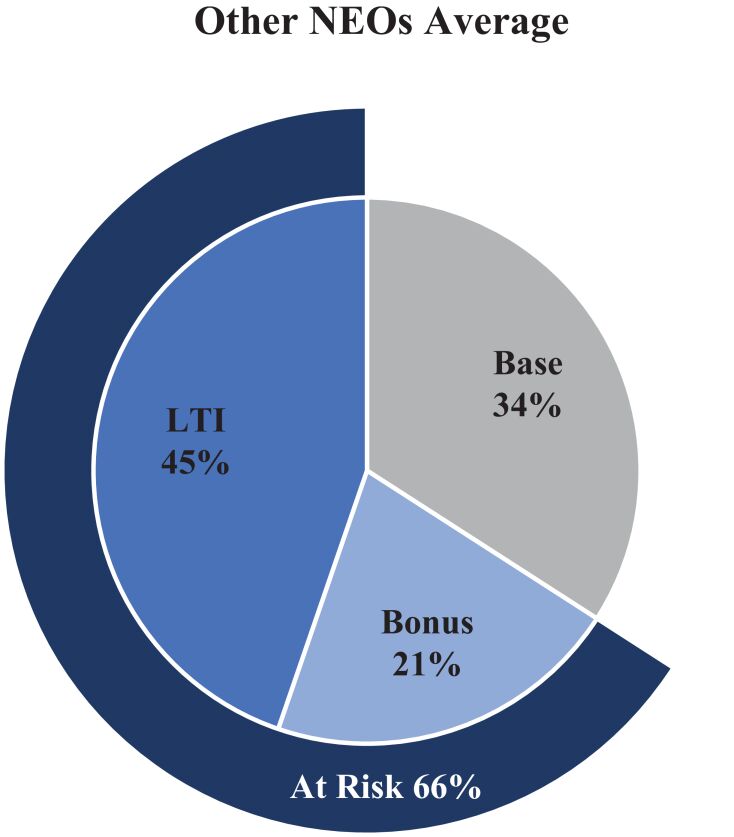
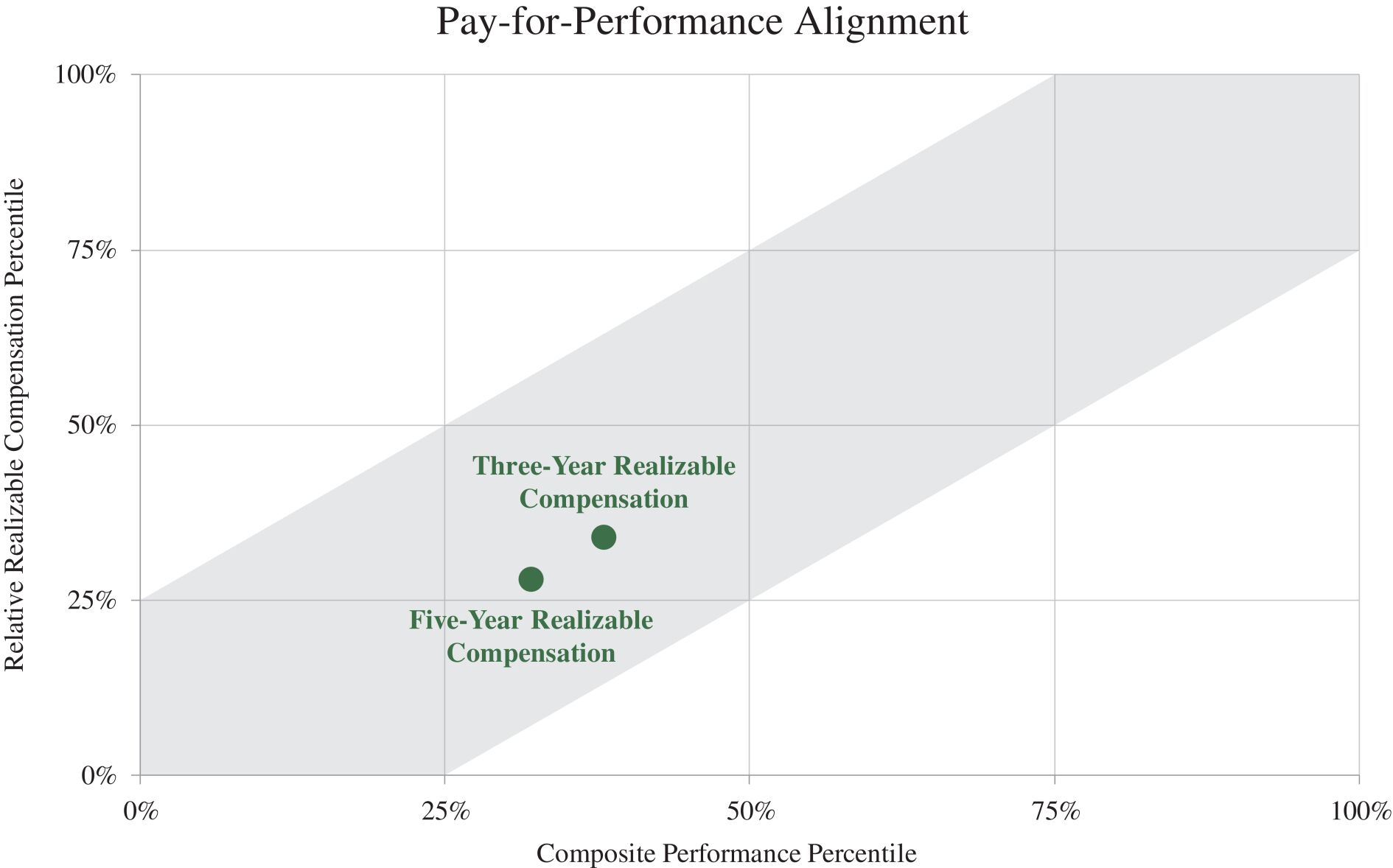
| (2) | to provide payment to each Director (except the NE Chairperson shall only be entitled to Meeting Fees for attending Board meetings and the Annual Meeting) for the following (collectively, the “Meeting Fees”): (i) fees if any, paid for attendance at meetings of the Board or committees of the Board; and (ii) fees, if any, paid to a Director for attendance at the Annual Meeting; |
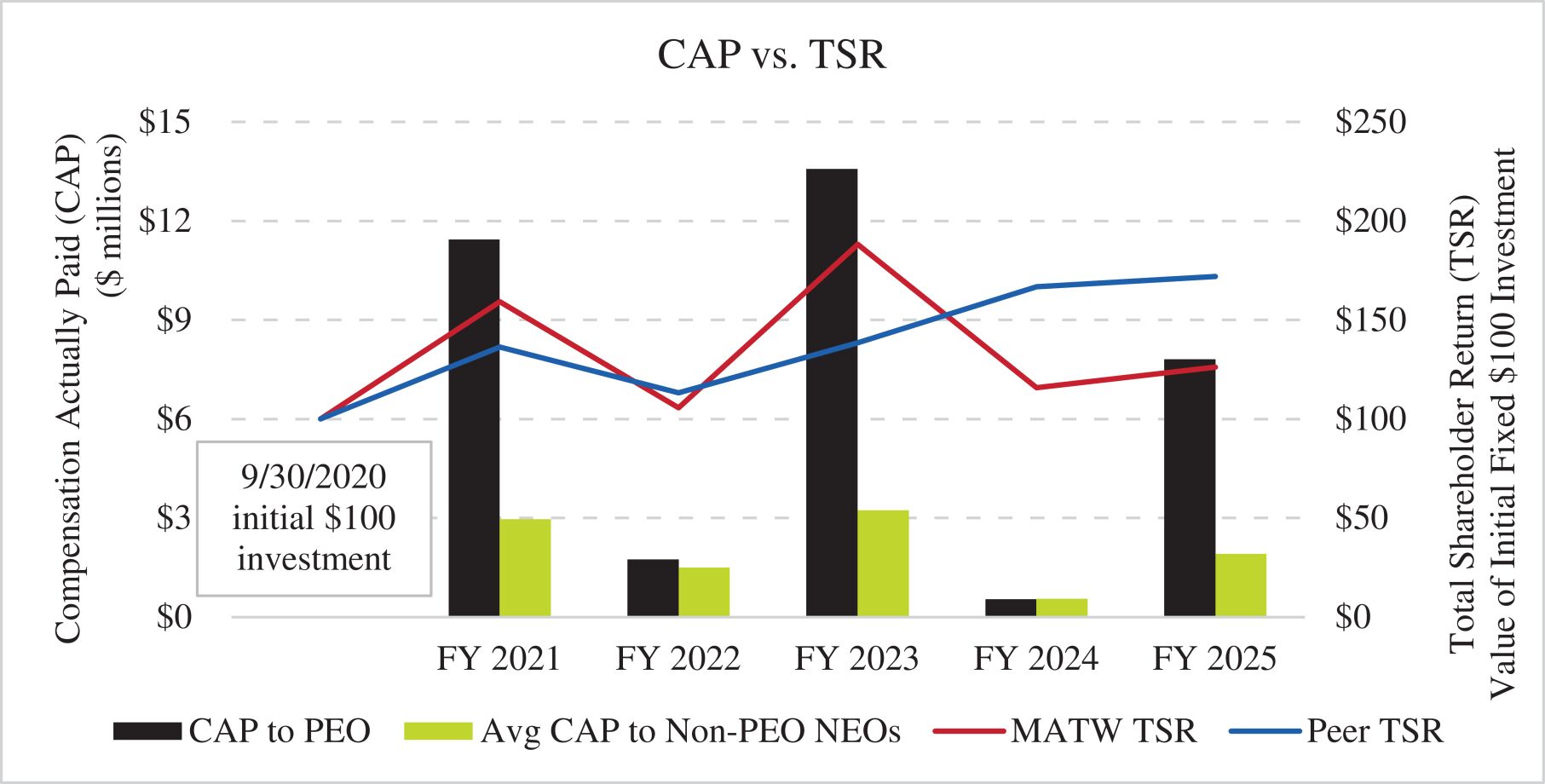
| (3) | to increase the identification of interests between the Directors and the shareholders of the Corporation by permitting (i) the Governance and Sustainability Committee of the Board or a Stock Compensation Subcommittee of the Committee (the “Subcommittee”) to award restricted stock awards (“RSA”), restricted stock units (“RSU”), nonstatutory stock options and/or stock appreciation rights to each Director on the fifteenth (15th) business day after the Annual Meeting, and |
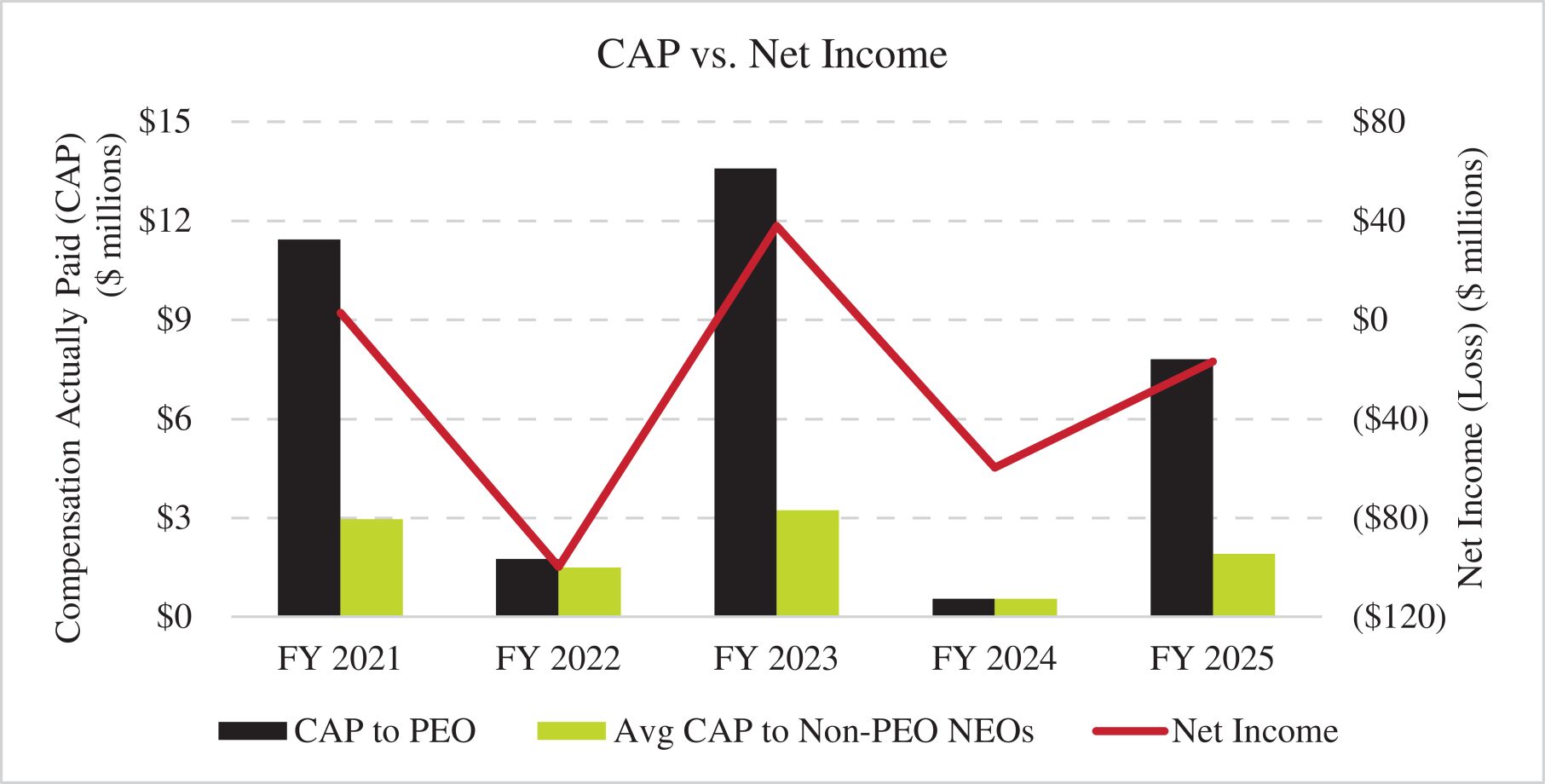
| (4) | to allow Directors to elect to (i) receive payment of certain fees in shares of Class A Common Stock, par value $1.00 per share of the Corporation (the “Common Stock”), (ii) defer receipt of certain fees and awards into a deferred stock account as deferred stock units (“DSU”), and (iii) reinvest dividends payable on Common Stock for awards or stock issued under this Plan instead of receiving cash. |
For purposes of the Plan, the term “Subsidiary” means any corporation, partnership, limited liability company, joint venture, trust or estate in an unbroken chain beginning with the Corporation, if each of the entities other than the last entity in the unbroken chain owns equity possessing fifty percent (50%) or more of the total combined voting power of all classes of equity in one of the other entities in the chain. As used hereinafter, the term “Committee” shall mean either the Governance and Sustainability Committee or the Subcommittee, if the Subcommittee is authorized by the Board to act under this Plan; provided, however, that the members of the Committee must be composed solely of two or more “non-employee directors” in accordance with Rule 16b-3(d) under the 1934 Act. The term “Annual Meeting” shall refer to the annual shareholders’ meeting of the Corporation. The term “business day” means a day other than a Saturday, Sunday or other day on which commercial banks in the City of Pittsburgh, Pennsylvania are authorized or required to close.
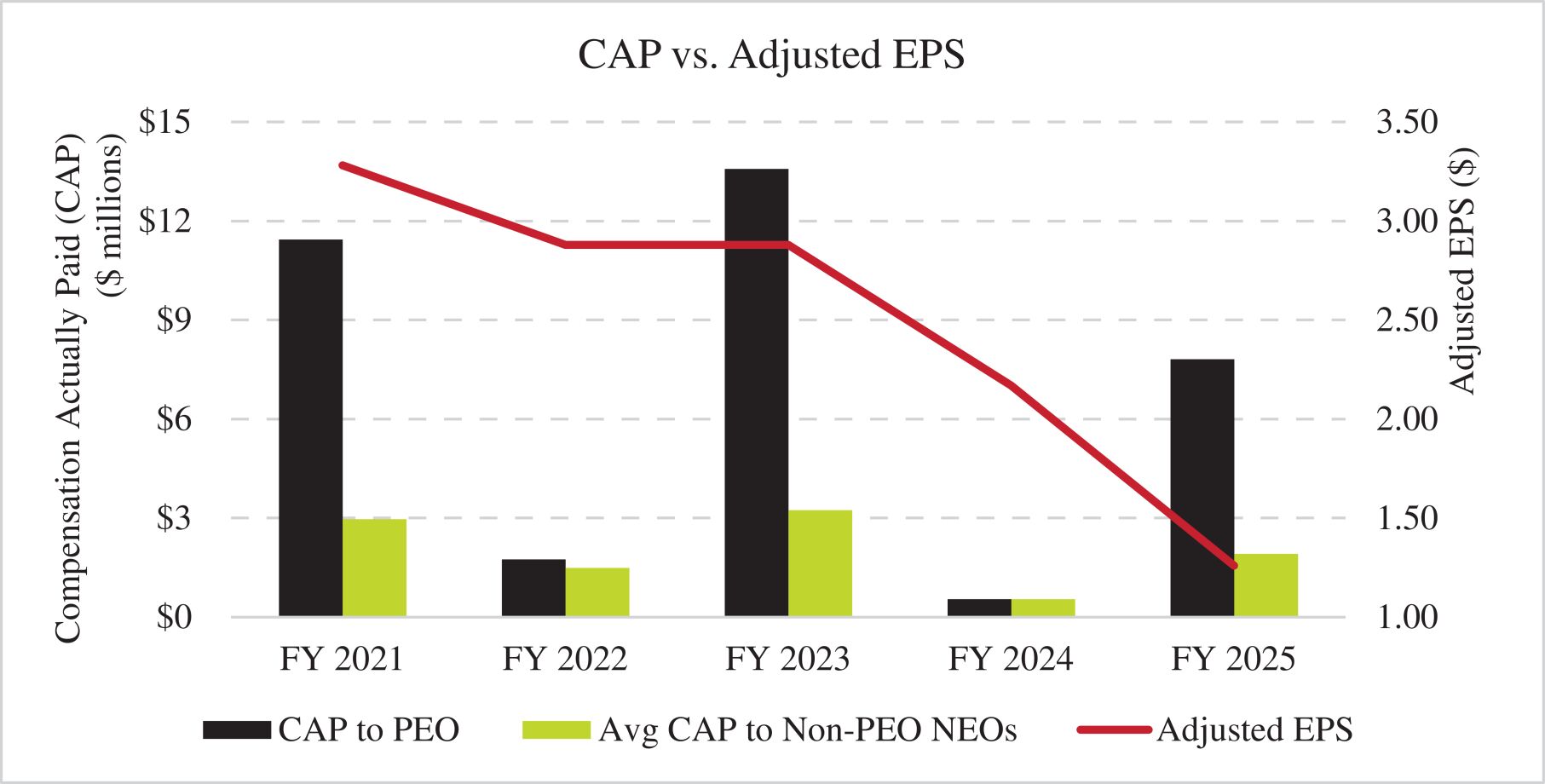
(b) Reservation of Shares. Except as otherwise provided in this Section 1(b), the aggregate number of shares of Common Stock which may be issued under the Plan or credited (in DSUs) to deferred stock compensation accounts for subsequent issuance under the Plan from the date of its first adoption is limited to five hundred fifty thousand (550,000) shares, subject to adjustment and substitution as set forth in Section 14 hereof. Shares of Common Stock issued under the Plan may be authorized but unissued shares or shares previously issued and
C-1
thereafter acquired by the Corporation or partly each, as shall be determined from time to time by the Board (or a committee thereof). If any stock option, RSU or stock appreciation right granted under the Plan is cancelled by mutual consent, forfeited, or terminates or expires for any reason without having been exercised in full, or if any RSAs under the Plan are forfeited, the number of shares subject thereto, in the case of stock options, RSUs or stock appreciation rights, or the number of shares forfeited, in the case of RSAs, shall again be available for all purposes of the Plan. All shares of Common Stock covered by a stock appreciation right or RSU, to the extent it is exercised or vests, as applicable, and shares of Common Stock are actually issued upon exercise or vesting of the right, shall be counted, regardless of the number of shares used to settle the stock appreciation right upon exercise.
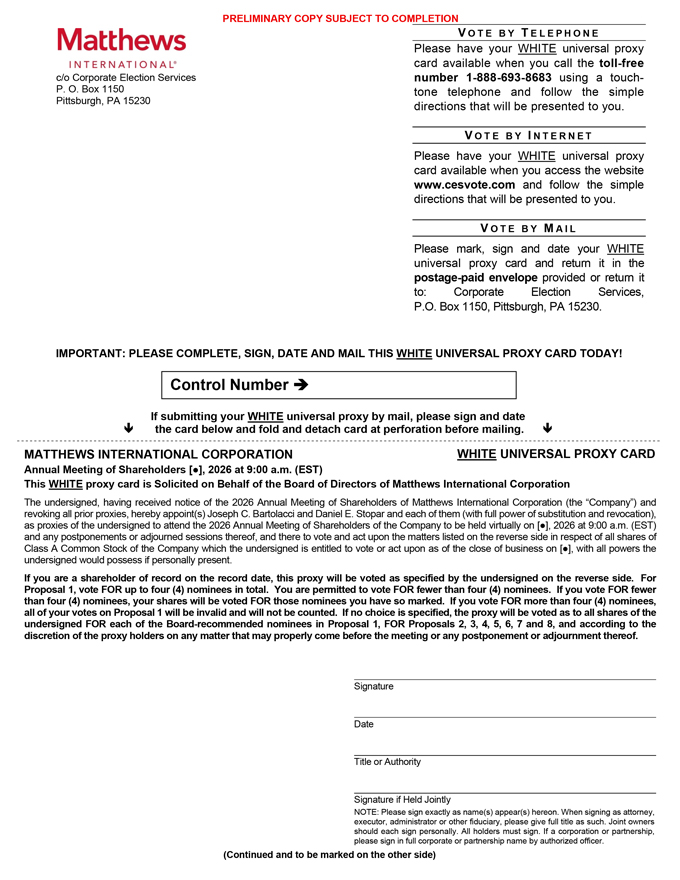
(c) Individual Limits. During any calendar year:
(i) the maximum aggregate Fair Market Value of Equity Awards (as determined on the date of issuance of each such Equity Award) issued under this Plan to a Director in a calendar year shall not exceed $400,000 during such calendar year; and
(ii) the maximum aggregate (x) Director Fees or Meeting Fees payable under this Plan to a Director in a calendar year and (y) Fair Market Value of Equity Awards issued under this Plan (as determined pursuant to clause (i) above) shall not exceed $600,000 during such calendar year.
SECTION 2
Eligibility
Any Director of the Corporation who is separately compensated in the form of Director Fees or Meeting Fees for services on the Board shall be eligible to participate in the Plan.
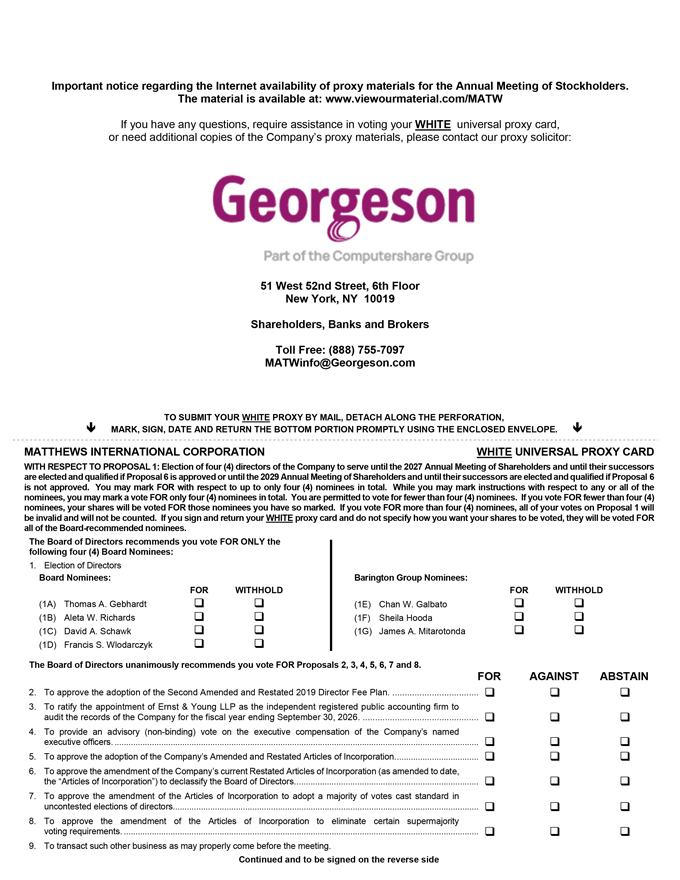
SECTION 3
Payment of Director Fees
(a) Director Fee Payment. Subject to the provisions of Section 3(b) hereof, on the fifteenth (15th) business day following the Annual Meeting (or the election or re-election to a committee chair or lead director position if such election is not made at the time of the Annual Meeting) (each such date of payment referred to as a “Regular Payment Date”), each Director as of that date shall receive payment of Director Fees by:
| (1) | the payment to the Director of such amounts determined by the Board or by any committee of the Board which the Board authorizes to determine such amounts (collectively, the “Director Fee Amount”); or |
| (2) | the issuance to the Director of a number of whole shares of Common Stock equal to the Director Fee Amount divided by the Fair Market Value of one share of the Common Stock, as defined in Section 17 hereof, on such Payment Date (rounded upward to the next whole share). |
Subject to the provisions of Section 3(b) hereof, each Director who first becomes a Director after a Regular Payment Date and before the next Annual Meeting shall, on the fifteenth (15th) business day following his or her election as a Director (the “Interim Payment Date”, and collectively with any Regular Payment Date, a “Payment Date”), receive payment of a pro-rata portion of the Director Fee Amount (in cash or in shares of Common Stock, as the case may be), equal to the applicable Director Fee Amount multiplied by a fraction, the numerator of which shall be the number of Board meetings scheduled between the date of such Director’s election and the date of the next Annual Meeting (excluding any Board meeting on the date of such Annual Meeting), and the denominator of which shall be the total number of Board meetings (actual and scheduled) between the date of the last Annual Meeting (including any Board meeting on the date of such Annual Meeting) and the date of the next Annual Meeting (excluding any Board meeting on the date of such Annual Meeting).
C-2
(b) Stock Election. The Committee shall determine by November 30 of each year whether Director Fees in the following calendar year will be paid in cash or in shares of Common Stock, with the default election being the payment of Directors Fees in shares of Common Stock. Notwithstanding the foregoing, if the Director Fees are to be paid in cash, a Director may elect to receive payment of the Director Fees in shares (a “Stock Election”). A Stock Election shall be made by filing a notice of election with the Secretary of the Corporation in the form prescribed by the Corporation (each, a “Notice of Election”). Once made, a Stock Election shall be effective on January 1 of the year following the date on which the Notice of Election is filed; provided, however, that Stock Elections shall be effective on the date on which the Notice of Election is filed with respect to Director Fees payable after the time of a person’s initial election to the office of Director, or any subsequent re-election if immediately prior thereto such person was not serving as a Director, provided the Director files such Notice of Election within ten (10) business days subsequent to being elected or re-elected as a Director. A Stock Election shall apply to all Director Fees otherwise payable while such election is effective. A Director may terminate a current Stock Election and receive current payment of Director Fees in cash (where the Committee has elected to pay Director Fees in cash) by filing a notice of termination with the Secretary of the Corporation in the form prescribed by the Corporation (each, a “Notice of Termination”), which shall be effective on January 1 of the year following the date on which a Notice of Termination is filed.
(c) Evidence of Shares. As of the date on which the Director Fees are payable in shares of Common Stock pursuant to Section 3(a) or 3(b) hereof, (i) the Corporation, at its sole discretion, shall either issue share certificates to the Director for any shares of Common Stock received under the Plan or cause such shares to be registered in the name of the Director on any book-entry registration maintained by the Corporation or its transfer agent, and (ii) the Director shall be a shareholder of the Corporation with respect to any such shares of Common Stock so issued.
(d) Deferral Election. Notwithstanding the foregoing provisions of this Section, each Director may elect to defer the receipt of Director Fees in accordance with the procedures set forth in Section 5.
SECTION 4
Payment of Meeting Fees
(a) Current Cash Payment. Subject to the provisions of Section 5 hereof, each Director shall receive payment of Meeting Fees in cash in such amounts determined by the Board or by any committee of the Board which the Board authorizes to determine such amounts, except that the NE Chairperson shall only be entitled to fees for attending Board meetings and the Annual Meeting, if any.
Except as set forth in Section 5 hereof, payment of Meeting Fees, if any, shall be paid within ten (10) business days following the meeting with respect to which such fees are payable. The amount and time of payment of Meeting Fees may be changed from time to time by the Board in its sole discretion through a duly adopted Board resolution.
(b) Deferral Election. Notwithstanding the foregoing provisions of this Section, each Director may elect to defer the receipt of Meeting Fees in accordance with the procedures set forth in Section 5.
SECTION 5
Deferral Elections
(a) Deferred Payment of Director Fees and Meeting Fees. Regardless of whether Director Fees or Meeting Fees are scheduled to be paid in cash or shares of Common Stock, each Director may elect to defer the receipt of Director Fees, Meeting Fees and/or RSAs granted pursuant to Section 12, as provided under this Section 5 (a “Deferral Election”).
C-3
(b) Deferral Election Procedures. A Deferral Election may be made by timely filing a Notice of Election with the Secretary of the Corporation in the form prescribed by the Corporation, subject to the following terms and conditions:
| (1) | A Deferral Election shall be effective only if made on or prior to December 31st of the calendar year immediately preceding the beginning of the calendar year to which the Deferral Election relates (or such other date as may be established by the Committee to the extent consistent with Section 409A); |
| (2) | Deferral Elections are entirely voluntary and shall be irrevocable once made; provided, however, the Committee, in its sole discretion, may permit a Deferral Election to be changed at any time prior to the last permissible date for making a Deferral Election; |
| (3) | A Deferral Election shall apply to all Director Fees and/or RSAs earned and payable in each calendar year while such Deferral Election remains effective, and to all Meeting Fees paid or payable for meetings held in each calendar year while such Deferral Election remains effective; |
| (4) | A Deferral Election shall, to the extent permitted by the Committee, allow a Director to select whether any dividends or distributions payable with respect to the Director’s DSUs shall be paid currently in cash (or other property, as applicable) or otherwise credited in additional DSUs to the Director’s Account (the “Dividend Election”). |
(c) Elections for New Plan Participants. A Director who first becomes eligible to participate in the Plan may, to the extent permitted by the Committee, file a Deferral Election (the “Initial Election”) at any time on or before the 10th business day following the date on which the Director initially becomes eligible to participate in the Plan. Any such Initial Election shall only apply to fees and awards earned and payable for services rendered after the date on which the Initial Election is delivered to the Corporation. Accordingly, an Initial Election shall apply to all Director Fees or RSAs earned and payable subsequent to the date the Initial Election is delivered to the Corporation, and to all Meeting Fees earned and payable for meetings held following the date the Initial Election is delivered to the Corporation.
(d) Termination/Modification of Deferral Elections. Unless otherwise specifically provided in a Notice of Election, a Deferral Election shall remain in effect for future calendar years unless and until such election is timely revoked. A Director may increase, decrease, terminate or recommence a Deferral Election (including an Initial Election) by filing a new Deferral Election on or prior to the last date for filing a Deferral Election for the next calendar year. A new Deferral Election shall be effective January 1st of the calendar year following the date on which the election is filed with the Corporation.
SECTION 6
Deferred Stock Compensation Account
(a) General. The amount of any Director Fees, RSAs or Meeting Fees elected to be deferred in accordance with a Deferral Election for a calendar year shall be credited, in the form of shares of DSUs, to a deferred stock compensation account maintained by the Corporation in the name of the Director (an “Account”). On each Payment Date that a Deferral Election is effective for a Director, or on which DSUs are to be credited pursuant to a Deferral Election, the Director’s Account(s) shall be credited on the Payment Date with the number of DSUs (including fractional shares to at least two decimal places) (i) equal to that number of shares of Common Stock that otherwise would have been payable to the Director on such Payment Date where the Director Fees had been payable to the Director in shares of Common Stock, (ii) equal to the aggregate amount of all Director Fees and/or Meeting Fees subject to such Deferral Election otherwise payable during such calendar year to such Director in cash divided by the Fair Market Value of one share of the Common Stock, as defined in Section 17 hereof, on such Payment Date, and/or (iii) equivalent to the number of shares of restricted stock granted. DSUs shall represent the right to receive an equivalent number of shares of Common Stock upon the terms and conditions outlined in this Section. No interest or other amount shall be paid or credited to a Director notwithstanding that
C-4
Director Fees and/or Meeting Fees which otherwise would have been payable under the Plan are not reflected as DSUs until the Payment Date. A separate Account shall be maintained for each amount of deferred Director Fees, Meeting Fees or RSAs for which a Director has elected a different payment option or as otherwise determined by the Committee. Separate Accounts shall be maintained for deferred Director Fees, Meeting Fees and/or RSAs under the Plan as opposed to those deferred, if any, under the 1994 Director Fee Plan, as amended or the 2014 Director Fee Plan, as amended.
The Account of a Director shall be charged on the date of distribution with any distribution of DSUs made to the Director from such Account pursuant to Section 6(b) hereof.
(b) Dividend Equivalent Rights. If DSUs are outstanding in an Account on the record date with respect to a dividend was declared on the Corporation’s Common Stock in cash or property other than Common Stock, then on the date of such payment of the dividend the Corporation shall, based on each Director’s Dividend Election in effect at the time, either (i) pay directly to the Director an amount in cash or property other than Common Stock, as the case may be, or (ii) increase the number of DSUs credited to the Director’s Account by an amount, determined in accordance with the following formula, rounded down to the nearest hundredth of a whole share: X =((A x B)/C)-D, where
X = the additional number of DSUs to be credited to the Account, or paid in cash, based on the Director’s Dividend Election then in effect;
A = the number of DSUs in the Director’s Account;
B = the per share amount of the dividend;
C = the average of the high and low per share selling prices of the Corporation’s Common Stock on the payment date of such dividend;
D = the taxes, if any, required to be withheld on such amount, including but not limited to any taxes required to be withheld due to the characterization of such amounts as wages or compensation.
(c) Manner of Payment of Account. The DSUs held in a Director’s Account will be paid in shares of Common Stock to the Director or, in the event of the Director’s death, to the Director’s Beneficiary as defined in Section 6(d) hereof.
| (1) | Elections. For Deferral Elections, a Director may elect at the time of filing the Notice of Election to receive payment of the DSUs credited to the Director’s Account, in whole or in part, as follows (except as otherwise provided in Sections 6(d) and 7(b) hereof, if applicable): |
| (i) | In a lump sum on April 1 (or if April 1 is not a business day, on the immediately preceding business day) of the calendar year following the calendar year in which the Director first separates from service with the Corporation under Section 409A of the Internal Revenue Code of 1986, as amended (the “Code”), or any successor Section, upon or after ceasing to be a member of the Board for any reason, including by reason of death or disability (the “Separation from Service Payment Commencement Date”); |
| (ii) | In two to five annual installments commencing on the Separation From Service Payment Commencement Date and continuing on the same date (or if such date is not a business day, on the immediately preceding business day) in the calendar year(s) thereafter; |
| (iii) | In a lump sum on April 1 (or if April 1 is not a business day, on the immediately preceding business day) of the calendar year specified by the Director at the time of filing of such Notice of Election (the “Designated Payment Commencement Date”); |
| (iv) | In two to five annual installments commencing on the Designated Payment Commencement Date and continuing on the same date (or if such date is not a business day, on the immediately preceding business day) in the calendar year(s) thereafter; or |
| (v) | If earlier than the date on which payment would be received under (i)-(iv) of this Section 6(c)(1), in a lump sum or in two to five annual installments, with payment commencing on the sixtieth |
C-5
| (60th) day (or if such date is not a business day, on the immediately preceding business day) following the death of the Director or following the date on which the Director becomes disabled (within the meaning of Section 409A of the Code) and continuing on the same date (or if such date is not a business day, on the immediately preceding business day) in the calendar year(s) thereafter. |
| (2) | Installment Payments. In any case where payments are made in installments, the number of shares of Common Stock distributed in each installment shall be determined by multiplying (A) the number of DSUs in the Account on the date of payment of such installment, by (B) a fraction, the numerator of which is one and the denominator of which is the number of remaining unpaid installments, and by rounding such result down to the nearest whole number of shares. The balance of the number of DSUs in the Account shall be appropriately reduced in accordance with Section 6(a) hereof to reflect the installment payments made hereunder. DSUs remaining in an Account pending distribution pursuant to this Section 6(c) shall be subject to adjustment pursuant to Section 14 hereof. |
| (3) | General. If a lump sum payment or the final installment payment hereunder would result in the issuance of a fractional share of Common Stock, such fractional share shall not be issued and cash in lieu of such fractional share shall be paid to the Director based on the Fair Market Value of a share of Common Stock, as defined in Section 17 hereof, on the date immediately preceding the date of such payment. The Corporation, at its sole discretion, shall either issue share certificates to the Director, or the Director’s Beneficiary, for the shares of Common Stock distributed hereunder or cause such shares to be registered in the name of the Director, or the Director’s Beneficiary, on any book-entry registration maintained by the Corporation or its transfer agent. As of the date on which the Director is entitled to receive payment of shares of Common Stock pursuant to this Section 6(c) hereof, a Director or the Director’s Beneficiary shall be a shareholder of the Corporation with respect to such shares. For purposes of Section 409A and the Plan, a payment shall be treated as made on a scheduled Payment Date if such payment is made at such date or a later date in the same calendar year or, if later, by the 15th day of the third calendar month following the scheduled Payment Date. |
(d) Director’s Beneficiary. The “Director’s Beneficiary” means any beneficiary or beneficiaries (who may be named contingently or successively) named by a Director under the Plan to whom any benefit under the Plan is to be paid in the case of his or her death before he or she receives any or all of such benefit. Each such designation shall revoke all prior designations by the same Director, shall be in a form prescribed by the Committee, and will be effective only when filed by the Director in writing with the Secretary of the Corporation during the Director’s lifetime. In the absence of such a designation, Director’s Beneficiary means the person designated by the Director in the Director’s Will, or, if the Director fails to make a testamentary disposition of the shares or dies intestate, to the person entitled to receive the shares pursuant to the laws of descent and distribution of the state of domicile of the Director at the time of death.
SECTION 7
Other Payment Commencement Dates
(a) General. If, in the case of a Deferral Election, the first DSUs credited to a particular Account with respect to such Director is credited after the relevant payment commencement date specified in Section 6(c) hereof or any DSUs are credited to an Account after a lump sum payment has been made pursuant to Section 6(c) hereof from such Account, payment of shares credited to such Account shall be made or commence on the April 1 (or if April 1 is not a business day, on the immediately preceding business day) following the date on which the shares are so credited.
(b) Delay in Payment. Notwithstanding Section 6(c) hereof and except as otherwise provided in Section 7(c) hereof, a Director may irrevocably elect, by filing a Notice of Election with the Secretary of the Corporation in
C-6
the form prescribed by the Corporation, to commence payment on a date later than the date specified under Section 6(c) hereof provided that:
| (i) | Such election must be made at least twelve (12) months prior to the date on which payments (or the initial scheduled Payment Date in the case of installment payments) otherwise would have commenced pursuant to the election under Section 6(c) hereof; and |
| (ii) | The payment commencement date specified in such election under this Section 7(b) must be not less than five (5) years from the date on which payments (or the initial scheduled Payment Date in the case of installment payments) otherwise would have commenced pursuant to the election under Section 6(c) hereof. |
The provisions of this Section 7(b) are intended to comply with Section 409A(4)(C) of the Code, or any successor Section, and shall be interpreted consistently therewith.
(c) Change in Control Event. Notwithstanding Sections 6(c) and 7(b) hereof, effective for Director Fees, Meeting Fees and/or RSAs payable (but for any Deferral Elections) on and after January 1 of the year following the date on which the Notice of Election is filed, a Director may irrevocably elect, by filing a Notice of Election with the Secretary of the Corporation in a form prescribed by the Corporation, to receive payment of all DSUs credited to the Director’s Account with respect to such Director Fees, Meeting Fees and/or RSAs, upon the earlier of when payment would be made pursuant to the election under Section 6(c) or 7(b) hereof or in a lump sum immediately following the occurrence of any Change in Control Event, as defined below (a “Change in Control Event Election”).
A Change in Control Event Election shall be effective on the date on which it is filed with respect to Director Fees, Meeting Fees and RSAs payable (but for any Deferral Elections) after the time of a person’s initial election to the office of Director, or any subsequent re-election if immediately prior thereto such person was not serving as a Director, provided (i) the Director files such Change in Control Event Election within ten (10) business days subsequent to being elected or re-elected as a Director and (ii) a Change in Control Event Election shall only be effective for Director Fees, Meeting Fees and RSAs payable for services performed after the Change in Control Event Election is filed. A Director may terminate a Change in Control Event Election only by filing a Notice of Termination of Change in Control Event Election with the Secretary of the Corporation in the form prescribed by the Corporation, which shall be effective for Director Fees, Meeting Fees and/or RSAs payable (but for any Deferral Elections) on and after January 1 of the year following the date on which such Notice of Termination of Change in Control Event Election is filed. If payments from a Director’s Account have previously commenced at the time of a Change in Control Event which results in a permissible lump sum payment pursuant to this Section 7(c), for purposes of applying this Section 7(c) shares previously paid from the Director’s Account shall be deemed to be from Director Fees, Meeting Fees and RSAs not subject to a Change in Control Event Election, to the extent thereof. A “Change in Control Event” shall mean the date upon which any event occurs which constitutes a change in the ownership or effective control of the Corporation or in the ownership of a substantial portion of the assets of the Corporation under Section 409A of the Code or any successor Section and Treasury Regulation §1.409A-3(i)(5)(v)-(vii) thereunder or any successor Section, provided that:
| (i) | The percentage specified in Treasury Regulation §1.409A-3(i)(5)(v) (addressing the percentage change in the ownership of the total fair market value or voting power of the Corporation’s stock) shall be 50 percent and not a higher percentage; |
| (ii) | The percentage specified in Treasury Regulation §1.409-3(i)(5)(vi)(A)(1) (addressing the percentage change in the ownership of the voting power of the Corporation’s stock) shall be 30 percent and not a higher percentage; |
| (iii) | For purposes of Treasury Regulation §1.409A-3(i)(5)(vi)(A)(2) (addressing a change in the effective control of the Corporation by virtue of a change in the composition of the Board), the words “a majority of the members of the corporation’s board of directors” shall not be replaced by a higher portion; and |
C-7
| (iv) | The percentage specified in Treasury Regulation §1.409A-3(i)(5)(vii)(A) (addressing the percentage change in the ownership of the Corporation’s assets) shall be 40 percent and not a higher percentage. |
SECTION 8
Non-Alienability of Benefits
Except as may be required by law, neither the Director nor the Director’s Beneficiary shall have the right to, directly or indirectly, alienate, assign, transfer, pledge, anticipate or encumber (except by reason of death) any amounts or shares of Common Stock or DSUs that are or may be payable hereunder, including but not limited to in respect of any liability of a Director or the Director’s Beneficiary for alimony or other payments for the support of a spouse, former spouse, child or other dependent, prior to such amount actually being received by the Director or the Director’s Beneficiary hereunder, nor shall any such amounts or shares be subject in any manner to anticipation, alienation, sale, transfer, assignment, pledge, encumbrance, attachment or garnishment by creditors of the Director or the Director’s Beneficiary or to the debts, contracts, liabilities, engagements, or torts of any Director or Director’s Beneficiary, or transfer by operation of law in the event of bankruptcy or insolvency of the Director or the Director’s Beneficiary, or any legal process.
SECTION 9
Nature of Deferred Stock Compensation Accounts
Any Account, and any DSUs reflected in such Account, shall be established and maintained only on the books and records of the Corporation. No assets or funds of the Corporation, a Subsidiary or the Plan shall be removed from the claims of the Corporation’s or a Subsidiary’s general or judgment creditors or otherwise made available, and no shares of Common Stock of the Corporation to be issued pursuant to an Account shall be issued or outstanding, until such amounts and shares are actually payable to a Director or a Director’s Beneficiary as provided herein. DSUs credited to an Account constitute a mere promise by the Corporation to make payments in the future. Each Director and Director’s Beneficiary shall have the status of, and their rights to receive a payment of shares of Common Stock under the Plan shall be no greater than the rights of, general unsecured creditors of the Corporation. No person shall be entitled to any voting rights with respect to DSUs credited to an Account. The Corporation shall not be obligated under any circumstances to fund any financial obligations under the Plan and the Plan is intended to constitute an unfunded plan for tax purposes. However, the Corporation may, in its sole discretion, set aside funds in a trust or other vehicle, subject to the claims of its creditors, in order to assist it in meeting its obligations under the Plan, if:
| (a) | such arrangement will not cause the Plan to be considered a funded deferred compensation plan under the Code; |
| (b) | any trust created by the Corporation, and any assets held by such trust to assist the Corporation in meeting its obligations under the Plan, will conform to the terms of the model trust, as described in Rev. Proc. 92-64, 1992-2 C.B. 422 or any successor; and |
| (c) | such set aside of funds is not described in Section 409A(b) of the Code, or any successor provision. |
SECTION 10
Grant of Equity Awards
The Committee shall have authority, in its sole discretion, (a) to grant “nonstatutory stock options” (i.e., stock options which do not qualify under Sections 422 and 423 of the Code), (b) to grant stock appreciation
C-8
rights, (c) to award RSAs, and (d) to award RSUs (collectively “Equity Awards”). All grants and awards pursuant to this Section 10 shall be made on or to be effective on a Payment Date. On or as of each Payment Date, the Committee shall grant or award to each Director on such Payment Date Equity Awards with such amount determined by the Board or by any committee of the Board which the Board authorizes to determine such amount (subject to such limitations set forth under this Plan). The Committee shall determine in its sole discretion the portion of each grant and/or award to be comprised of nonstatutory stock options, stock appreciation rights, RSAs and RSUs and the value of each.
SECTION 11
Terms and Conditions of
Stock Options and Stock Appreciation Rights
Stock options and stock appreciation rights granted under the Plan shall be subject to the following terms and conditions:
| (A) | The purchase price at which each stock option may be exercised (the “option price”) and the base price at which each stock appreciation right may be granted (the “Base Price”) shall be such price as the Committee, in its sole discretion, shall determine but shall not be less than one hundred percent (100%) of the Fair Market Value per share of the Common Stock covered by the stock option or stock appreciation right on the date of grant. For purposes of this Section 11, the Fair Market Value of the Common Stock shall be determined as provided in Section 17 hereof. In no event may any stock option or stock appreciation right granted under this Plan, other than pursuant to Section14, be amended to decrease the exercise price or Base Price thereof, be cancelled in conjunction with the grant of any new stock option or stock appreciation right with a lower exercise price or Base Price, be cancelled or repurchased for cash, property, or another award at a time when the exercise price or Base Price is greater than the Fair Market Value of the underlying Common Stock, or otherwise be subject to any action that would be treated, for accounting purposes, as a “repricing” of such stock option or stock appreciation right, unless such amendment, cancellation, or action is approved by the Corporation’s shareholders. |
| (B) | The option price for each stock option shall be paid in full upon exercise and shall be payable in cash in United States dollars (including check, bank draft or money order), which may include cash forwarded through a broker or other agent-sponsored exercise or financing program; provided, however, that in lieu of such cash the person exercising the stock option may if authorized by the Committee pay the option price in whole or in part by delivering to the Corporation shares of the Common Stock (by delivery of such shares or by attestation) not restricted under Section 12 and having a Fair Market Value on the date of exercise of the stock option, determined as provided in Section 17 hereof, equal to the option price for the shares being purchased, except that any portion of the option price representing a fraction of a share shall in any event be paid in cash. If the person exercising a stock option participates in a broker or other agent-sponsored exercise or financing program, the Corporation will cooperate with all reasonable procedures of the broker or other agent to permit participation by the person exercising the stock option in the exercise or financing program. Notwithstanding any procedure of the broker or other agent-sponsored exercise or financing program, if the option price is paid in cash, the exercise of the stock option shall not be deemed to occur and no shares of the Common Stock will be issued until the Corporation has received full payment in cash (including check, bank draft or money order) for the option price from the broker or other agent. To facilitate the foregoing, the Corporation may, to the extent permitted by applicable law, enter into agreements for coordinated procedures with one or more brokerage firms. In the event the broker sells any shares on behalf of a Director, the broker shall be acting solely as the agent of the Director, and the Corporation disclaims any responsibility for the actions of the broker in making any such sales. The date of exercise of a stock option shall be determined under procedures established by the Committee, and as of the |
C-9
| date of exercise the person exercising the stock option shall be considered for all purposes to be the owner of the shares with respect to which the stock option has been exercised. |
| (C) | Upon the exercise of stock appreciation rights the Corporation shall pay to the person exercising the stock appreciation rights a number of shares of the Common Stock with a Fair Market Value, as defined in Section 17 hereof, equal to the difference between the aggregate Fair Market Value, as defined in Section 17 hereof, of the Common Stock on the date of exercise of the stock appreciation rights and the aggregate Base Prices for the stock appreciation rights which are exercised (the “Spread”) (rounded down to the next whole number of shares). No fractional shares of the Common Stock shall be issued nor shall cash in lieu of a fraction of a share of Common Stock be paid. Notwithstanding the foregoing, at the sole discretion of the Committee, the Corporation may pay to the person exercising the stock appreciation rights an amount of cash, rather than shares of the Common Stock, equal to the Spread if and only if the payment of cash upon exercise of the stock appreciation rights would not cause the stock appreciation rights to provide for a deferral of compensation within the meaning of Section 409A of the Code. The date of exercise of a stock appreciation right shall be determined under procedures established by the Committee. |
| (D) | Unless the Committee, in its sole discretion, shall otherwise determine and subject to the terms of Sections 11(G) and 11(H) hereof, stock options and stock appreciation rights shall be exercisable by a Director commencing on the second anniversary of the date of grant. Subject to the terms of Sections 11(G) and 11(H) hereof providing for earlier termination of a stock option or stock appreciation right, no stock option or stock appreciation right shall be exercisable after the expiration of ten years from the date of grant. Unless the Committee, in its sole discretion, shall otherwise determine, a stock option or stock appreciation right to the extent exercisable at any time may be exercised in whole or in part. |
| (E) | Unless the Committee, in its sole discretion, shall otherwise determine: |
| (i) | no stock option or stock appreciation right shall be transferable or assignable by the grantee otherwise than: |
| (a) | by Will; or |
| (b) | if the grantee dies intestate, by the laws of descent and distribution of the state of domicile of the grantee at the time of death; or |
| (c) | to the trustee of a trust that is revocable by the grantee alone, both at the time of the transfer or assignment and at all times thereafter prior to such grantee’s death; and |
| (ii) | all stock options and stock appreciation rights shall be exercisable during the lifetime of the grantee only by the grantee (or the grantee’s guardian or legal representative) or by the trustee of a trust described in Section 11(E)(i)(c) hereof. |
A transfer or assignment of a stock option or a stock appreciation right by a trustee of a trust described in Section 11(E)(i)(c) to any person other than the grantee shall be permitted only to the extent approved in advance by the Committee in writing, in its sole discretion and subject to applicable law. Stock options or stock appreciation rights held by such trustee also shall be subject to all of the conditions and restrictions set forth in the Plan and in the applicable agreement with the grantee as if such trustee were a party to such agreement as the grantee. In the event the grantee ceases to be a Director of the Corporation, the provisions set forth in the Plan and in the applicable agreement with the grantee shall continue to be applicable to the stock option or stock appreciation right and shall limit the ability of such trustee to exercise any such transferred stock options or stock appreciation rights to the same extent they would have limited the grantee. The Corporation shall not have any obligation to notify such trustee of any termination of a stock option or stock appreciation right due to the termination of service of the grantee as a Director of the Corporation.
| (F) | Unless otherwise specified by the Committee, the applicable Director shall have all of the rights of a shareholder of the Corporation holding Common Stock with respect to the shares of Common Stock to |
C-10
| be issued upon the exercise of a stock option or stock appreciation right (including the right to vote the applicable shares and the right to receive dividends), when the Director (i) has given written notice of exercise in accordance with the procedures established by the Committee, (ii) if requested, has given the representation described in Section 18, and (iii) in the case of a stock option, has paid in full the option price for such shares. |
| (G) | Unless the Committee, in its sole discretion, shall otherwise determine, if a grantee ceases to be a Director of the Corporation, any outstanding stock options and stock appreciation rights held by the grantee shall vest and be exercisable and shall terminate, according to the following provisions: |
| (i) | Notwithstanding Section 11(D) hereof, if a grantee ceases to be a Director of the Corporation for any reason other than those set forth in Section 11(G)(ii) or (iii) hereof, any then outstanding stock option and stock appreciation right held by such grantee (whether or not vested and exercisable by the grantee immediately prior to such time) shall vest and be exercisable by the grantee (or, in the event of the grantee’s death, by the person entitled to do so under the Will of the grantee, or, if the grantee shall fail to make testamentary disposition of the stock option or stock appreciation right or shall die intestate, by the legal representative of the grantee (the “Grantee’s Heir or Representative”)), at any time prior to the second anniversary of the date on which the grantee ceases to be a Director of the Corporation or the expiration date of the stock option or stock appreciation right, whichever is the shorter period; |
| (ii) | Unless the exercise period of a stock option or stock appreciation right following termination of service as Director has been extended as provided in Section 15(c) hereof, if during his or her term of office as a non-employee Director a grantee is removed from office for cause or resigns without the consent of the Board, any then outstanding stock option and stock appreciation right held by such grantee shall terminate as of the close of business on the last day on which the grantee is a Director of the Corporation; and |
| (iii) | Notwithstanding Section 11(D) hereof, following the death of a grantee during service as a Director of the Corporation, or upon the disability of a Director which requires his or her termination as a Director of the Corporation, any outstanding stock option and stock appreciation right held by the grantee at the time of death or termination as a Director due to disability (whether or not vested and exercisable by the grantee immediately prior to such time) shall vest and be exercisable, in the case of death of the grantee, by the Grantee’s Heir or Representative, or, in the case of disability of the grantee, by the grantee at any time prior to the second anniversary of the date on which the grantee ceases to be a Director of the Corporation or the expiration date of the stock option or stock appreciation right, whichever is the shorter period. |
Whether a resignation of a Director is with or without the consent of the Board and whether a grantee is disabled shall be determined in each case, in its sole discretion, by the Committee and such determination by the Committee shall be final and binding.
| (H) | If a grantee of a stock option or stock appreciation right engages in the operation or management of a business (whether as owner, partner, officer, director, employee or otherwise and whether during or after service as a Director of the Corporation) which is in competition with the Corporation or any of its Subsidiaries, or solicits any of the Corporation’s customers or employees other than for the benefit of the Corporation, the Committee may immediately terminate all outstanding stock options and stock appreciation rights held by the grantee; provided, however, that this sentence shall not apply if the exercise period of a stock option or stock appreciation right following termination of service as a Director of the Corporation has been extended as provided in Section 15(c) hereof. Whether a grantee has engaged in the operation or management of a business which is in competition with the Corporation or any of its Subsidiaries, or solicits any of the Corporation’s customers or employees other than for the benefit of the Corporation, shall be determined, in its sole discretion, by the Committee, and any such determination by the Committee shall be final and binding. |
C-11
| (I) | All stock options and stock appreciation rights shall be confirmed by a written agreement or an amendment thereto in a form prescribed by the Committee, in its sole discretion. Each agreement or amendment thereto shall be executed on behalf of the Corporation by the Chief Executive Officer (if other than the President), the President or any Vice President and by the grantee. The provisions of such agreements need not be identical. |
Subject to the foregoing provisions of this Section 11 and the other provisions of the Plan, any stock option or stock appreciation right granted under the Plan may be exercised at such times and in such amounts and be subject to such restrictions and other terms and conditions, if any, as shall be determined, in its sole discretion, by the Committee and set forth in the agreement referred to in Section 11(I) hereof or an amendment thereto.
SECTION 12
Terms and Conditions of Restricted Share Awards
(a) Restricted Share Awards. RSAs shall be evidenced by a written agreement in a form prescribed by the Committee, in its sole discretion, which shall set forth the number of shares of the Common Stock awarded, the restrictions imposed thereon (including, without limitation, restrictions on the right of the awardee to sell, assign, transfer, pledge or otherwise encumber such shares while such shares are subject to the other restrictions imposed under this Section 12), the duration of such restrictions, events (which may, in the sole discretion of the Committee, include performance-based events) the occurrence of which would cause a forfeiture of the RSAs and such other terms and conditions as the Committee in its sole discretion deems appropriate. Restricted share awards shall be effective only upon execution of the applicable RSA agreement on behalf of the Corporation by the Chief Executive Officer (if other than the President), the President or any Vice President, and by the awardee. The provisions of such agreements need not be identical. Notwithstanding the foregoing provisions of this Section, each Director may elect to defer the receipt of any such RSAs in accordance with the procedures set forth in Section 5; provided, that the receipt of any DSUs in lieu of restricted share awards shall remain subject to the same vesting and forfeiture restrictions as the original equity award.
(b) Transfers to Trusts. Neither this Section 12 nor any other provision of the Plan shall preclude an awardee from transferring or assigning RSAs to (i) the trustee of a trust that is revocable by such awardee alone, both at the time of the transfer or assignment and at all times thereafter prior to such awardee’s death or (ii) the trustee of any other trust to the extent approved in advance by the Committee in writing. A transfer or assignment of RSAs from such trustee to any person other than such awardee shall be permitted only to the extent approved in advance by the Committee in writing, and RSAs held by such trustee shall be subject to all of the conditions and restrictions set forth in the Plan and in the applicable agreement as if such trustee were a party to such agreement.
(c) Default Vesting Restrictions. Unless otherwise determined by the Committee, RSAs awarded to a Director shall be forfeited if the awardee terminates as a Director of the Corporation within two (2) years following the grant of such RSAs due to the voluntary resignation of the Director without the consent of the Board or the removal of the Director with cause. Any RSAs which have not previously vested shall vest and the restrictions related to service as a Director shall lapse upon the death of a Director or the disability of a Director which requires his or her termination as a Director of the Corporation.
(d) Evidence of Shares. Following a grant of RSA and prior to the lapse or termination of the applicable restrictions, the Corporation, at its sole discretion, shall (i) issue share certificates in the name of the awardee and hold them in escrow together with related stock powers in blank signed by the awardee, (ii) issue such share certificates and deliver them to the awardee with an appropriate conspicuous legend referring to the terms, conditions, and restrictions applicable to such award, substantially in the following form:
“The transferability of this certificate and the shares of stock represented hereby are subject to the terms and conditions (including forfeiture) of the Matthews International Corporation Amended
C-12
and Restated 2019 Director Fee Plan and a corresponding agreement. Copies of such Plan and agreement are on file at the offices of Matthews International Corporation, Two NorthShore Center, Pittsburgh, PA 15212-5851.”;
or (iii) issue the shares in book-entry form in the name of the awardee. If share certificates are issued in the name of the awardee, the awardee shall execute and deliver to the Corporation a blank stock power in form acceptable to the Corporation with respect to each of the certificates subject to the RSAs. In the case of forfeiture of the shares, the Corporation shall use the stock power(s) to transfer ownership of the shares to the Corporation. Upon the lapse or termination of the applicable restrictions, certificate(s) without the legend referenced in (ii) above and the blank stock power(s) shall be delivered to the awardee (or the awardee’s personal representative) upon the surrender by such person of the legended certificates if they were previously provided to such person. If shares are issued in book-entry form, the Corporation shall instruct its transfer agent that the shares are to be designated as restricted on the transfer agent’s book-entry records of the owners of the Common Stock, and may not be transferred from the name of the awardee until the earlier of (i) in the case of forfeiture of the shares, when the Corporation instructs its transfer agent in writing to record the shares as owned by the Corporation (rather than by the awardee), or (ii) when requested in writing by the awardee (or the awardee’s personal representative) after the Corporation has instructed its transfer agent in writing that such shares are no longer to be designated as restricted on the transfer agent’s book-entry records due to the lapse or termination of the applicable restrictions.
(e) Dividends; Dividend Reinvestment. From the date a RSA is effective, the awardee shall be a shareholder with respect to all of the restricted shares and shall have all the rights of a shareholder with respect to the restricted shares, including the right to vote the restricted shares and to receive all dividends, and other distributions paid with respect to the restricted shares, subject only to the preceding provisions of this Section 12(e) and the other restrictions imposed by the Committee. Except as provided in Section 14 hereof, the Committee, in its sole discretion, may determine that dividends and other distributions on the shares shall not be paid to the awardee until the lapse or termination of the applicable restrictions. Unless otherwise provided, in its sole discretion, by the Committee, any such dividends or other distributions shall not bear interest. Upon the lapse or termination of the applicable restrictions (and not before such time), the unpaid dividends, if any, shall be delivered to the awardee. Further, the Committee shall have the ability, in its sole discretion following a written request of a Director, to authorize the automatic reinvestment of such dividends in additional shares of restricted stock at the time of any dividend payment (such shares referred to herein as “Reinvested Shares”), provided that sufficient shares of Common Stock are available under Section 1(B) for the issuance of such Reinvested Shares (taking into account then outstanding awards). In the event that sufficient shares of Common Stock are not available for such Reinvestment Shares to be issued, such reinvestment of dividends shall be made in the form of a grant of RSUs equal in number to the shares of Common Stock that would have been obtained by such reinvestment, the terms of which RSUs shall provide for settlement in cash and for dividend equivalent reinvestment in further RSUs on the terms contemplated by Section 13. Any Reinvestment Shares issued in connection with a Director’s election hereunder shall be subject to the same terms and conditions, including vesting schedule, as the shares of restricted stock upon which the dividend was issued.
(f) Competition. If an awardee of restricted shares engages in the operation of management of a business (whether as owner, partner, officer, director, employee or otherwise) which is in competition with the Corporation or any of its Subsidiaries or solicits any of the Corporation’s customers or employees other than for the benefit of the Corporation, the Committee may immediately declare forfeited all restricted shares, including any Reinvested Shares, held by the awardee as to which the restrictions have not yet lapsed. Whether an awardee has engaged in the operation or management of a business which is in competition with the Corporation or any of its Subsidiaries or has solicited any of the Corporation’s customers or employees other than for the benefit of Corporation, shall also be determined, in its sole discretion, by the Committee, and any such determination by the Committee shall be final and binding.
C-13
SECTION 13
Restricted Stock Units
(a) Restricted Stock Unit Awards. An RSU award represents the unsecured right to receive in the future payment (in cash, shares of Common Stock or a combination of both, as contemplated in the award) equal to the Fair Market Value of a specified number of shares of Common Stock, which is subject to a risk of forfeiture or a restriction period or both. RSUs shall be evidenced by a written agreement in a form prescribed by the Committee, in its sole discretion. RSU awards shall be effective only upon execution of the applicable RSU agreement on behalf of the Corporation by the Chief Executive Officer (if other than the President), the President or any Vice President, and by the awardee. The provisions of such agreements need not be identical.
(b) Terms and Conditions. Restricted stock units shall be subject to the restrictions imposed thereon, the duration of such restrictions, events (which may, in the sole discretion of the Committee, include performance-based events) the occurrence of which would cause a forfeiture of the RSUs and such other terms and conditions as the Committee in its sole discretion deems appropriate. Unless otherwise determined by the Committee, RSUs awarded to a Director shall be forfeited if the awardee terminates as a Director of the Corporation within two (2) years following the grant of such RSU due to the voluntary resignation of the Director without the consent of the Board or the removal of the Director with cause. An award of RSUs shall be settled as and when the RSUs vest, as determined and certified by the Committee, or at a later time specified by the Committee or in accordance with an election of the Director, if the Committee so permits. Subject to the restrictions set forth in this Plan, the Committee at any time after the date of grant, in its sole discretion, may modify or waive any of the conditions applicable to an award of RSUs. During the period, if any, set by the Committee, commencing with the date of grant of such RSUs for which such vesting restrictions apply, and until the expiration thereof, the Director shall not be permitted to sell, assign, transfer, pledge or otherwise encumber RSUs.
(c) Dividends. RSUs shall not have any voting rights, and holders of RSUs shall not be shareholders of the Corporation unless and until shares of Common Stock are issued by the Corporation (in book-entry form or otherwise). An award of RSUs shall not entitle the Director to receive dividends during the Restriction Period, nor vote the Common Stock subject to such award, or to otherwise enjoy any other stockholder rights; provided, however that the Administrator may, in its sole discretion, prescribe additional terms, conditions or restrictions relating to RSU awards, including but not limited to the issuance of any dividend equivalent units in tandem with a Restricted Stock Unit Award.
(d) Dividend Equivalent Units. Subject to the terms of this Plan, the Administrator will determine all terms and conditions of each award of dividend equivalent units, including but not limited to whether: (i) such award will be granted in tandem with another award; (ii) payment of the award shall be made currently or credited to an account for the Director that provides for the deferral of such amounts until a stated time; and (iii) the award will be settled in cash or shares; provided that dividend equivalent units may be granted only in connection with a “full-value award.” For this purpose, a “full-value award” includes Restricted Stock, RSUs and any other similar award under which the value of the award is measured as the full value of a share, rather than the increase in the value of a share.
SECTION 14
Adjustment and Substitution of Shares
In the event of a (i) merger, consolidation, acquisition of shares, stock rights offering, liquidation, separation, spinoff, disaffiliation of a Subsidiary from the Corporation, extraordinary dividend of cash or other property, or similar event affecting the Corporation or any of its Subsidiaries, including but not limited to a Section 15 Event (each, a “Corporate Transaction”) or (ii) a stock dividend, stock split, reverse stock split,
C-14
reorganization, share combination, or recapitalization or similar event affecting the capital structure of the Corporation (each, a “Share Change”) the Committee or the Board shall make such substitutions or adjustments as it deems appropriate and equitable, to prevent the dilution or enlargement of the rights of Directors, to (A) the aggregate number and kind of shares of Common Stock reserved for issuance and delivery under the Plan, (B) the number of DSUs credited to any Account, (C) the number and kind of shares of Common Stock subject to outstanding grants and awards; (D) the option price and Base Price of outstanding stock options and stock appreciation rights, respectively, carried to at least three decimal places with the last decimal place being rounded up to the nearest whole number.
In the case of Corporate Transactions, such adjustments may include, without limitation, (1) the cancellation of outstanding stock options, stock appreciation rights or RSUs in exchange for payments of cash, property or a combination thereof having an aggregate value equal to the value of such grants and awards, as determined by the Committee or the Board in its sole discretion (it being understood that in the case of a Corporate Transaction with respect to which shareholders of Common Stock receive consideration other than publicly-traded equity securities of the ultimate surviving entity, any such determination by the Committee that the value of an option stock appreciation right shall for this purpose be deemed to equal the excess, if any, of the value of the consideration being paid for each share pursuant to such Corporate Transaction over the option price of such option or the Base Price of such stock appreciation right shall conclusively be deemed valid); (2) the substitution of other property (including, without limitation, cash or other securities of the Corporation and securities of entities other than the Corporation) for the shares subject to outstanding grants and awards; and (3) in connection with any disaffiliation of a Subsidiary, arranging for the assumption of grants and awards, or replacement of grants and awards with new grants and awards based on other property or other securities (including, without limitation, other securities of the Corporation and securities of entities other than the Corporation), by the affected Subsidiary, or by the entity that controls such Subsidiary following such disaffiliation (as well as any corresponding adjustments to grants and awards that remain based upon Corporation securities). No adjustment or substitution provided in this Section 14 shall require the Corporation or any other entity to issue or sell a fraction of a share or other security. Except as provided in this Section 14, a Director shall not have any rights with respect to any Corporate Transaction or Share Change. Notwithstanding the foregoing: (i) any adjustments made pursuant to this Section 14 to Accounts shall be made in compliance with the requirements of Section 409A of the Code; (ii) any adjustments made pursuant to this Section 14 to grants and awards that are not considered “deferred compensation” subject to Section 409A of the Code shall be made in such a manner as to ensure that after such adjustment, the grants and awards either (A) continue not to be subject to Section 409A of the Code or (B) comply with the requirements of Section 409A of the Code; and (iii) in any event, neither the Committee nor the Board shall have the authority to make any adjustments pursuant to this Section 14 to the extent the existence of such authority would cause a grant or award that is not intended to be subject to Section 409A of the Code at the grant or award date of the Award to be subject thereto.
SECTION 15
Additional Rights in Certain Events
(a) Definitions. For purposes of this Section 15, the following terms shall have the following meanings:
| (1) | The term “Person” shall be used as that term is used in Sections 13(d) and 14(d) of the 1934 Act as in effect on the effective date of the Plan. |
| (2) | “Beneficial Ownership” shall be determined as provided in Rule 13d-3 under the 1934 Act as in effect on the effective date of the Plan. |
| (3) | “Voting Shares” shall mean all securities of a corporation entitling the holders thereof to vote in an annual election of directors (without consideration of the rights of any class of stock other than the Common Stock to elect directors by a separate class vote); and a specified percentage of “Voting |
C-15
| Power” of a corporation shall mean such number of the Voting Shares as shall enable the holders thereof to cast such percentage of all the votes which could be cast in an annual election of directors (without consideration of the rights of any class of stock other than the Common Stock to elect Directors by a separate class vote). |
| (4) | “Section 15 Event” shall mean the date upon which any of the following events occurs: |
| (i) | The Corporation acquires actual knowledge that any Person other than the Corporation, a Subsidiary or any employee benefit plan(s) sponsored by the Corporation has acquired the Beneficial Ownership, directly or indirectly, of securities of the Corporation entitling such Person to 20% or more of the Voting Power of the Corporation; |
| (ii) | During any period of two consecutive years, less than a majority of the total number of authorized members of the Board (excluding vacant seats) are filled by individuals who were (i) Directors at the beginning of such period and (ii) individuals whose election by the Corporation’s security holders, or nomination for election, was approved by a vote (including a vote approving a merger or other agreement providing the membership of such individuals on the Board) of at least a majority of the members of the Nominating and Corporate Governance Committee (consisting of directors then still in office who were directors at the beginning of such period or who were approved for election or nomination hereunder) or at least two-thirds of the Directors then still in office who were Directors on the effective date of the original Plan on November 15, 2018 or who were so approved (other than an individual whose initial assumption of office is in connection with an actual or threatened election contest or other actual or threatened solicitation of proxies or consents by or on behalf of a Person other than the Board of Directors relating to the election of Directors which would be subject to Rule 14a-11 under the 1934 Act, or any successor rule, including by reason of any agreement intended to avoid or settle any such election contest or proxy contest), provided that for purposes of this Section 15(a)(4)(ii), each Board then-authorized seat shall count once for determining whether a Section 15 Event has occurred; |
| (iii) | The consummation of a merger, consolidation, share exchange, division or sale or other disposition of assets of the Corporation as a result of which the shareholders of the Corporation immediately prior to such transaction shall not hold, directly or indirectly, immediately following such transaction, a majority of the Voting Power of (i) in the case of a merger or consolidation, the surviving or resulting corporation, (ii) in the case of a share exchange, the acquiring corporation or (iii) in the case of a division or a sale or other disposition of assets, each surviving, resulting or acquiring corporation which, immediately following the transaction, holds more than 30% of the consolidated assets of the Corporation immediately prior to the transaction; or |
| (iv) | The commencement of any liquidation or dissolution of the Corporation (other than pursuant to any transfer of 70% or more of the consolidated assets of the Corporation to an entity or entities controlled by the Corporation and/or its shareholders following such liquidation or dissolution); |
provided, however, that if securities beneficially owned by a Director are included in determining the Beneficial Ownership of a Person referred to in paragraph 4(a) above, then no Section 15 Event with respect to such Director shall be deemed to have occurred by reason of such event.
(b) Acceleration of the Exercise Date of Stock Options and Stock Appreciation Rights. Subject to Section 15(e), unless the agreement referred to in Section 11(I) hereof, or an amendment thereto, shall otherwise provide, notwithstanding any other provision contained in the Plan, in case any Section 15 Event occurs all outstanding stock options and stock appreciation rights (other than those held by a Director referred to in the proviso to Section 15(a)) shall become immediately and fully exercisable whether or not otherwise exercisable by their terms.
C-16
(c) Extension of the Expiration Date of Stock Options and Stock Appreciation Rights. Subject to Section 15(e), unless the agreement referred to in Section 11(I) hereof, or an amendment thereto, shall otherwise provide, notwithstanding any other provision contained in the Plan, all outstanding stock options and stock appreciation rights held by a grantee whose service with the Corporation as a Director terminates within one year of any Section 15 Event (other than those held by a Director referred to in the proviso to Section 15(a)) for any reason shall be exercisable for the longer of (i) a period of three months from the date of such termination of service or (ii) the period specified in Section 11(G) hereof, but in no event after the expiration date of the stock option or stock appreciation right.
(d) Lapse of Restrictions on Restricted Share Awards and RSUs. Unless the agreement referred to in Section 12 hereof, or an amendment thereto, shall otherwise provide, notwithstanding any other provision contained in the Plan, if any Section 15 Event occurs prior to the scheduled lapse of all restrictions applicable to restricted share awards or RSUs under the Plan, all such restrictions (other than those applicable to a Director referred to in the proviso to Section 15(a)) shall lapse upon the occurrence of any such Section 15 Event regardless of the scheduled lapse of such restrictions.
(e) Code Section 409A. Notwithstanding the foregoing, if any grant or award is subject to Section 409A of the Code, this Section 15 shall be applicable only to the extent specifically provided in the agreement under Sections 11(I) or 12 applicable to the grant or award and permitted pursuant to Section 409A. Notwithstanding any contrary provision in this Plan, DSU agreement, or Equity Award agreement, any payment(s) of “nonqualified deferred compensation” (within the meaning of Section 409A of the Code) that are otherwise required to be made under this Plan to a “specified employee” (as defined under Section 409A of the Code) as a result of such employee’s separation from service (other than a payment that is not subject to Section 409A of the Code) shall be delayed for the first six (6) months following such separation from service (or, if earlier, until the date of death of the specified employee) and shall instead be paid (in a manner set forth in the Equity Award agreement) upon expiration of such delay period.
SECTION 16
Administration of Plan; Hardship Withdrawal
(a) Administration of Plan. Except where the terms of the Plan specifically grant authority to the Committee of the Board or where the Board delegates authority to the Committee, full power and authority to construe, interpret, and administer the Plan shall be vested in the Board and it and the Committee shall have plenary authority to interpret the Plan and prescribe such rules, regulations and procedures in connection with the operations of the Plan as it shall deem to be necessary and advisable for the administration of the Plan consistent with the purposes of the Plan. Decisions of the Committee and the Board shall be final, conclusive, and binding upon all parties. Without limitation of the foregoing, the Committee shall have the authority, subject to the terms and conditions of the Plan:
| (i) | To determine the grants or awards to be made to the Directors pursuant to Sections 10-13 and all of the relevant terms thereof; |
| (ii) | Subject to Sections 11(I) and 12(a), to modify, amend or adjust the terms and conditions of any such grant or award; |
| (iii) | To adopt, alter and repeal such administrative rules, regulations, procedures, guidelines and practices governing the Plan as it shall from time to time deem advisable; |
| (iv) | To interpret the terms, provisions and conditions of the Plan and any such grant or award (and any agreement under Sections 11(I) and 12(a) relating thereto); |
| (v) | Subject to Sections 11(I) and 12(a), to accelerate the vesting or lapse of restrictions on any outstanding award, based in each case on such considerations as the Committee in its sole discretion determines; |
| (vi) | To decide all other matters that must be determined in connection with such grants and awards; |
C-17
| (vii) | To establish any “blackout” period that the Committee in its sole discretion deems necessary or advisable; and |
| (viii) | To otherwise administer the Plan in connection with such grants and awards. |
The Committee may, except to the extent prohibited by applicable law or the listing standards of the stock exchange which is the principal market for the Common Stock, allocate all or any portion of its responsibilities and powers to any one or more of its members and may delegate all or any part of its responsibilities and powers to any officers of the Corporation or committee of officers of the Corporation selected by it. The Committee shall keep records of action taken at its meetings. A majority of the Committee shall constitute a quorum at any meeting and the acts of a majority of the members present at any meeting at which a quorum is present, or acts approved in writing by all members of the Committee, shall be the acts of the Committee. Any determination made by the Committee or by an appropriately delegated officer pursuant to delegated authority under the provisions of the Plan with respect to any grant or award pursuant to Section 10 shall be made in the sole discretion of the Committee or such officer at the time of such grant or award or, unless in contravention of any express term of the Plan, at any time thereafter. All decisions made by the Committee or any appropriately delegated officer pursuant to the provisions of the Plan and shall be final and binding on all persons, including the Corporation, its Subsidiaries, and the Directors eligible under the Plan.
(b) Hardship Withdrawal. Notwithstanding the terms of Deferral Election made by a Director hereunder, the Committee may, in its sole discretion, permit the issuance of shares in accordance with the number of DSUs held in an Account with respect to Director Fees or Meeting Fees previously payable upon the request of a Director or the Director’s representative, or following the death of a Director upon the request of a Director’s Beneficiary or such beneficiary’s representative, if the Board determines that the Director or the Director’s Beneficiary, as the case may be, is confronted with an unforeseeable emergency.
For this purpose, an unforeseeable emergency means a severe financial hardship to the Director or the Director’s Beneficiary resulting from an illness or accident of the Director or the Director’s Beneficiary, the spouse, or a dependent (as defined in Section 152(a) of the Code) of the Director or the Director’s Beneficiary, loss of the Director or the Director’s Beneficiary’s property due to casualty, or other similar extraordinary and unforeseeable circumstances arising as a result of events beyond the control of the Director or the Director’s Beneficiary. The Director or the Director’s Beneficiary shall provide to the Committee evidence as the Committee, in its sole discretion, may require to demonstrate that such emergency exists and financial hardship would occur if the withdrawal were not permitted. The withdrawal shall be limited to the amount reasonably necessary to satisfy such emergency plus amounts necessary to pay taxes reasonably anticipated as a result of the distribution, after taking into account the extent to which such hardship is or may be relieved through reimbursement or compensation by insurance or otherwise, by liquidation of the Director or the Director’s Beneficiary’s assets (to the extent the liquidation of such assets would not itself cause severe financial hardship) or by the cessation of deferrals under the Plan. Cash needs arising from foreseeable events, such as the purchase or building of a house or education expenses, will not be considered to be the result of an unforeseeable financial emergency. Payment shall be made, as soon as practicable after the Committee approves the payment and determines the number of shares which shall be issued under and pursuant to the Account(s) providing for the latest payments or series of payments. No Director shall participate in any decision of the Committee regarding such Director’s request for a withdrawal under this Section 16.
(c) Cancellation; Suspension; Clawback. Any or all outstanding grants and awards to a Director may, at any time between the date of grant or award and the third anniversary of any exercise, payment or vesting of such grant and award, in the Board’s or the Committee’s sole discretion and subject to such terms and conditions established by the Board or the Committee, be cancelled, suspended, or required to be repaid to the Corporation if the Director (whether during or after service as a Director of the Corporation) (i) engages in the operation or management of a business (whether as owner, partner, officer, director, employee or otherwise) which is in competition with the Corporation or any of its Subsidiaries, (ii) induces or attempts to induce any customer, supplier, licensee or other individual, corporation or other business organization having a business relationship with the Corporation or any of its Subsidiaries to cease doing business with the Corporation or any of its Subsidiaries or in any way interferes with
C-18
the relationship between any such customer, supplier, licensee or other person and the Corporation or any of its Subsidiaries, (iii) solicits any employee of the Corporation or any of its Subsidiaries to leave the employment thereof or in any way interferes with the relationship of such employee with the Corporation or any of its Subsidiaries, (iv) commits any act of fraud or embezzlement against the Corporation, or (v) makes any statements or comments, orally or in writing, of a defamatory or disparaging nature regarding the Corporation or any of its Subsidiaries (including but not limited to regarding any of their respective businesses, officers, directors, personnel, products or policies), provided, however, that this sentence shall not apply following the occurrence of a Section 15 Event unless the agreement under Sections 11(I) or 12(a) specifically so provides. Whether a Director has engaged in any such activities shall also be determined, in its sole discretion, by the Board or the Committee, and any such determination by the Board or the Committee shall be final and binding.
SECTION 17
Fair Market Value
“Fair Market Value” of the Common Stock shall be the mean between the following prices, as applicable, for the date as of which Fair Market Value is to be determined as quoted in The Wall Street Journal (or in any other reliable publication (electronic or otherwise) as the Board of the Corporation or its delegate, in its sole discretion, may determine to rely upon):
| (a) | if the Common Stock is listed on the New York Stock Exchange, the highest and lowest sales prices per share of the Common Stock as quoted in the NYSE-Composite Transactions listing for such date; or |
| (b) | if the Common Stock is not listed on such exchange, the highest and lowest sales prices per share of Common Stock for such date on (or on any composite index including) the NASDAQ Exchange or the principal United States securities exchange registered under the Securities Exchange Act of 1934, as amended (the “1934 Act”) on which the Common Stock is listed. |
If there are no such sale price quotations for the date as of which Fair Market Value is to be determined but there are such sale price quotations within a reasonable period both before and after such date, then Fair Market Value shall be determined by taking a weighted average of the means between the highest and lowest sales prices per share of the Common Stock as so quoted on the nearest date before and the nearest date after the date as of which Fair Market Value is to be determined. The average should be weighted inversely by the respective numbers of trading days between the selling dates and the date as of which Fair Market Value is to be determined. If there are no such sale price quotations on or within a reasonable period both before and after the date as of which Fair Market Value is to be determined, then Fair Market Value of the Common Stock shall be the weighted average of the means between such bona fide bid and asked prices on the nearest trading date before and the nearest trading date after the date as of which Fair Market Value is to be determined, if both such dates are within a reasonable period. The average is to be determined in the manner described above in this Section 17. If the Fair Market Value of the Common Stock cannot be determined on the basis previously set forth in this Section 17 on the date as of which Fair Market Value is to be determined, the Board or its delegate shall in good faith and in conformance with the requirements of Section 409A of the Code, to the extent applicable, determine the Fair Market Value of the Common Stock on such date. Fair Market Value shall be determined without regard to any restriction other than a restriction which, by its terms, will never lapse.
SECTION 18
Securities Laws; Issuance of Shares
The obligation of the Corporation to issue Common Stock or credit DSUs under the Plan shall be subject to:
| (i) | the effectiveness of a registration statement under the Securities Act of 1933, as amended, with respect to such shares, if deemed necessary or appropriate by counsel for the Corporation; |
C-19
| (ii) | the condition that the shares shall have been listed (or authorized for listing upon official notice of issuance) upon each stock exchange, if any, on which the Common Stock shares may then be listed; |
| (iii) | if required by the Committee, the representation and agreement of the Director that the Director is acquiring the shares only for investment and without a present view of the sale or distribution of such shares, with a corresponding legend on any stock certificates; |
| (iv) | all other applicable laws, regulations, rules and orders which may then be in effect; and |
| (v) | obtaining any other consent, approval, or permit from any state or federal governmental agency which the Committee shall, in its sole discretion, determine to be necessary or advisable. |
The inability or impracticability of the Corporation to obtain or maintain authority from any regulatory body having jurisdiction, which authority is deemed by the Corporation’s counsel to be necessary to the lawful issuance, sale or delivery of any shares of Common Stock or credit DSUs in an Account hereunder, shall relieve the Corporation of any liability in respect of the failure to issue, sell or deliver such shares of Common Stock or credit DSUs in an Account as to which such requisite authority shall not have been obtained. If, on the date on which any shares of Common Stock would be issued pursuant to a current stock payment under Section 3(a) hereof any DSUs or credited to an Account and after consideration of any shares of Common Stock subject to outstanding Equity Awards, sufficient shares of Common Stock are not available under the Plan or the Corporation is not obligated to issue shares pursuant to this Section 18, then no shares of Common Stock shall be issued or DSUs credited but rather, in the case of a current stock payment under Section 3(a) hereof, cash shall be paid in payment of the Director Fees payable, and in the case of DSUs, Director Fees and Meeting Fees shall instead be credited in cash to a deferred cash compensation account in the name of the Director. The Board shall adopt appropriate rules and regulations to carry out the intent of the immediately preceding sentence if the need for such rules and regulations arises.
SECTION 19
Governing Law; Integration
(a) Governing Law. The provisions of this Plan shall be construed, administered and governed by the laws of the Commonwealth of Pennsylvania including its statute of limitations provisions, but without reference to conflicts of law principals. Titles of Sections of the Plan are for convenience of reference only and are not to be taken into account when construing and interpreting the Plan. In case any provision of the Plan shall be held illegal or invalid for any reason, such illegal or invalid provision shall not affect the remaining parts of the Plan, but the Plan shall be construed and enforced without regard to such.
(b) Integration. The Plan contains all of the understandings and representations between the Corporation, its Subsidiaries and any of the Directors and supersedes any prior understandings and agreements entered into between them regarding the subject matter of the Plan. There are no representations, agreements, arrangements or understandings, oral or written, between the Corporation, its Subsidiaries and any of the Directors relating to the subject matter of the Plan which are not fully expressed in the Plan.
SECTION 20
Effect of the Plan on the Rights of Corporation and Shareholders
Nothing in the Plan or in any stock option, stock appreciation right or restricted share award under the Plan or in any agreement providing for any of the foregoing or any amendment thereto shall confer any right to any person to continue as a Director of the Corporation or interfere in any way with the rights of the shareholders of the Corporation or the Board to elect and remove Directors.
C-20
SECTION 21
Amendment and Termination
(a) General. The right to amend the Plan at any time and from time to time and the right to terminate the Plan at any time are hereby specifically reserved to the Board; provided that no amendment of the Plan shall:
| (i) | be made without shareholder approval if shareholder approval of the amendment is at the time required by the rules of any stock exchange on which the Common Stock may then be listed; or |
| (ii) | otherwise amend the Plan in any manner that would cause the shares of Common Stock issued or DSUs credited under the Plan not to qualify for the exemption from Section 16(b) of the 1934 Act provided by Rule 16b-3. |
No amendment or termination of the Plan shall, without the written consent of the holder of shares of Common Stock issued or credited under the Plan or the holder of an Equity Award theretofore granted or awarded under the Plan, adversely affect the rights of such holder with respect thereto.
(b) Rule 16b-3. Notwithstanding anything contained in the preceding paragraph or any other provision of the Plan, the Board shall have the power to amend the Plan in any manner deemed necessary or advisable for shares of Common Stock issued or DSUs credited under the Plan to qualify for the exemption provided by Rule 16b-3 (or any successor rule relating to exemption from Section 16(b) of the 1934 Act), and any such amendment shall, to the extent deemed necessary or advisable by the Board, be applicable to any outstanding shares of Common Stock theretofore issued or credited under the Plan.
(c) Termination Date. Notwithstanding any other provision of the Plan:
| (i) | no shares of Common Stock shall be issued or DSUs credited on a Payment Date under the Plan after March 31, 2030; |
| (ii) | no shares of Common Stock shall be credited with respect to Meeting Fees payable under the Plan after March 31, 2030; |
| (iii) | no stock option or stock appreciation right shall be granted under the Plan after March 31, 2030; and |
| (iv) | no RSAs or vesting after March 31, 2030 of RSAs or RSUs shall be awarded under the Plan after March 31, 2030; |
provided, however, that the preceding provisions of this Section 21(c) shall not preclude the issuance of shares of Common Stock under the Plan in payment of the balance of a Director’s Account or upon the exercise after March 31, 2030 of a stock option or stock appreciation right or vesting after March 31, 2030 of RSAs or RSUs.
SECTION 22
Unsecured Creditor
The Plan constitutes a mere promise by the Corporation to make benefit payments in the future. The Corporation’s obligations under the Plan shall be unfunded and unsecured promises to pay. Any amount payable under the Plan shall be established and maintained only on the books and records of the Corporation. The Corporation and its Subsidiaries shall not be obligated under any circumstance to fund the Corporation’s financial obligations under the Plan and no assets or funds of the Corporation, any Subsidiary, or the Plan shall be removed from the claims of the Corporation’s general or judgment creditors or otherwise made available until such amounts are actually paid to a Director as provided herein. Any of them may, in its sole discretion, set aside funds in a trust or other vehicle, subject to the claims of its creditors, in order to assist it in meeting its
C-21
obligations under the Plan, if such arrangement will not cause the Plan to be considered a funded deferred compensation plan. To the extent that any Director or Director’s Beneficiary or other person acquires a right to receive payments under the Plan, such right shall be no greater than the right, and each Director and Director’s Beneficiary shall at all times have the status, of a general unsecured creditor of the Corporation.
SECTION 23
Limitation of Liability
Any grant or award under the Plan shall not give a Director or Director’s Beneficiary any rights except as expressly set forth in the Plan and in any such grant or award or create (i) any fiduciary or other obligation of the Corporation or any Subsidiary to take any action or provide to the Director or Director’s Beneficiary any assistance or dedicate or permit the use of any assets of the Corporation or any Subsidiary in any manner; (ii) any trust, fiduciary or other duty or obligation of the Corporation or any Subsidiary to engage in any particular business, continue to engage in any particular business, engage in any particular business practices or sell any particular product or products; or (iii) any obligation of the Corporation that shall be greater than the obligation of the Corporation to any of its general unsecured creditors.
SECTION 24
Dispute Resolution
Since fees are paid and grants or awards are made under the Plan in Western Pennsylvania, records relating to the Plan and fees, grants or awards thereunder are located in Western Pennsylvania, and the Plan and fees, grants or awards are administered in Western Pennsylvania, the Corporation and the Director participating in the Plan, for themselves and their heirs, representatives, successors and assigns (collectively, the “Parties”) irrevocably submit to the exclusive and sole jurisdiction and venue of the state courts of Allegheny County, Pennsylvania and the federal courts of the Western District of Pennsylvania with respect to any and all disputes arising out of or relating to the Plan, the subject matter of the Plan or fees, grants or awards under the Plan, including but not limited to any disputes arising out of or relating to the interpretation and enforceability of any fees, grants or awards or the terms and conditions of the Plan. To achieve certainty regarding the appropriate forum in which to prosecute and defend actions arising out of or relating to the Plan, and to ensure consistency in application and interpretation of the governing law under Section 19 of the Plan, the Parties agree that (a) sole and exclusive appropriate venue for any such action shall be the Pennsylvania courts described in the immediately preceding sentence, and no other, (b) all claims with respect to any such action shall be heard and determined exclusively in such Pennsylvania courts, and no other, (c) such Pennsylvania courts shall have sole and exclusive jurisdiction over the Parties and over the subject matter of any dispute relating hereto and (d) the Parties waive any and all objections and defenses to bringing any such action before such Pennsylvania courts, including but not limited to those relating to lack of personal jurisdiction, improper venue or forum non conveniens.
SECTION 25
Non-Uniform Determinations
The Committee’s determinations under the Plan (including without limitation its determinations of the grants and awards under Section 10, the form, amount and timing of such grants and awards and the terms and provisions of such grants and awards) need not be uniform and may be made by it selectively among Directors who receive, or are eligible to receive, grants and awards under the Plan, whether or not such persons are similarly situated.
C-22
SECTION 26
Indemnification
Subject to the requirements of Pennsylvania state law, each individual who is or shall have been a member of the Board or the Committee, or an officer of the Corporation to whom authority was delegated in accordance with Section 16, shall be indemnified and held harmless by the Corporation against and from any loss, cost, liability, or expense that may be imposed upon or reasonably incurred by him or her in connection with or resulting from any claim, action, suit, or proceeding to which he or she may be a party or in which he or she may be involved by reason of any action taken or failure to act under this Plan and against and from any and all amounts paid by him or her in settlement thereof, with the Corporation’s approval, or paid by him or her in satisfaction of any judgment in any such action, suit, or proceeding against him or her, provided he or she shall give the Corporation an opportunity, at its own expense, to handle and defend the same before he or she undertakes to handle and defend it on his/her own behalf, unless such loss, cost, liability, or expense is a result of his/her own willful misconduct or except as expressly provided by statute. The foregoing right of indemnification shall not be exclusive of any other rights of indemnification to which such individuals may be entitled under the Corporation’s Articles of Incorporation or Bylaws, as a matter of law, or otherwise, or any power that the Corporation may have to indemnify them or hold them harmless.
SECTION 27
No Representations or Covenants With Respect to Tax Qualification
Although the Corporation may endeavor to (i) qualify the payment of fees or a grant or award for favorable United States tax treatment or avoid adverse tax treatment (e.g., under Section 409A of the Code), the Corporation makes no representation to that effect and expressly disavows any covenant to maintain favorable or avoid unfavorable tax treatment. The Corporation shall be unconstrained in its corporate activities without regard to any potential negative tax impact to Directors under the Plan.
SECTION 28
Compliance With Laws
Without limitation, payment of fees or a grant or award under the Plan and any issuance of shares of Common Stock under the Plan shall be subject to all applicable laws, rules, and regulations, and to such approvals by any governmental agencies or stock exchanges on which the Corporation is listed as may be required.
SECTION 29
Effective Date
The effective date and date of adoption of the original Plan was November 15, 2018, the date of adoption of the Plan by the Board, and this Plan was amended and restated on November 19, 2025, provided that on or prior to November 19, 2026 such adoption of the Plan by the Board was approved by the affirmative vote of holders of record of a majority of the shares of voting stock of the Corporation represented in person or by proxy and entitled to vote at a duly called and convened meeting of such holders at which a quorum is present.
C-23
Appendix D-1
MATTHEWS INTERNATIONAL CORPORATION
AMENDED AND RESTATED ARTICLES OF INCORPORATION
| FIRST: | The name of the Corporation is Matthews International Corporation. | |
| SECOND: | The registered office of the corporation shall be provided by Corporation Service Company, located in Dauphin County in the Commonwealth of Pennsylvania. | |
| THIRD: | The purposes for which the Corporation is incorporated under the Business Corporation Law of the Commonwealth of Pennsylvania are to engage in the manufacture, fabrication, assembly, merchandising and distribution of various items, as well as to engage in and to do any lawful act concerning any or all lawful business for which corporations may be organized under the Business Corporation Law of 1988, as amended. | |
| FOURTH: | The term of the Corporation’s existence shall be perpetual. | |
| FIFTH: | 5.1 Capitalization. | |
| The total number of shares which the Corporation shall have authority to issue is 100,010,000, of which 100,000,000 shares shall be Common Stock, par value $1.00 per share, issuable in two classes, and 10,000 shares shall be Preferred Stock, par value $100 per share, issuable in one or more classes. | ||
| 5.2 Common Stock. | ||
| A. Two Classes | ||
| The Common Stock shall be divided into two classes, one such class being denominated “Class A Common Stock” and the other such class being denominated “Class B Common Stock”. There shall be authorized 70,000,000 shares of Class A Common Stock and 30,000,000 shares of Class B Common Stock. The designations, powers, preferences, qualifications, privileges, limitations, restrictions, voting rights, relative voting power and other special or relative rights of the Class A Common Stock and of the Class B Common Stock shall be as set forth in this Section 5.2. | ||
| B. Dividends and Other Distributions | ||
| Each share of Class A Common Stock and each share of Class B Common Stock shall be identical to each other in respect of rights to all dividends and distributions (including distributions upon liquidation of the Corporation) made with respect to shares of Common Stock, except that in the case of dividends or other distributions payable in Common Stock, including distributions pursuant to stock splits or stock dividends, such dividends or distributions shall be declared at the same rate and number per share on Class A Common Stock and on Class B Common Stock, but only shares of the Class A Common Stock shall be distributed with respect to Class A Common Stock and only shares of Class B Common Stock shall be distributed with respect to Class B Common Stock. If the Corporation shall in any manner split, subdivide or combine the outstanding shares of Class A Common Stock or Class B Common Stock, the outstanding shares of the other class of Common Stock shall be split, subdivided or combined in the same manner proportionately and on the same basis per share, shares of each such class being split, subdivided or combined only into or with shares of the same class. | ||
| C. Voting | ||
| (1) With respect to all matters upon which shareholders are entitled to vote or to which shareholders are entitled or requested to give consent, the holders of the | ||
D-1-1
| outstanding shares of Class A Common Stock and the holders of the outstanding shares of Class B Common Stock (together with the holders of any outstanding shares of the Preferred Stock, if entitled to vote) shall vote together without regard to class except as provided in subparagraph (2) of this Paragraph C or applicable law, and every holder of the outstanding shares of Class A Common Stock shall be entitled to cast thereon one vote in person or by proxy for each share of Class A Common Stock standing in the holder’s name and every holder of the outstanding shares of Class B Common Stock shall be entitled to cast thereon ten votes in person or by proxy for each share of Class B Common Stock standing in the holder’s name. | ||
| (2) With respect to any proposed amendment to the Articles which would increase or decrease the par value or the number of authorized shares of either Class A Common Stock or Class B Common Stock, or alter or change the powers, preferences, qualifications, privileges, limitations, restrictions, voting rights, relative voting power or other special or relative rights of the shares of Class A Common Stock or the shares of Class B Common Stock or both, the approval of a majority of the shares of each class, voting separately as a class, shall be required to be obtained in addition to any other shareholder vote required by the Articles or applicable law. | ||
| (3) In the election of directors, no shareholder shall have any right to cumulate his votes and cast them for one candidate or distribute them among two or more candidates. | ||
| D. Issuance of Class B Common Stock | ||
| The Corporation may issue shares of Class B Common Stock only (i) to an active employee of the Corporation in sole or joint name, but only to the extent permitted by applicable law and the regulations of The Nasdaq Stock Market (“Nasdaq”), or (ii) in the form of a distribution pursuant to a stock dividend on or split of the share of Class B Common Stock and only to then holders of the outstanding shares of Class B Common Stock in conjunction with and in the same ratio as a stock dividend on or split of the shares of Class A Common Stock. | ||
| E. Transfer of Class B Common Stock | ||
| (1) No person holding shares of Class B Common Stock of record (a “Class B Holder”) may transfer, and the Corporation shall not register the transfer of, such shares of Class B Common Stock, as Class B Common Stock, whether by sale, assignment, inheritance, gift, bequest, appointment or otherwise, except to the Corporation or to a person who is an active employee of the Corporation, holding in a sole or joint name. Subject to the next succeeding sentence, Class B Holders shall be permitted to transfer their stock by exchanging such Class B Common Stock for Class A Common Stock and then so transferring such Class A Common Stock. Except under the circumstances described in subparagraph (2) of this Paragraph E, no exchange of Class B Common Stock for Class A Common Stock, whether in contemplation of transfer of such stock or otherwise, shall be permitted unless the Class B Holder (including, in the case of death, the legal representative thereof) shall first offer to the Corporation in writing the Class B shares to be exchanged, upon which the Corporation shall within 24 hours of such offer notify the Class B Holder whether the Corporation will purchase such shares. If the Corporation does so notify the Class B Holder, the shares will be purchased at the fair market value per share (as defined below) of the Class A Common Stock as determined on the date the Corporation so notifies the Class B Holder. If the Corporation does not so notify the Class B Holder, the Class B Holder shall tender such shares to the Corporation, upon which the Corporation shall exchange such shares for a like number of shares of Class A Common Stock. | ||
D-1-2
| Fair market value for the purposes of this subparagraph (1) shall be the mean between the following prices, as applicable, for the date as of which fair market value is to be determined as quoted in The Wall Street Journal (or in such other reliable publication as the Corporation, in its discretion, may determine to rely upon): (a) if the Class A Common Stock is listed on the New York Stock Exchange, the highest and lowest sales prices per share of the Class A Common Stock as quoted in the NYSE-Composite Transactions listing for such date, (b) if the Class A Common Stock is not listed on such exchange, the highest and lowest sales prices per share of Class A Common Stock for such date on (or on any composite index including) the principal United States securities exchange registered under the Securities Exchange Act of 1934, as amended, on which the Class A Common Stock is listed or (c) if the Class A Common Stock is not listed on any such exchange, the highest and lowest sales prices per share of the Class A Common Stock for such date on Nasdaq. If there are no such sale price quotations for the date as of which fair market value is to be determined but there are such sale price quotations within a reasonable period both before and after such date, then fair market value shall be determined by taking a weighted average of the means between the highest and lowest sales prices per share of the Class A Common Stock as so quoted on the nearest date before and the nearest date after the date as of which fair market value is to be determined. The average shall be weighted inversely by the respective numbers of trading days between the selling dates and the date as of which fair market value is to be determined. If there are no such sale price quotations on or within a reasonable period both before and after the date as of which fair market value is to be determined, then fair market value of the Class A Common Stock shall be the mean between the bona fide bid and asked prices per share of Class A Common Stock as so quoted for such date on Nasdaq, or if none, the weighted average of the means between such bona fide bid and asked prices on the nearest trading date before and the nearest trading date after the date as of which fair market value is to be determined, if both such dates are within a reasonable period. The average is to be determined in the manner described above in this subparagraph (1). If the fair market value of the Class A Common Stock cannot be determined on the basis previously set forth in this Paragraph E on the date as of which fair market value is to be determined, the Corporation shall in good faith determine the fair market value of the Class A Common Stock on such date. Fair market value shall be determined without regard to any restriction other than a restriction which, by its terms, will never lapse. | ||
| (2) From and after the date these Amended and Restated Articles of Incorporation are filed with the Pennsylvania Department of State, upon the retirement or termination of employment for any reason of an employee of the Corporation who is a sole or joint Class B Holder, such Class B Holder shall immediately tender the Class B shares to the Corporation in exchange for a like number of shares of Class A Common Stock. If any shares of Class B Common Stock are held in a joint name, the retirement or termination of employment for any reason of one of the joint holders shall not require the exchange described in this subparagraph (2) as to such shares so long as at least one of the remaining holders thereof is an active employee of the Corporation. | ||
| (3) Notwithstanding anything to the contrary set forth herein, any Class B Holder may pledge such holder’s shares of Class B Common Stock to a pledgee pursuant to a bona fide pledge of such shares as collateral security for indebtedness due to the pledgee, provided that such shares shall not be transferred to or registered in the name of the pledgee and shall remain subject to the provisions of this Paragraph E. In the event of foreclosure or other similar action by the pledgee, such pledged shares of | ||
D-1-3
| Class B Common Stock may only be (i) transferred to the Corporation or to a person who is an active employee of the Corporation, holding in a sole or joint name or (ii) tendered to the Corporation in exchange for a like number of shares of Class A Common Stock, in accordance with the procedure described in subparagraph (1) of this Paragraph E, as the pledgee may elect. | ||
| (4) Any attempted transfer of shares of Class B Common Stock for which an exchange described in subparagraphs (1) or (2) of this Paragraph E cannot be effected shall result in the conversion of such shares of Class B Common Stock into shares of Class A Common Stock and the transfer thereof to the transferee, effective as of the date on which certificates representing such shares of Class B Common Stock are presented for transfer on the books of the Corporation. | ||
| (5) Shares of Class B Common Stock shall be registered only in the names of the beneficial owners thereof and not in “street” or “nominee” name. For this purpose a “beneficial owner” of any shares of Class B Common Stock shall mean a person who, or an entity which, possesses the power, either singly or jointly, to direct the disposition of such shares. | ||
| (6) The Corporation shall make appropriate, conspicuous reference in or on the certificates for shares of Class B Common Stock of the restrictions on transfer imposed by this Paragraph E. | ||
| F. Automatic Conversion of Class B Common Stock | ||
| At any time when the number of outstanding shares of Class B Common Stock as reflected on the stock transfer books of the Corporation falls below 5% of the aggregate number of the issued and outstanding shares of Class A Common Stock and Class B Common Stock of the Corporation, or the Board of Directors and the holders of a majority of the outstanding shares of Class B Common Stock approve the conversion of all of the Class B Common Stock into Class A Common Stock, then, immediately upon the occurrence of either such event, the outstanding shares of Class B Common Stock shall be deemed, without further act, to be converted into shares of Class A Common Stock on a one-for-one basis. In the event of such a conversion, certificates formerly representing outstanding shares of Class B Common Stock shall thereupon and thereafter be deemed to represent a like number of shares or Class A Common Stock. | ||
| G. Issuance and Transfer of Class A Common Stock | ||
| Except as otherwise restricted by applicable law or regulation, the right of the Board of Directors to issue Class A Common Stock shall not require shareholder action, and shares of Class A Common Stock are freely transferable. | ||
| H. Other Rights | ||
| Except as otherwise required by the Pennsylvania Business Corporation Law of 1988, as amended, or as otherwise provided in the Articles, each share of Class A Common Stock and each share of Class B Common Stock shall have identical preferences, qualifications, privileges, limitations and other rights, including rights in liquidation or upon a merger, consolidation or sale of substantially all the assets of the Corporation. | ||
| 5.3 Preferred Stock | ||
| A. Issuance of Preferred Stock | ||
| The Preferred Stock may be issued in one or more classes or series, with such voting rights, dividend rights, redemption rights, rights upon dissolution, conversion or exchange rights, designations, preferences and other special rights, if any, and qualifications or | ||
D-1-4
| restrictions thereof, as shall be set forth in the resolution or resolutions providing for the issue of such Preferred Stock, or classes or series thereof, adopted at any time or from time to time by the Board of Directors of the Corporation. | ||
| B. Rights of Holders of Preferred Stock | ||
| Except for and subject to these rights expressly granted to the holders of the Preferred Stock or any class or series thereof by resolution or resolutions adopted by the Board of Directors pursuant to Section 5.3, Paragraph A of this Article FIFTH and except as may be provided by the laws of the Commonwealth of Pennsylvania, the holders of the Common Stock shall have exclusively all other rights of shareholders. | ||
| SIXTH: | 6.1 The business and affairs of the Corporation shall be managed under the direction of a Board of Directors comprised as follows: | |
| A. Number | ||
| The Board of Directors shall consist of such number of persons (not less than five and not more than fifteen) as may from time to time be fixed by the Board pursuant to a resolution adopted by the affirmative vote of a majority of the directors then in office. | ||
| B. Election and Terms | ||
| (1) The directors elected by the holders of Voting Stock (as defined below) shall be classified in respect of the time for which they shall severally hold office by dividing them into three classes, until the 2028 annual meeting of the shareholders of the Corporation, at which time the directors will no longer be divided into classes. Subject to the filing of these Amended and Restated Articles of Incorporation with the Pennsylvania Department of State, directors with terms expiring at the 2026 annual meeting of the shareholders of the Corporation shall serve out the remainder of their current terms, and they and any successors shall stand for re-election to a one-year term at the 2026 annual meeting of the shareholders of the Corporation; directors with terms expiring at the 2027 annual meeting of the shareholders of the Corporation shall serve out the remainder of their current terms, and they and any successors shall stand for re-election to a one-year term at the 2027 annual meeting of the shareholders of the Corporation; and directors with terms expiring at the 2028 annual meeting of the shareholders of the Corporation shall serve out the remainder of their current terms, and they and any successors shall stand for re-election to a one-year term at the 2028 annual meeting of the shareholders of the Corporation. Upon the filing of these Amended and Restated Articles of Incorporation with the Pennsylvania Department of State until the election of directors at the 2028 annual meeting of the shareholders of the Corporation and qualification of such directors so elected, each class of directors shall not be required to be as nearly equal in number as possible pursuant to Section 1724(b)(1) of the Business Corporation Law of 1988, as amended. At each succeeding annual meeting of shareholders, commencing with the 2029 annual meeting of the shareholders of the Corporation, the holders of Voting Stock shall elect directors whose term then expires, to hold office until the annual meeting held in the year following the year of their election. Each director shall hold office for the term for which elected until his or her successor shall be elected and shall qualify, subject to their earlier death, resignation, disqualification or removal. | ||
| (2) | ||
| (a) In an election of directors, at any meeting of shareholders therefor at which a quorum is present, that is not a contested election of directors (as defined | ||
D-1-5
| below), a nominee for director shall be elected to the Board of Directors if the votes cast for such nominee’s election exceed the votes cast against such nominee’s election. Abstentions and broker non-votes shall not be considered to be votes cast. Any incumbent director who was a nominee in an election that is not a contested election and was not elected in such election pursuant to this Article SIXTH, Paragraph 6.1.B(2) shall submit a resignation to the Board of Directors that is subject to review by the Board of Directors in accordance with the procedures set forth in the By-Laws of the Corporation or the policies or guidelines of the Board of Directors. | ||
| (b) In a contested election of directors, at any meeting of shareholders therefor at which a quorum is present, the nominees receiving the highest number of votes from each class or group of classes, if any, entitled to elect directors separately up to the number of directors to be elected by the class or group of classes shall be elected. Shareholders shall not have the right to vote against a nominee in a contested election of directors. | ||
| (c) For purposes of this Article SIXTH, Paragraph 6.1.B(2), “contested election of directors” shall mean an annual or special meeting of the Corporation with respect to which (i) the Secretary of the Corporation receives a notice that a shareholder has nominated or intends to nominate a person for election to the Board in compliance with the requirements for shareholder nominees under these Articles of Incorporation, as amended, and the By-Laws of the Corporation and (ii) such nomination notice has not been withdrawn by such shareholder on or prior to the tenth (10th) day before the Corporation first mails its notice of meeting for such meeting to the shareholders. | ||
| C. Nominations of Director Candidates | ||
| Nominations for the election of directors may be made only by the Board of Directors or a committee appointed by the Board of Directors or by a holder of record of stock entitled to vote in the election of the directors to be elected: provided, however, that a nomination may be made by a shareholder only if written notice of such nomination is received by the Secretary of the Corporation not later than (i) with respect to an election to be held at an annual meeting of shareholders, 75 days prior to the anniversary date of the immediately preceding annual meeting, and (ii) with respect to an election to be held at a special meeting of shareholders, the close of business on the 10th day following the date on which notice of such meeting is first given to shareholders, such notice to include: (1) the name and address of the shareholder who intends to make the nomination and of the person or persons to be nominated; (2) a representation that the shareholder is a holder of record of stock of the Corporation entitled to vote at such meeting and intends to appear in person or by proxy at the meeting to nominate the person or persons specified in the notice; (3) a description of all arrangements or understandings between the shareholder and each nominee and any other person or persons (naming such person or persons) pursuant to which the nomination or nominations are to be made by the shareholder; (4) such other information regarding each nominee proposed by such shareholder as would be required by the By-laws of the Corporation, as then in effect, and such other information regarding each such nominee proposed by such shareholder as would be required to be included in a proxy statement filed pursuant to the proxy rules of the Securities and Exchange Commission, had the nominee been nominated by the Board of Directors; and (5) the consent of each nominee to serve as a director of the Corporation if so elected. Only candidates who have been nominated in accordance with this Article SIXTH shall be eligible for election by the shareholders as directors of the Corporation. | ||
D-1-6
| SEVENTH: | 7.1 Elimination of Liability of Directors. | |
| To the fullest extent that the laws of the Commonwealth of Pennsylvania permit elimination or limitation of the liability of directors, no director of the Corporation shall be personally liable for monetary damages as such for any action taken, or any failure to take any action, as a director. | ||
| 7.2 Matters Regarding Elimination of Director Liability. | ||
| This Article SEVENTH shall apply to any breach of performance of duty or any failure of performance of duty by any director of the Corporation occurring after January 27, 1987. The provisions of this Article shall be deemed to be a contract with each director of the Corporation who serves as such at any time while this Article is in effect and each such director shall be deemed to be so serving in reliance on the provisions of this Article. Any amendment or repeal of this Article or adoption of any By-law or other provision of the Articles of the Corporation which has the effect of increasing director liability shall operate prospectively only and shall not have any effect with respect to any action taken, or any failure to act, by a director prior to such amendment, repeal or adoption. | ||
| EIGHTH: | 8.1 Right to Indemnification. | |
| Except as prohibited by law, every director and officer of the Corporation shall be entitled as a matter of right to be indemnified by the Corporation against expenses and any liabilities paid or incurred by such person in connection with any actual or threatened claim, action, suit or proceedings, civil, criminal, administrative, investigative or other, whether brought by or in the right of the Corporation or otherwise, in which he or she may be involved in any manner, as a party, witness or otherwise, or is threatened to be made so involved, by reason of such person being or having been a director or officer of the Corporation or of a subsidiary of the Corporation or by reason of the fact that such person is or was serving at the request of the Corporation as a director, officer, employee, fiduciary or other representative of another corporation, partnership, joint venture, trust, employee benefit plan or other entity (such claim, action, suit or proceeding hereinafter being referred to as an “Action”); provided, that no such right of indemnification shall exist with respect to an action initiated by an indemnitee (as hereinafter defined) against the Corporation (an “Indemnitee Action”) except as provided in the last sentence of this Section 8.1. Persons who are not directors or officers of the Corporation may be similarly indemnified in respect of service to the Corporation or to another such entity at the request of the Corporation to the extent the Board of Directors at any time designates any of such persons as entitled to the benefits of this Article EIGHTH. As used in this Article EIGHTH, “indemnitee” shall include each director and officer of the Corporation and each other person designated by the Board of Directors as entitled to the benefits of this Article EIGHTH, “expenses” shall mean all expenses actually and reasonably incurred, including fees and expenses of counsel selected by an indemnitee, and “liabilities” shall mean amounts of judgments, excise taxes, fines, penalties and amounts paid in settlement. An indemnitee shall be entitled to be indemnified pursuant to this Section 8.1 for expenses incurred in connection with any Indemnitee Action only (i) if the indemnitee is successful, and provided in Section 8.3 of this Article EIGHTH, (ii) if the indemnitee is successful in whole or in part in another Indemnitee Action for which expenses are claimed or (iii) if the indemnification for expenses is included in a settlement of, or is awarded by a court in, such other Indemnitee Action. | ||
| 8.2 Right to Advancement of Expenses | ||
| Every indemnitee shall be entitled as a matter of right to have his or her expenses in defending any Action, or in initiating and pursuing any Indemnitee Action for indemnity | ||
D-1-7
| or advancement of expenses under Section 8.3 of this Article EIGHTH, paid in advance by the Corporation prior to final disposition of such Action or Indemnitee Action, provided that the Corporation receives a written undertaking by or on behalf of the indemnitee to repay the amount advanced if it should ultimately be determined that the indemnitee is not entitled to be indemnified for such expenses. | ||
| 8.3 Right of Indemnitee to Initiate Action. | ||
| If a written claim under Section 8.1 or Section 8.2 of this Article EIGHTH is not paid in full by the Corporation within thirty days after such claim has been received by the Corporation, the indemnitee may at any time thereafter initiate an Indemnitee Action to recover the unpaid amount of the claim and, if successful in whole or in part, the indemnitee shall also be entitled to be paid the expense of prosecuting such Indemnitee Action. The only defense to an Indemnitee Action to recover on a claim for indemnification under Section 8.1 of this Article EIGHTH shall be that the indemnitee’s conduct was such that under Pennsylvania law the Corporation is prohibited from indemnifying the indemnitee for the amount claimed, but the burden of proving such defense shall be on the Corporation. The only defense to an Indemnitee Action to recover a claim for advancement of expenses under Section 8.2 of this Article EIGHTH shall be the indemnitee’s failure to provide the undertaking required by Section 8.2 of this Article EIGHTH. | ||
| 8.4 Insurance and Funding. | ||
| The Corporation may purchase and maintain insurance to protect itself and any person eligible to be indemnified hereunder against any liability or expense asserted or incurred by such person in connection with any Action, whether or not the Corporation would have the power to indemnify such person against such liability or expense by law or under the provisions of this Article EIGHTH. The Corporation may create a trust fund, grant a security interest, cause a letter of credit to be issued or use other means (whether or not similar to the foregoing) to ensure the payment of such sums as may become necessary to effect indemnification as provided herein. | ||
| 8.5 Non-Exclusivity: Nature and Extent of Rights. | ||
| The rights to indemnification and advancement of expenses provided for in this Article EIGHTH shall (i) not be deemed exclusive of any other rights, whether now existing or hereafter created, to which any indemnitee may be entitled under any agreement or By-law, charter provision, vote of shareholders or directors or otherwise, (ii) be deemed to create contractual rights in favor of each indemnitee who serves the Corporation at any time while this Article EIGHTH is in effect (and each such indemnitee shall be deemed to be so serving in reliance on the provision of this Article), and (iii) continue as to each indemnitee who has ceased to have the status pursuant to which he or she was entitled or was designated as entitled to indemnification under this Article EIGHTH and shall inure to the benefit of the heirs and legal representatives of each indemnitee. Any amendment or repeal of this Article EIGHTH or adoption of any other By-law or provision of the Articles of the Corporation which limits in any way the right to indemnification or the right to advancement of expenses provided for in this Article EIGHTH shall operate prospectively only and shall not affect any action taken, or failure to act, by an indemnitee prior to the adoption of such amendment, repeal, By-law or other provision. | ||
| 8.6 Partial Indemnity. | ||
| If an indemnitee is entitled under any provision of this Article EIGHTH to indemnification by the Corporation for some or a portion of the expenses or liabilities paid or incurred by the indemnitee in the preparation, investigation, defense, appeal or settlement of any Action or | ||
D-1-8
| Indemnitee Action but not, however, for the total amount thereof, the Corporation shall indemnify the indemnitee for the portion of such expenses or liabilities to which the indemnitee is entitled. | ||
| 8.7 Applicability of Section. | ||
| This Article EIGHTH shall apply to every Action, except that it shall not apply to the extent that Pennsylvania law does not permit its application to any breach of performance of duty or any failure of performance of duty by an indemnitee occurring prior to January 17, 1987. | ||
| NINTH: | 9.1 Votes Required for Certain Business Combinations. | |
| A. Special Votes for Certain Business Combinations. | ||
| In addition to any affirmative vote required by law, these Articles or otherwise, and except as otherwise expressly provided in Section 9.2: | ||
| (1) any merger, consolidation or share exchange of the Corporation or any Subsidiary with (a) any Interested Shareholder or with (b) any other person (whether or not itself an Interested Shareholder) which is, or after such merger, consolidation or share exchange would be, an Affiliate or Associate of an Interested Shareholder or which does not include in its articles of incorporation the substance of the terms of this Article NINTH, in each case without regard to which person is the surviving person; | ||
| (2) any sale, lease, exchange, mortgage, pledge, transfer or other disposition or security arrangement, investment, loan, advance, guarantee, agreement to purchase, agreement to pay, extension of credit, joint venture participation or other arrangement (in one transaction or a class of transactions) to, with or for the benefit of any Interested Shareholder or any Affiliate or Associate of any Interested Shareholder involving any assets, securities or commitments of the Corporation or any Subsidiary having an aggregate Fair Market Value and/or involving aggregate commitments equal to 5% or more of Total Assets; | ||
| (3) the issuance or transfer by the Corporation or any Subsidiary (in one transaction or a class of transactions) of any securities of the Corporation or any Subsidiary to any Interested Shareholder or any Affiliate or Associate of any Interested Shareholder in exchange for cash, securities or other consideration (or a combination thereof) having an aggregate Fair Market Value equal to 5% or more of Total Assets; | ||
| (4) the adoption of any plan or proposal for the liquidation or dissolution of the Corporation proposed by or on behalf of any Interested Shareholder or any Affiliate or Associate of any Interested Shareholder; | ||
| (5) any reclassification of securities (including any reverse stock split), or recapitalization of the Corporation, or any merger or consolidation of the Corporation with any of its Subsidiaries or any other transaction (whether or not with or into or otherwise involving an Interested Shareholder) which has the effect, directly or indirectly, of increasing the proportionate share of the outstanding shares of any class of equity securities or securities convertible into equity securities of the Corporation or any Subsidiary which is directly or indirectly beneficially owned by any Interested Shareholder or any Affiliate or Associate of any Interested Shareholder; or | ||
| (6) any other transaction or series of transactions similar in purpose or effect to, or any agreement, contract or other arrangement providing for, any one or more of the transactions specified in the foregoing subparagraphs (1) through (5); | ||
| shall require the affirmative votes of (i) the holders of at least 80% of the voting power of all then outstanding shares of Voting Stock, voting together as a single class and (ii) the | ||
D-1-9
| holders of at least a majority of the voting power of the then outstanding shares of Voting Stock which are not beneficially owned by such Interested Shareholder, voting together as a single class. Such affirmative votes shall be required notwithstanding the fact that no vote may be required, or that a lesser percentage may be specified, by law or in any agreement with any national securities exchange or otherwise. | ||
| B. Definition of “Business Combination” | ||
| The term “Business Combination” as used in this Article NINTH shall mean any transaction which is referred to in any one or more of clauses (1) through (6) of Paragraph A of this Section 9.1. | ||
| 9.2 Exceptions to Special Vote Requirements. | ||
| The provisions of Section 9.1 shall not be applicable to any Business Combination, and such Business Combination shall require only such affirmative vote (if any) as is required by law, any other provision of these Articles, any agreement with any national securities exchange or otherwise, if the Business Combination shall have been approved by a majority of the Disinterested Directors. | ||
| 9.3 No Effect on Fiduciary Obligations of Interested Shareholder. | ||
| Nothing contained in this Article NINTH shall be construed to relieve any Interested Shareholder from any fiduciary obligation imposed by law or equity. | ||
| TENTH: | 10.1 Definitions | |
| For the purposes of Articles SIXTH, NINTH and TENTH | ||
| A. A “person” shall mean any individual, firm, corporation, partnership, joint venture, trust or other entity and shall include any group comprised of any person and any other person with whom such person or any Affiliate or Associate of such person has any agreement, arrangement or understanding, directly or indirectly, for the purpose of acquiring, holding, voting or disposing of Voting Stock. As used herein, the pronouns “which”, “that” and “it” in relation to persons that are individuals shall be construed to mean “who” or “whom”, “he” or “she” and “him” or “her”, as appropriate. | ||
| B. “Interested Shareholder” at any particular time shall mean any person (other than the Corporation or a Subsidiary, or an employee benefit plan of the Corporation or a Subsidiary, or a trustee or fiduciary of any such plan when acting in such capacity) which: | ||
| (1) is at such time the beneficial owner, directly or indirectly, of more than 15% of the voting power of the outstanding Voting Stock; | ||
| (2) is at such time an Affiliate of the Corporation and at any time within the two-year period immediately prior to such time was the beneficial owner, directly or indirectly, of more than 15% of the voting power of the then outstanding Voting Stock; or | ||
| (3) is at such time an assignee of or has otherwise succeeded to the beneficial ownership of any shares of Voting Stock which were at any time within the two-year period immediately prior to such time beneficially owned by any Interested Shareholder, if such assignment or succession shall have occurred in the course of a transaction or series of transactions not involving a public offering within the meaning of the Securities Act of 1933, as amended. | ||
| With respect to any particular transaction, the term “Interested Shareholder” means any Interested Shareholder involved in such transaction, any Affiliate or Associate of such | ||
D-1-10
| Interested Shareholder and any other member of a group acting in concert with such Interested Shareholder. | ||
| C. A person shall be a “beneficial owner” of any shares of Voting Stock: | ||
| (1) which such person or any of its Affiliates or Associates beneficially owns, directly or indirectly; | ||
| (2) which such person or any of its Affiliates or Associates has (a) the right to acquire (whether or not such right is exercisable immediately) pursuant to any agreement, arrangement or understanding or upon the exercise of conversion rights, exchange rights, warrants or options, revocation of a trust, or otherwise, or (b) the right to vote, or to direct the voting of, pursuant to any agreement, arrangement or understanding; or | ||
| (3) which are beneficially owned, directly or indirectly, by any other person with which such person or any of its Affiliates or Associates has any agreement, arrangement or understanding for the purpose of acquiring, holding, voting or disposing of any shares of Voting Stock. | ||
| For the purposes of determining whether a person is an Interested Shareholder pursuant to Paragraph B of this Section 10.1, the number of shares of Voting Stock deemed to be outstanding shall include shares deemed owned by an Interested Shareholder through application of this Paragraph C but shall not include any other shares of Voting Stock which may be issuable pursuant to any agreement, arrangement or understanding, or upon the exercise of conversion rights, exchange rights, warrants or options, or otherwise. | ||
| D. “Affiliate” of a specified person shall mean any person which, directly or indirectly through one or more intermediaries, controls, is controlled by, or is under common control with, the person specified. | ||
| E. An “Associate” of a specified person shall mean (1) any director, officer or partner of, or any beneficial owner, directly or indirectly, of 5% or more of any class of equity security of, such person or any of its Affiliates, (2) any corporation or organization (other than the Corporation or a Subsidiary) of which such person is a director, officer or partner or is, directly or indirectly, the beneficial owner of 10% or more of any class of equity securities, (3) any trust or other estate (other than an employee benefit plan of the Corporation or a Subsidiary) in which such person has a substantial beneficial interest or as to which such person serves as trustee or in a similar fiduciary capacity, (4) any relative or spouse of such person, or any relative of such spouse, who has the same home as such person or who is a director or officer of the Corporation or any of its parents or Subsidiaries and (5) any investment company registered under the Investment Company Act of 1940, as amended, for which such person or any Affiliate or Associate of such person serves as investment advisor. | ||
| F. “Subsidiary” shall mean any person (other than a natural person) of which a majority of any class of equity security is owned, directly or indirectly, by the Corporation, as well as any Affiliate of the Corporation which is controlled by the Corporation; provided, however, that for purposes of the definition of Interested Shareholder set forth in Paragraph B of this Section 10.1, the term “Subsidiary” shall mean only a corporation of which a majority of each class of equity security is owned, directly or indirectly, by the Corporation. | ||
| G. “Disinterested Director” shall mean a director of the Corporation who is not an Interested Shareholder or an Affiliate, Associate or representative of an Interested Shareholder and either (1) was a director of the Corporation immediately prior to the | ||
D-1-11
| time the Interested Shareholder became an Interested Shareholder or (2) is a successor to a Disinterested Director and is recommended or elected to succeed a Disinterested Director by a majority of the then Disinterested Directors. Whenever the holders of any class or series of stock having a preference over the Common Stock as to dividends or assets shall have the right, voting separately as a class or series, to elect one or more directors of the Corporation, the term “Disinterested Director” shall not include any director elected by the holders of such class or series. As used with respect to any particular transaction in Article NINTH or with respect to a determination or interpretation as to such transaction under Paragraph H of this Section 10.1 or Section 10.2, the term “Disinterested Director” shall include all directors who are Disinterested Directors with respect to the Interested Shareholders involved in such transaction. In all other cases, unless the context otherwise clearly requires, the term “Disinterested Director” shall mean only those directors who are Disinterested Directors with respect to all persons who are then Interested Shareholders. | ||
| H. “Fair Market Value” shall mean (1) in the case of stock, the highest closing sale price during the 30-day period immediately preceding the date in question of a share of such stock on the Composite Tape for New York Stock Exchange-Listed Stocks, or, if such stock is not quoted on the Composite Tape, on the New York Stock Exchange, or, if such stock is not listed on such Exchange, on the principal United States securities exchange registered under the Securities Exchange Act of 1934, as amended, on which such stock is listed, or, if such stock is not listed on any such exchange, the highest closing sale price or, if none, the highest closing bid quotation with respect to a share of such stock during the 30-day period preceding the date in question on the Nasdaq system or any similar system then in use, or if no such quotations are available, the fair market value on the date in question of a share of such stock as determined in good faith by a majority vote of the Disinterested Directors; and (2) in the case of property other than stock or cash, the fair market value of such property on the date in question as determined in good faith by a majority vote of the Disinterested Directors or by a qualified appraiser retained by them for such purpose. | ||
| I. “Voting Stock” shall mean capital stock of the Corporation entitled to vote generally in an annual election of directors of the Corporation. | ||
| J. “Announcement Date” shall mean the date of the first public announcement of the proposed Business Combination. | ||
| K. “Total Assets” shall mean the consolidated total assets of the Corporation and its consolidated subsidiaries as of the close of the most recent fiscal quarter ended on or prior to the Announcement Date of the Business Combination in question, as shown on the consolidated balance sheet published by the Corporation for such quarter. | ||
| 10.2 Power of the Disinterested Directors. | ||
| The Disinterested Directors, by a majority vote, are authorized to interpret all the terms and provisions of Articles SIXTH, NINTH and Section 10.1 of Article TENTH and to determine, on the basis of information known to them after reasonable inquiry, any fact necessary to determine compliance with any such term or provision, including, without limitation, (a) whether a person is an Interested Shareholder, (b) the number of shares of Voting Stock beneficially owned by any person, (c) whether a person is an Affiliate or Associate of another person, (d) whether any Articles provision required by Paragraph A(1) of Section 9.1 complies with such Section and is valid and enforceable, (e) whether the requirements of Section 9.2 have been met with respect to any Business Combination | ||
D-1-12
| and (f) whether the assets which are the subject of any Business Combination have, or the consideration to be received for the issuance or transfer of securities by the Corporation or any Subsidiary in any Business Combination has, an aggregate Fair Market Value equal to 5% or more of Total Assets. Any such interpretation or determination made in good faith shall be binding and conclusive for all purposes of these Articles. | ||
| 10.3 Amendments to Articles. | ||
| In addition to any affirmative vote required by law, these Articles or otherwise, any amendment, alteration, change or repeal of any provision of these Articles, or the adoption of any provision inconsistent therewith, shall require the affirmative vote of the holders of a majority of the voting power of all then outstanding shares of Voting Stock, voting together as a single class. | ||
D-1-13
Appendix D-2
MATTHEWS INTERNATIONAL CORPORATION
AMENDED AND RESTATED ARTICLES OF INCORPORATION
| FIRST: | The name of the Corporation is Matthews International Corporation. |
| SECOND: | The registered office of the corporation shall be provided by Corporation Service Company, located in Dauphin County in the Commonwealth of Pennsylvania. |
| THIRD: | The purposes for which the Corporation is incorporated under the Business Corporation Law of the Commonwealth of Pennsylvania are to engage in the manufacture, fabrication, assembly, merchandising and distribution of various items, as well as to engage in and to do any lawful act concerning any or all lawful business for which corporations may be organized under the Business Corporation lawLaw of 1988, as amended. |
| FOURTH: | The term of the Corporation’s existence shall be perpetual. |
| FIFTH: | 5.1 Capitalization. |
The total number of shares which the Corporation shall have authority to issue is 100,010,000, of which 100,000,000 shares shall be Common Stock, par value $1.00 per share, issuable in two classes, and 10,000 shares shall be Preferred Stock, par value $100 per share, issuable in one or more classes.
| 5.2 Common Stock. |
| A. Two Classes |
The Common Stock shall be divided into two classes, one such class being denominated “Class A Common Stock” and the other such class being denominated “Class B Common Stock”. There shall be authorized 70,000,000 shares of Class A Common Stock and 30,000,000 shares of Class B Common Stock. The designations, powers, preferences, qualifications, privileges, limitations, restrictions, voting rights, relative voting power and other special or relative rights of the Class A Common Stock and of the Class B Common Stock shall be as set forth in this Section 5.2.
| B. Dividends and Other Distributions |
Each share of Class A Common Stock and each share of Class B Common Stock shall be identical to each other in respect of rights to all dividends and distributions (including distributions upon liquidation of the Corporation) made with respect to shares of Common Stock, except that in the case of dividends or other distributions payable in Common Stock, including distributions pursuant to stock splits or stock dividends, such dividends or distributions shall be declared at the same rate and number per share on Class A Common Stock and on Class B Common Stock, but only shares of the Class A Common Stock shall be distributed with respect to Class A Common Stock and only shares of Class B Common Stock shall be distributed with respect to Class B Common Stock. If the Corporation shall in any manner split, subdivide or combine the outstanding shares of Class A Common Stock or Class B Common Stock, the outstanding shares of the other class of Common Stock shall be split, subdivided or combined in the same manner proportionately and on the same basis per share, shares of each such class being split, subdivided or combined only into or with shares of the same class.
| C. Voting |
(1) With respect to all matters upon which shareholders are entitled to vote or to which shareholders are entitled or requested to give consent, the holders of the outstanding shares of
D-2-1
Class A Common Stock and the holders of the outstanding shares of Class B Common Stock (together with the holders of any outstanding shares of the Preferred Stock, if entitled to vote) shall vote together without regard to class except as provided in subparagraph (2) of this Paragraph C or applicable law, and every holder of the outstanding shares of Class A Common Stock shall be entitled to cast thereon one vote in person or by proxy for each share of Class A Common Stock standing in the holder’s name and every holder of the outstanding shares of Class B Common Stock shall be entitled to cast thereon ten votes in person or by proxy for each share of Class B Common Stock standing in the holder’s name.
(2) With respect to any proposed amendment to the Articles which would increase or decrease the par value or the number of authorized shares of either Class A Common Stock or Class B Common Stock, or alter or change the powers, preferences, qualifications, privileges, limitations, restrictions, voting rights, relative voting power or other special or relative rights of the shares of Class A Common Stock or the shares of Class B Common Stock or both, the approval of a majority of the shares of each class, voting separately as a class, shall be required to be obtained in addition to any other shareholder vote required by the Articles or applicable law.
(3) In the election of directors, no shareholder shall have any right to cumulate his votes and cast them for one candidate or distribute them among two or more candidates.
| D. Issuance of Class B Common Stock |
Effective upon filing of these Restated Articles of Incorporation with the Pennsylvania Department of State, each share of the Corporation’s Common Stock, par value $.10 per share, issued and outstanding immediately prior to such filing, shall be and become fifteen shares of Class B Common Stock par value $1.00 per share without any further action on anyone’s part. Shares of Common Stock which are not outstanding shall cease to exist. Thereafter, theThe Corporation may issue shares of Class B Common Stock only (i) to an active employee of the Corporation in sole or joint name, but only to the extent permitted by applicable law and the regulations of the National Association of Securities Dealers, Inc.The Nasdaq Stock Market (the “NASDNasdaq”), or (ii) in the form of a distribution pursuant to a stock dividend on or split of the share of Class B Common Stock and only to then holders of the outstanding shares of Class B Common Stock in conjunction with and in the same ratio as a stock dividend on or split of the shares of Class A Common Stock.
| E. Transfer of Class B Common Stock |
(1) No person holding shares of Class B Common Stock of record (a “Class B Holder”) may transfer, and the Corporation shall not register the transfer of, such shares of Class B Common Stock, as Class B Common Stock, whether by sale, assignment, inheritance, gift, bequest, appointment or otherwise, except to the Corporation or to a person who is an active employee of the Corporation, holding in a sole or joint name. Subject to the next succeeding sentence, Class B Holders shall be permitted to transfer their stock by exchanging such Class B Common Stock for Class A Common Stock and then so transferring such Class A Common Stock. Except under the circumstances described in subparagraph (2) of this Paragraph E, no exchange of Class B Common Stock for Class A Common Stock, whether in contemplation of transfer of such stock or otherwise, shall be permitted unless the Class B Holder (including, in the case of death, the legal representative thereof) shall first offer to the Corporation in writing the Class B shares to be exchanged, upon which the Corporation shall within 24 hours of such offer notify the Class B Holder whether the Corporation will purchase such shares. If the Corporation does so notify the Class B Holder, the shares will be purchased at the fair market value per share (as defined below) of the Class A Common Stock as determined on the date the Corporation so notifies the Class B Holder. If the Corporation does not so notify the Class B Holder, the Class B Holder shall tender such
D-2-2
shares to the Corporation, upon which the Corporation shall exchange such shares for a like number of shares of Class A Common Stock.
Fair market value for the purposes of this subparagraph (1) shall be the mean between the following prices, as applicable, for the date as of which fair market value is to be determined as quoted in The Wall Street Journal (or in such other reliable publication as the Corporation, in its discretion, may determine to rely upon): (a) if the Class A Common Stock is listed on the New York Stock Exchange, the highest and lowest sales prices per share of the Class A Common Stock as quoted in the NYSE-Composite Transactions listing for such date, (b) if the Class A Common Stock is not listed on such exchange, the highest and lowest sales prices per share of Class A Common Stock for such date on (or on any composite index including) the principal United States securities exchange registered under the Securities Exchange Act of 1934, as amended, on which the Class A Common Stock is listed or (c) if the Class A Common Stock is not listed on any such exchange, the highest and lowest sales prices per share of the Class A Common Stock for such date on the National Association of Securities Dealers Automated Quotations System or any successor system then in use (“NASDAQ”)Nasdaq. If there are no such sale price quotations for the date as of which fair market value is to be determined but there are such sale price quotations within a reasonable period both before and after such date, then fair market value shall be determined by taking a weighted average of the means between the highest and lowest sales prices per share of the Class A Common Stock as so quoted on the nearest date before and the nearest date after the date as of which fair market value is to be determined. The average shouldshall be weighted inversely by the respective numbers of trading days between the selling dates and the date as of which fair market value is to be determined. If there are no such sale price quotations on or within a reasonable period both before and after the date as of which fair market value is to be determined, then fair market value of the Class A Common Stock shall be the mean between the bona fide bid and asked prices per share of Class A Common Stock as so quoted for such date on NASADQNasdaq, or if none, the weighted average of the means between such bona fide bid and asked prices on the nearest trading date before and the nearest trading date after the date as of which fair market value is to be determined, if both such dates are within a reasonable period. The average is to be determined in the manner described above in this subparagraph (1). If the fair market value of the Class A Common Stock cannot be determined on the basis previously set forth in this Paragraph E on the date as of which fair market value is to be determined, the Corporation shall in good faith determine the fair market value of the Class A Common Stock on such date. Fair market value shall be determined without regard to any restriction other than a restriction which, by its terms, will never lapse.
(2) From and after the date these Amended and Restated Articles of Incorporation are filed with the Pennsylvania Department of State, upon the retirement or termination of employment for any reason of an employee of the Corporation who is a sole or joint Class B Holder, such Class B Holder shall immediately tender the Class B shares to the Corporation in exchange for a like number of shares of Class A Common Stock. If any shares of Class B Common Stock are held in a joint name, the retirement or termination of employment for any reason of one of the joint holders shall not require the exchange described in this subparagraph (2) as to such shares so long as at least one of the remaining holders thereof is an active employee of the Corporation.
(3) Notwithstanding anything to the contrary set forth herein, any Class B Holder may pledge such holder’s shares of Class B Common Stock to a pledgee pursuant to a bona fide pledge of such shares as collateral security for indebtedness due to the pledgee, provided that such shares shall not be transferred to or registered in the name of the pledgee and shall remain subject to the provisions of this Paragraph E. In the event of foreclosure or other similar
D-2-3
action by the pledgee, such pledged shares of Class B Common Stock may only be (i) transferred to the Corporation or to a person who is an active employee of the Corporation, holding in a sole or joint name or (ii) tendered to the Corporation in exchange for a like number of shares of Class A Common Stock, in accordance with the procedure described in subparagraph (1) of this Paragraph E, as the pledgee may elect.
(4) Any attempted transfer of shares of Class B Common Stock for which an exchange described in subparagraphs (1) or (2) of this Paragraph E cannot be effected shall result in the conversion of such shares of Class B Common Stock into shares of Class A Common Stock and the transfer thereof to the transferee, effective as of the date on which certificates representing such shares of Class B Common Stock are presented for transfer on the books of the Corporation.
(5) Shares of Class B Common Stock shall be registered only in the names of the beneficial owners thereof and not in “street” or “nominee’” name. For this purpose a “beneficial owner” of any shares of Class B Common Stock shall mean a person who, or an entity which, possesses the power, either singly or jointly, to direct the disposition of such shares.
(6) The Corporation shall make appropriate, conspicuous reference in or on the certificates for shares of Class B Common Stock of the restrictions on transfer imposed by this Paragraph E.
| F. Automatic Conversion of Class B Common Stock |
At any time when the number of outstanding shares of Class B Common Stock as reflected on the stock transfer books of the Corporation falls below 5% of the aggregate number of the issued and outstanding shares of Class A Common Stock and Class B Common Stock of the Corporation, or the Board of Directors and the holders of a majority of the outstanding shares of Class B Common Stock approve the conversion of all of the Class B Common Stock into Class A Common Stock, then, immediately upon the occurrence of either such event, the outstanding shares of Class B Common Stock shall be deemed, without further act, to be converted into shares of Class A Common Stock on a one-for-one basis. In the event of such a conversion, certificates formerly representing outstanding shares of Class B Common Stock shall thereupon and thereafter be deemed to represent a like number of shares or Class A Common Stock.
| G. Issuance and Transfer of Class A Common Stock |
Except as otherwise restricted by applicable law or regulation, the right of the Board of Directors to issue Class A Common Stock shall not require shareholder action, and shares of Class A Common Stock are freely transferable.
| H. Other Rights |
Except as otherwise required by the Pennsylvania Business Corporation Law of 1988, as amended, or as otherwise provided in the Articles, each share of Class A Common Stock and each share of Class B Common Stock shall have identical preferences, qualifications, privileges, limitations and other rights, including rights in liquidation or upon a merger, consolidation or sale of substantially all the assets of the Corporation.
| 5.3 Preferred Stock |
| A. Issuance of Preferred Stock |
The Preferred Stock may be issued in one or more classes or series, with such voting rights, dividend rights, redemption rights, rights upon dissolution, conversion or exchange rights, designations, preferences and other special rights, if any, and qualifications or restrictions thereof, as shall be set forth in the resolution or resolutions providing for the issue of such Preferred Stock, or classes or series thereof, adopted at any time or from time to time by the Board of Directors of the Corporation.
D-2-4
| B. Rights of Holders of Preferred Stock |
Except for and subject to these rights expressly granted to the holders of the Preferred Stock or any class or series thereof by resolution or resolutions adopted by the Board of Directors pursuant to Section 5.3., Paragraph A of this Article FIFTH and except as may be provided by the laws of the Commonwealth of Pennsylvania, the holders of the Common Stock shall have exclusively all other rights of shareholders.
| SIXTH: | 6.1 The business and affairs of the Corporation shall be managed under the direction of a Board of Directors comprised as follows: |
| A. Number |
The Board of Directors shall consist of such number of persons (not less than five and not more than fifteen) as may from time to time be fixed by the Board pursuant to a resolution adopted by the affirmative vote of a majority of the directors then in office.
| B. Class Election and Terms |
(1) The directors elected by the holders of Voting Stock (as defined below) shall be classified in respect of the time for which they shall severally hold office by dividing them into three classes, as nearly equal in number as possible. If such classes of director are not equal, the Board of Directors shall determine which class shall contain an unequal number of directors. At the Annual Meeting of Shareholders of the Corporation in 1995, separate elections shall be held for the directors of each class, the term of office of the directors of the first class to expire at the first annual meeting after their election, the term of office of the directors of the second class to expire at the second annual meeting after their election and the term of office of the directors of the third class to expire at the third annual meeting after their election. until the 2028 annual meeting of the shareholders of the Corporation, at which time the directors will no longer be divided into classes. Subject to the filing of these Amended and Restated Articles of Incorporation with the Pennsylvania Department of State, directors with terms expiring at the 2026 annual meeting of the shareholders of the Corporation shall serve out the remainder of their current terms, and they and any successors shall stand for re-election to a one-year term at the 2026 annual meeting of the shareholders of the Corporation; directors with terms expiring at the 2027 annual meeting of the shareholders of the Corporation shall serve out the remainder of their current terms, and they and any successors shall stand for re-election to a one-year term at the 2027 annual meeting of the shareholders of the Corporation; and directors with terms expiring at the 2028 annual meeting of the shareholders of the Corporation shall serve out the remainder of their current terms, and they and any successors shall stand for re-election to a one-year term at the 2028 annual meeting of the shareholders of the Corporation. Upon the filing of these Amended and Restated Articles of Incorporation with the Pennsylvania Department of State until the election of directors at the 2028 annual meeting of the shareholders of the Corporation and qualification of such directors so elected, each class of directors shall not be required to be as nearly equal in number as possible pursuant to Section 1724(b)(1) of the Business Corporation Law of 1988, as amended. At each succeeding annual meeting of shareholders, commencing with the 2029 annual meeting of the shareholders of the Corporation, the holders of Voting Stock shall elect directors of the class whose term then expires, to hold office until the third succeeding annual meeting held in the year following the year of their election. Each director shall hold office for the term for which elected until his or her successor shall be elected and shall qualify, subject to their earlier death, resignation, disqualification or removal.
D-2-5
(2)
| (a) | In an election of directors, at any meeting of shareholders therefor at which a quorum is present, that is not a contested election of directors (as defined below), a nominee for director shall be elected to the Board of Directors if the votes cast for such nominee’s election exceed the votes cast against such nominee’s election. Abstentions and broker non-votes shall not be considered to be votes cast. Any incumbent director who was a nominee in an election that is not a contested election and was not elected in such election pursuant to this Article SIXTH, Paragraph 6.1.B(2) shall submit a resignation to the Board of Directors that is subject to review by the Board of Directors in accordance with the procedures set forth in the By-Laws of the Corporation or the policies or guidelines of the Board of Directors. |
| (b) | In a contested election of directors, at any meeting of shareholders therefor at which a quorum is present, the nominees receiving the highest number of votes from each class or group of classes, if any, entitled to elect directors separately up to the number of directors to be elected by the class or group of classes shall be elected. Shareholders shall not have the right to vote against a nominee in a contested election of directors. |
| (c) | For purposes of this Article SIXTH, Paragraph 6.1.B(2), “contested election of directors” shall mean an annual or special meeting of the Corporation with respect to which (i) the Secretary of the Corporation receives a notice that a shareholder has nominated or intends to nominate a person for election to the Board in compliance with the requirements for shareholder nominees under these Articles of Incorporation, as amended, and the By-Laws of the Corporation and (ii) such nomination notice has not been withdrawn by such shareholder on or prior to the tenth (10th) day before the Corporation first mails its notice of meeting for such meeting to the shareholders. |
| C. Nominations of Director Candidates |
Nominations for the election of directors may be made only by the Board of Directors or a committee appointed by the Board of Directors or by a holder of record of stock entitled to vote in the election of the directors to be elected: provided, however, that a nomination may be made by a shareholder only if written notice of such nomination is received by the Secretary of the Corporation not later than (i) with respect to an election to be held at an annual meeting of shareholders, 75 days prior to the anniversary date of the immediately preceding annual meeting, and (ii) with respect to an election to be held at a special meeting of shareholders, the close of business on the 10th day following the date on which notice of such meeting is first given to shareholders, such notice to include;: (1) the name and address of the shareholder who intends to make the nomination and of the person or persons to be nominated; (2) a representation that the shareholder is a holder of record of stock of the Corporation entitled to vote at such meeting and intends to appear in person or by proxy at the meeting to nominate the person or persons specified in the notice; (3) a description of all arrangements or understandings between the shareholder and each nominee and any other person or persons (naming such person or persons) pursuant to which the nomination or nominations are to be made by the shareholder; (4) such other information regarding each nominee proposed by such shareholder as would be required by the By-laws of the Corporation, as then in effect, and such other information regarding each such nominee proposed by such shareholder as would be required to be included in a proxy statement filed pursuant to the proxy rules of the Securities and Exchange Commission, had the nominee been nominated by the Board of Directors; and (5) the consent of each nominee to serve as a director of the Corporation if so elected. Only candidates who have been nominated in accordance with this Article SIXTH shall be eligible for election by the shareholders as directors of the Corporation.
D-2-6
| SEVENTH: | 7.1 Elimination of Liability of Directors. |
To the fullest extent that the laws of the Commonwealth of Pennsylvania permit elimination or limitation of the liability of directors, no director of the Corporation shall be personally liable for monetary damages as such for any action taken, or any failure to take any action, as a director.
| 7.2 Matters Regarding Elimination of Director Liability. |
This Article SEVENTH shall apply to any breach of performance of duty or any failure of performance of duty by any director of the Corporation occurring after January 27, 1987. The provisions of this Article shall be deemed to be a contract with each director of the Corporation who serves as such at any time while this Article is in effect and each such director shall be deemed to be so serving in reliance on the provisions of this Article. Any amendment or repeal of this Article or adoption of any By-law or other provision of the Articles of the Corporation which has the effect of increasing director liability shall operate prospectively only and shall not have any effect with respect to any action taken, or any failure to act, by a director prior to such amendment, repeal or adoption.
| EIGHTH: | 8.1 Right to Indemnification. |
Except as prohibited by law, every director and officer of the Corporation shall be entitled as a matter of right to be indemnified by the Corporation against expenses and any liabilities paid or incurred by such person in connection with any actual or threatened claim, action, suit or proceedings, civil, criminal, administrative, investigative or other, whether brought by or in the right of the Corporation or otherwise, in which he or she may be involved in any manner, as a party, witness or otherwise, or is threatened to be made so involved, by reason of such person being or having been a director or officer of the Corporation or of a subsidiary of the Corporation or by reason of the fact that such person is or was serving at the request of the Corporation as a director, officer, employee, fiduciary or other representative of another corporation, partnership, joint venture, trust, employee benefit plan or other entity (such claim, action, suit or proceeding hereinafter being referred to as an “Action”); provided, that no such right of indemnification shall exist with respect to an action initiated by an indemnitee (as hereinafter defined) against the Corporation (an “Indemnitee Action”) except as provided in the last sentence of this Section 8.1. Persons who are not directors or officers of the Corporation may be similarly indemnified in respect of service to the Corporation or to another such entity at the request of the Corporation to the extent the Board of Directors at any time designates any of such persons as entitled to the benefits of this Article EIGHTH. As used in this Article EIGHTH, “indemnitee” shall include each director and officer of the Corporation and each other person designated by the Board of Directors as entitled to the benefits of this Article EIGHTH, “expenses” shall mean all expenses actually and reasonably incurred, including fees and expenses of counsel selected by an indemnitee, and “liabilities” shall mean amounts of judgments, excise taxes, fines, penalties and amounts paid in settlement. An indemnitee shall be entitled to be indemnified pursuant to this Section 8.1 for expenses incurred in connection with any Indemnitee Action only (i) if the indemnitee is successful, and provided in Section 8.3 of this Article EIGHTH, (ii) if the indemnitee is successful in whole or in part in another Indemnitee Action for which expenses are claimed or (iii) if the indemnification for expenses is included in a settlement of, or is awarded by a court in, such other Indemnitee Action.
| 8.2 Right to Advancement of Expenses |
Every indemnitee shall be entitled as a matter of right to have his or her expenses in defending any Action, or in initiating and pursuing any Indemnitee Action for indemnity or advancement of expenses under Section 8.3 of this Article EIGHTH, paid in advance by the Corporation prior to final disposition of such Action or Indemnitee Action, provided that the Corporation receives a written undertaking by or on behalf of the indemnitee to repay the amount advanced if it should ultimately be determined that the indemnitee is not entitled to be indemnified for such expenses.
D-2-7
| 8.3 Right of Indemnitee to Initiate Action. |
If a written claim under Section 8.1 or Section 8.2 of this Article EIGHTH is not paid in full by the Corporation within thirty days after such claim has been received by the Corporation, the indemnitee may at any time thereafter initiate an Indemnitee Action to recover the unpaid amount of the claim and, if successful in whole or in part, the indemnitee shall also be entitled to be paid the expense of prosecuting such Indemnitee Action. The only defense to an Indemnitee Action to recover on a claim for indemnification under Section 8.1 of this Article EIGHTH shall be that the indemnitee’s conduct was such that under Pennsylvania law the Corporation is prohibited from indemnifying the indemnitee for the amount claimed, but the burden of proving such defense shall be on the Corporation. The only defense to an Indemnitee Action to recover a claim for advancement of expenses under Section 8.2 of this Article EIGHTH shall be the indemnitee’s failure to provide the undertaking required by Section 8.2 of this Article EIGHTH.
| 8.4 Insurance and Funding. |
The Corporation may purchase and maintain insurance to protect itself and any person eligible to be indemnified hereunder against any liability or expense asserted or incurred by such person in connection with any Action, whether or not the Corporation would have the power to indemnify such person against such liability or expense by law or under the provisions of this Article EIGHTH. The Corporation may create a trust fund, grant a security interest, cause a letter of credit to be issued or use other means (whether or not similar to the foregoing) to ensure the payment of such sums as may become necessary to effect indemnification as provided herein.
| 8.5 Non-Exclusivity: Nature and Extent of Rights. |
The rights to indemnification and advancement of expenses provided for in this Article EIGHTH shall (i) not be deemed exclusive of any other rights, whether now existing or hereafter created, to which any indemnitee may be entitled under any agreement or By-law, charter provision, vote of shareholders or directors or otherwise, (ii) be deemed to create contractual rights in favor of each indemnitee who serves the Corporation at any time while this Article EIGHTH is in effect (and each such indemnitee shall be deemed to be so serving in reliance on the provision, of this Article), and (iii) continue as to each indemnitee who has ceased to have the status pursuant to which he or she was entitled or was designated as entitled to indemnification under this Article EIGHTH and shall inure to the benefit of the heirs and legal representatives of each indemnitee. Any amendment or repeal of this Article EIGHTH or adoption of any other By-law or provision of the Articles of the Corporation which limits in any way the right to indemnification or the right to advancement of expenses provided for in this Article EIGHTH shall operate prospectively only and shall not affect any action taken, or failure to act, by an indemnitee prior to the adoption of such amendment, repeal, By-law or other provision.
| 8.6 Partial Indemnity. |
If an indemnitee is entitled under any provision of this Article EIGHTH to indemnification by the Corporation for some or a portion of the expenses or liabilities paid or incurred by the indemnitee in the preparation, investigation, defense, appeal or settlement of any Action or Indemnitee Action but not, however, for the total amount thereof, the Corporation shall indemnify the indemnitee for the portion of such expenses or liabilities to which the indemnitee is entitled.
| 8.7 Applicability of Section. |
This Article EIGHTH shall apply to every Action, except that it shall not apply to the extent that Pennsylvania law does not permit its application to any breach of performance of duty or any failure of performance of duty by an indemnitee occurring prior to January 17, 1987.
D-2-8
| NINTH: | 9.1 Votes Required for Certain Business Combinations. |
| A. Special Votes for Certain Business Combinations. |
In addition to any affirmative vote required by law, these Articles or otherwise, and except as otherwise expressly provided in Section 9.2:
(1) any merger, consolidation or share exchange of the Corporation or any Subsidiary with (a) any Interested Shareholder or with (b) any other person (whether or not itself an Interested Shareholder) which is, or after such merger, consolidation or share exchange would be, an Affiliate or Associate of an Interested Shareholder or which does not include in its articles of incorporation the substance of the terms of this Article NINTH, in each case without regard to which person is the surviving person;
(2) any sale, lease, exchange, mortgage, pledge, transfer or other disposition or security arrangement, investment, loan, advance, guarantee, agreement to purchase, agreement to pay, extension of credit, joint venture participation or other arrangement (in one transaction or a class of transactions) to, with or for the benefit of any Interested Shareholder or any Affiliate or Associate of any Interested Shareholder involving any assets, securities or commitments of the Corporation or any Subsidiary having an aggregate Fair Market Value and/or involving aggregate commitments equal to 5% or more of Total Assets;
(3) the issuance or transfer by the Corporation or any Subsidiary (in one transaction or a class of transactions) of any securities of the Corporation or any Subsidiary to any Interested Shareholder or any Affiliate or Associate of any Interested Shareholder in exchange for cash, securities or other consideration (or a combination thereof) having an aggregate Fair Market Value equal to 5% or more of Total Assets;
(4) the adoption of any plan or proposal for the liquidation or dissolution of the Corporation proposed by or on behalf of any Interested Shareholder or any Affiliate or Associate of any Interested Shareholder;
(5) any reclassification of securities (including any reverse stock split), or recapitalization of the Corporation, or any merger or consolidation of the Corporation with any of its Subsidiaries or any other transaction (whether or not with or into or otherwise involving an Interested Shareholder) which has the effect, directly or indirectly, of increasing the proportionate share of the outstanding shares of any class of equity securities or securities convertible into equity securities of the Corporation or any Subsidiary which is directly or indirectly beneficially owned by any Interested Shareholder or any Affiliate or Associate of any Interested Shareholder; or
(6) any other transaction or series of transactions similar in purpose or effect to, or any agreement, contract or other arrangement providing for, any one or more of the transactions specified in the foregoing subparagraphs (1) through (5);
shall require the affirmative votes of (i) the holders of at least 80% of the voting power of all then outstanding shares of Voting Stock, voting together as a single class and (ii) the holders of at least a majority of the voting power of the then outstanding shares of Voting Stock which are not beneficially owned by such Interested Shareholder, voting together as a single class. Such affirmative votes shall be required notwithstanding the fact that no vote may be required, or that a lesser percentage may be specified, by law or in any agreement with any national securities exchange or otherwise.
| B. Definition of “Business Combination” |
The term “Business Combination” as used in this Article NINTH shall mean any transaction which is referred to in any one or more of clauses (1) through (6) of Paragraph A of this Section 9.1.
D-2-9
| 9.2 Exceptions to Special Vote Requirements. |
The provisions of Section 9.1shall not be applicable to any Business Combination, and such Business Combination shall require only such affirmative vote (if any) as is required by law, any other provision of these Articles, any agreement with any national securities exchange or otherwise, if the Business Combination shall have been approved by a majority of the Disinterested Directors.
| 9.3 No Effect on Fiduciary Obligations of Interested Shareholder. |
Nothing contained in this Article NINTH shall be construed to relieve any Interested Shareholder from any fiduciary obligation imposed by law or equity.
| TENTH: | 10.1 Definitions |
For the purposes of Articles SIXTH and, NINTH. and TENTH
| A. | A “person” shall mean any individual, firm, corporation, partnership, joint venture, trust or other entity and shall include any group comprised of any person and any other person with whom such person or any Affiliate or Associate of such person has any agreement, arrangement or understanding, directly or indirectly, for the purpose of acquiring, holding, voting or disposing of Voting Stock. As used herein, the pronouns “which”, “that” and “it” in relation to persons that are individuals shall be construed to mean “who” or “whom”, “he” or “she” and “him” or “her”, as appropriate. |
| B. | “Interested Shareholder” at any particular time shall mean any person (other than the Corporation or a Subsidiary, or an employee benefit plan of the Corporation or a Subsidiary, or a trustee or fiduciary of any such plan when acting in such capacity) which: |
(1) is at such time the beneficial owner, directly or indirectly, of more than 15% of the voting power of the outstanding Voting Stock;
(2) is at such time an Affiliate of the Corporation and at any time within the two-year period immediately prior to such time was the beneficial owner, directly or indirectly, of more than 15% of the voting power of the then outstanding Voting Stock; or
(3) is at such time an assignee of or has otherwise succeeded to the beneficial ownership of any shares of Voting Stock which were at any time within the two-year period immediately prior to such time beneficially owned by any Interested Shareholder, if such assignment or succession shall have occurred in the course of a transaction or series of transactions not involving a public offering within the meaning of the Securities Act of 1933, as amended.
With respect to any particular transaction, the term “Interested Shareholder” means any Interested Shareholder involved in such transaction, any Affiliate or Associate of such Interested Shareholder and any other member of a group acting in concert with such Interested Shareholder.
| C. | A person shall be a “beneficial owner” of any shares of Voting Stock: |
(1) which such person or any of its Affiliates or Associates beneficially owns, directly or indirectly;
(2) which such person or any of its Affiliates or Associates has (a) the right to acquire (whether or not such right is exercisable immediately) pursuant to any agreement, arrangement or understanding or upon the exercise of conversion rights, exchange rights, warrants or options, revocation of a trust, or otherwise, or (b) the right to vote, or to direct the voting of, pursuant to any agreement, arrangement or understanding; or
(3) which are beneficially owned, directly or indirectly, by any other person with which such person or any of its Affiliates or Associates has any agreement, arrangement or
D-2-10
understanding for the purpose of acquiring, holding, voting or disposing of any shares of Voting Stock.
For the purposes of determining whether a person is an Interested Shareholder pursuant to Paragraph B of this Section 10.1, the number of shares of Voting Stock deemed to be outstanding shall include shares deemed owned by an Interested Shareholder through application of this Paragraph C but shall not include any other shares of Voting Stock which may be issuable pursuant to any agreement, arrangement or understanding, or upon the exercise of conversion rights, exchange rights, warrants or options, or otherwise.
| D. | “Affiliate” of a specified person shall mean any person which, directly or indirectly through one or more intermediaries, controls, is controlled by, or is under common control with, the person specified. |
| E. | An “Associate” of a specified person shall mean (1) any director, officer or partner of, or any beneficial owner, directly or indirectly, of 5% or more of any class of equity security of, such person or any of its Affiliates, (2) any corporation or organization (other than the Corporation or a Subsidiary) of which such person is a director, officer or partner or is, directly or indirectly, the beneficial owner of 10% or more of any class of equity securities, (3) any trust or other estate (other than an employee benefit plan of the Corporation or a Subsidiary) in which such person has a substantial beneficial interest or as to which such person serves as trustee or in a similar fiduciary capacity, (4) any relative or spouse of such person., or any relative of such spouse, who has the same home as such person or who is a director or officer of the Corporation or any of its parents or Subsidiaries and (5) any investment company registered under the Investment Company Act of 1940, as amended, for which such person or any Affiliate or Associate of such person serves as investment advisor. |
| F. | “Subsidiary” shall mean any corporationperson (other than a natural person) of which a majority of any class of equity security is owned, directly or indirectly, by the Corporation, as well as any Affiliate of the Corporation which is controlled by the Corporation; provided, however, that for purposes of the definition of Interested Shareholder set forth in Paragraph B of this Section 10.1, the term “Subsidiary” shall mean only a corporation of which a majority of each class of equity security is owned, directly or indirectly, by the Corporation. |
| G. | “Disinterested Director” shall mean a director of the Corporation who is not an Interested Shareholder or an Affiliate, Associate or representative of an Interested Shareholder and either (1) was a director of the Corporation immediately prior to the time the Interested Shareholder became an Interested Shareholder or (2) is a successor to a Disinterested Director and is recommended or elected to succeed a Disinterested Director by a majority of the then Disinterested Directors. Whenever the holders of any class or series of stock having a preference over the Common Stock as to dividends or assets shall have the right, voting separately as a class or series, to elect one or more directors of the Corporation, the term “Disinterested Director” shall not include any director elected by the holders of such class or series. As used with respect to any particular transaction in Article NINTH or with respect to a determination or interpretation as to such transaction under Paragraph H of this Section 10.1 or Section 10.2, the term “Disinterested Director” shall include all directors who are Disinterested Directors with respect to the Interested Shareholders involved in such transaction. In all other cases, unless the context otherwise clearly requires, the term “Disinterested Director” shall mean only those directors who are Disinterested Directors with respect to all persons who are then Interested Shareholders. |
| H. | “Fair Market Value” shall mean ( 1) in the case of stock, the highest closing sale price during the 30-day period immediately preceding the date in question of a share of such stock on the Composite Tape for New York Stock Exchange-Listed Stocks, or, if such stock is not quoted on the Composite Tape, on the New York Stock Exchange, or, if such stock is not listed on |
D-2-11
| such Exchange, on the principal United States securities exchange registered under the Securities Exchange Act of 1934, as amended, on which such stock is listed, or, if such stock is not listed on any such exchange, the highest closing sale price or, if none, the highest closing bid quotation with respect to a share of such stock during the 30-day period preceding the date in question on the National Association of Securities Dealers, Inc. Automated Quotation SystemNasdaq system or any similar system then in use, or if no such quotations are available, the fair market value on the date in question of a share of such stock as determined in good faith by a majority vote of the Disinterested Directors; and (2) in the case of property other than stock or cash, the fair market value of such property on the date in question as determined in good faith by a majority vote of the Disinterested Directors or by a qualified appraiser retained by them for such purpose. |
| I. | “Voting Stock” shall mean capital stock of the Corporation entitled to vote generally in an annual election of directors of the Corporation. |
| J. | “Announcement Date” shall mean the date of the first public announcement of the proposed Business Combination. |
| K. | “Total Assets” shall mean the consolidated total assets of the Corporation and its consolidated subsidiaries as of the close of the most recent fiscal quarter ended on or prior to the Announcement Date of the Business Combination in question, as shown on the consolidated balance sheet published by the Corporation for such quarter. |
| 10.2 Power of the Disinterested Directors. |
The Disinterested Directors, by a majority vote, are authorized to interpret all the terms and provisions of Articles SIXTH, NINTH and Section 10.1 of Article TENTH and to determine, on the basis of information known to them after reasonable inquiry, any fact necessary to determine compliance with any such term or provision, including, without limitation, (a) whether a person is an Interested Shareholder, (b) the number of shares of Voting Stock beneficially owned by any person, (c) whether a person is an Affiliate or Associate of another person, (d) whether any Articles provision required by Paragraph A(1) of Section 9.1 complies with such Section and is valid and enforceable, (e) whether the requirements of Section 9.2 have been met with respect to any Business Combination and (f) whether the assets which are the subject of any Business Combination have, or the consideration to be received for the issuance or transfer of securities by the Corporation or any Subsidiary in any Business Combination has, an aggregate Fair Market Value equal to 5% or more of Total Assets. Any such interpretation or determination made in good faith shall be binding and conclusive for all purposes of these Articles.
| 10.3 Amendments to Articles. |
In addition to any affirmative vote required by law, these Articles or otherwise, any amendment, alteration, change or repeal of any provision of these Articles, or the adoption of any provision inconsistent therewith, shall require the affirmative votes vote of (a) the holders of at least 80%a majority of the voting power of all then outstanding shares of Voting Stock, voting together as a single class and (b) the holders of at least a majority of the voting power of the then outstanding shares of Voting Stock which are not beneficially owned by any Interested Shareholder, voting together as a single class; provided, however, that the additional affirmative votes required by this Section 10.3 shall not apply to any amendment, alteration, change, repeal or provision if it is recommended and submitted to the shareholders for their consideration by the affirmative vote of a majority of the Disinterested Directors then in office.
D-2-12
Appendix E
AMENDMENT TO ARTICLES OF INCORPORATION TO DECLASSIFY THE BOARD OF DIRECTORS
| B. | Class Election and Terms |
(1) The directors elected by the holders of Voting Stock (as defined below) shall be classified in respect of the time for which they shall severally hold office by dividing them into three classes, as nearly equal in number as possible. If such classes of director are not equal, the Board of Directors shall determine which class shall contain an unequal number of directors. At the Annual Meeting of Shareholders of the Corporation in 1995, separate elections shall be held for the directors of each class, the term of office of the directors of the first class to expire at the first annual meeting after their election, the term of office of the directors of the second class to expire at the second annual meeting after their election and the term of office of the directors of the third class to expire at the third annual meeting after their election. until the 2028 annual meeting of the shareholders of the Corporation, at which time the directors will no longer be divided into classes. Subject to the filing of these Amended and Restated Articles of Incorporation with the Pennsylvania Department of State, directors with terms expiring at the 2026 annual meeting of the shareholders of the Corporation shall serve out the remainder of their current terms, and they and any successors shall stand for re-election to a one-year term at the 2026 annual meeting of the shareholders of the Corporation; directors with terms expiring at the 2027 annual meeting of the shareholders of the Corporation shall serve out the remainder of their current terms, and they and any successors shall stand for re-election to a one-year term at the 2027 annual meeting of the shareholders of the Corporation; and directors with terms expiring at the 2028 annual meeting of the shareholders of the Corporation shall serve out the remainder of their current terms, and they and any successors shall stand for re-election to a one-year term at the 2028 annual meeting of the shareholders of the Corporation. Upon the filing of these Amended and Restated Articles of Incorporation with the Pennsylvania Department of State until the election of directors at the 2028 annual meeting of the shareholders of the Corporation and qualification of such directors so elected, each class of directors shall not be required to be as nearly equal in number as possible pursuant to Section 1724(b)(1) of the Business Corporation Law of 1988, as amended. At each succeeding annual meeting of shareholders, commencing with the 2029 annual meeting of the shareholders of the Corporation, the holders of Voting Stock shall elect directors of the class whose term then expires, to hold office until the third succeeding annual meeting held in the year following the year of their election. Each director shall hold office for the term for which elected until his or her successor shall be elected and shall qualify, subject to their earlier death, resignation, disqualification or removal.
E-1
Appendix F
AMENDMENT TO ARTICLES OF INCORPORATION TO ADOPT A MAJORITY OF VOTES CAST STANDARD IN UNCONTESTED ELECTIONS OF DIRECTORS
(2)
| (a) | In an election of directors, at any meeting of shareholders therefor at which a quorum is present, that is not a contested election of directors (as defined below), a nominee for director shall be elected to the Board of Directors if the votes cast for such nominee’s election exceed the votes cast against such nominee’s election. Abstentions and broker non-votes shall not be considered to be votes cast. Any incumbent director who was a nominee in an election that is not a contested election and was not elected in such election pursuant to this Article SIXTH, Paragraph 6.1.B(2) shall submit a resignation to the Board of Directors that is subject to review by the Board of Directors in accordance with the procedures set forth in the By-Laws of the Corporation or the policies or guidelines of the Board of Directors. |
| (b) | In a contested election of directors, at any meeting of shareholders therefor at which a quorum is present, the nominees receiving the highest number of votes from each class or group of classes, if any, entitled to elect directors separately up to the number of directors to be elected by the class or group of classes shall be elected. Shareholders shall not have the right to vote against a nominee in a contested election of directors. |
| (c) | For purposes of this Article SIXTH, Paragraph 6.1.B(2), “contested election of directors” shall mean an annual or special meeting of the Corporation with respect to which (i) the Secretary of the Corporation receives a notice that a shareholder has nominated or intends to nominate a person for election to the Board in compliance with the requirements for shareholder nominees under these Articles of Incorporation, as amended, and the By-Laws of the Corporation and (ii) such nomination notice has not been withdrawn by such shareholder on or prior to the tenth (10th) day before the Corporation first mails its notice of meeting for such meeting to the shareholders. |
F-1
Appendix G
AMENDMENT TO ARTICLES OF INCORPORATION TO ELIMINATE CERTAIN SUPERMAJORITY VOTING REQUIREMENTS
| 10.3 | Amendments to Articles. |
In addition to any affirmative vote required by law, these Articles or otherwise, any amendment, alteration, change or repeal of any provision of these Articles, or the adoption of any provision inconsistent therewith, shall require the affirmative votes vote of (a) the holders of at least 80%a majority of the voting power of all then outstanding shares of Voting Stock, voting together as a single class and (b) the holders of at least a majority of the voting power of the then outstanding shares of Voting Stock which are not beneficially owned by any Interested Shareholder, voting together as a single class; provided, however, that the additional affirmative votes required by this Section 10.3 shall not apply to any amendment, alteration, change, repeal or provision if it is recommended and submitted to the shareholders for their consideration by the affirmative vote of a majority of the Disinterested Directors then in office.
G-1
PRELIMINARY COPY SUBJECT TO COMPLETION c/o Corporate Election Services P. O. Box 1150 Pittsburgh, PA 15230 V OT E B Y T E L E P H O N E Please have your WHITE universal proxy card available when you call the toll-free number 1-888-693-8683 using a touch-tone telephone and follow the simple directions that will be presented to you. V OT E B Y I N T E R N E T Please have your WHITE universal proxy card available when you access the website www.cesvote.com and follow the simple directions that will be presented to you. V OT E B Y M A I L Please mark, sign and date your WHITE universal proxy card and return it in the postage-paid envelope provided or return it to: Corporate Election Services, P.O. Box 1150, Pittsburgh, PA 15230. IMPORTANT: PLEASE COMPLETE, SIGN, DATE AND MAIL THIS WHITE UNIVERSAL PROXY CARD TODAY! Control Number If submitting your WHITE universal proxy by mail, please sign and date the card below and fold and detach card at perforation before mailing. MATTHEWS INTERNATIONAL CORPORATION WHITE UNIVERSAL PROXY CARD Annual Meeting of Shareholders [●], 2026 at 9:00 a.m. (EST) This WHITE proxy card is Solicited on Behalf of the Board of Directors of Matthews International Corporation The undersigned, having received notice of the 2026 Annual Meeting of Shareholders of Matthews International Corporation (the “Company”) and revoking all prior proxies, hereby appoint(s) Joseph C. Bartolacci and Daniel E. Stopar and each of them (with full power of substitution and revocation), as proxies of the undersigned to attend the 2026 Annual Meeting of Shareholders of the Company to be held virtually on [●], 2026 at 9:00 a.m. (EST) and any postponements or adjourned sessions thereof, and there to vote and act upon the matters listed on the reverse side in respect of all shares of Class A Common Stock of the Company which the undersigned is entitled to vote or act upon as of the close of business on [●], with all powers the undersigned would possess if personally present. If you are a shareholder of record on the record date, this proxy will be voted as specified by the undersigned on the reverse side. For Proposal 1, vote FOR up to four (4) nominees in total. You are permitted to vote FOR fewer than four (4) nominees. If you vote FOR fewer than four (4) nominees, your shares will be voted FOR those nominees you have so marked. If you vote FOR more than four (4) nominees, all of your votes on Proposal 1 will be invalid and will not be counted. If no choice is specified, the proxy will be voted as to all shares of the undersigned FOR each of the Board-recommended nominees in Proposal 1, FOR Proposals 2, 3, 4, 5, 6, 7 and 8, and according to the discretion of the proxy holders on any matter that may properly come before the meeting or any postponement or adjournment thereof. Signature Date Title or Authority Signature if Held Jointly NOTE: Please sign exactly as name(s) appear(s) hereon. When signing as attorney, executor, administrator or other fiduciary, please give full title as such. Joint owners should each sign personally. All holders must sign. If a corporation or partnership, please sign in full corporate or partnership name by authorized officer. (Continued and to be marked on the other side)
Important notice regarding the Internet availability of proxy materials for the Annual Meeting of Stockholders. The material is available at: www.viewourmaterial.com/MATW If you have any questions, require assistance in voting your WHITE universal proxy card, or need additional copies of the Company’s proxy materials, please contact our proxy solicitor: 51 West 52nd Street, 6th Floor New York, NY 10019 Shareholders, Banks and Brokers Toll Free: (888) 755-7097 MATWinfo@Georgeson.com TO SUBMIT YOUR WHITE PROXY BY MAIL, DETACH ALONG THE PERFORATION, ? MARK, SIGN, DATE AND RETURN THE BOTTOM PORTION PROMPTLY USING THE ENCLOSED ENVELOPE. ? MATTHEWS INTERNATIONAL CORPORATION WHITE UNIVERSAL PROXY CARD WITH RESPECT TO PROPOSAL 1: Election of four (4) directors of the Company to serve until the 2027 Annual Meeting of Shareholders and until their successors are elected and qualified if Proposal 6 is approved or until the 2029 Annual Meeting of Shareholders and until their successors are elected and qualified if Proposal 6 is not approved. You may mark FOR with respect to up to only four (4) nominees in total. While you may mark instructions with respect to any or all of the nominees, you may mark a vote FOR only four (4) nominees in total. You are permitted to vote for fewer than four (4) nominees. If you vote FOR fewer than four (4) nominees, your shares will be voted FOR those nominees you have so marked. If you vote FOR more than four (4) nominees, all of your votes on Proposal 1 will be invalid and will not be counted. If you sign and return your WHITE proxy card and do not specify how you want your shares to be voted, they will be voted FOR all of the Board-recommended nominees. The Board of Directors recommends you vote FOR ONLY the following four (4) Board Nominees:” 1. Election of Directors Board Nominees: (1A) Thomas A. Gebhardt (1B) Aleta W. Richards (1C) David A. Schawk (1D) Francis S. Wlodarczyk FOR WITHHOLD (1E) Chan W. Galbato (1F) Sheila Hooda (1G) James A. Mitarotonda FOR WITHHOLD The Board of Directors unanimously recommends you vote FOR Proposals 2, 3, 4, 5, 6, 7 and 8. 2. To approve the adoption of the Second Amended and Restated 2019 Director Fee Plan. 3. To ratify the appointment of Ernst & Young LLP as the independent registered public accounting firm to audit the records of the Company for the fiscal year ending September 30, 2026. 4. To provide an advisory (non-binding) vote on the executive compensation of the Company’s named executive officers. 5. To approve the adoption of the Company’s Amended and Restated Articles of Incorporation 6. To approve the amendment of the Company’s current Restated Articles of Incorporation (as amended to date, the “Articles of Incorporation”) to declassify the Board of Directors 7. To approve the amendment of the Articles of Incorporation to adopt a majority of votes cast standard in uncontested elections of directors 8. To approve the amendment of the Articles of Incorporation to eliminate certain supermajority voting requirements. 9. To transact such other business as may properly come before the meeting. Continued and to be signed on the reverse side FOR AGAINST ABSTAIN